
Access Engineering evolved from a locally rooted enterprise into a diversified, publicly listed conglomerate with expanding global partnerships.
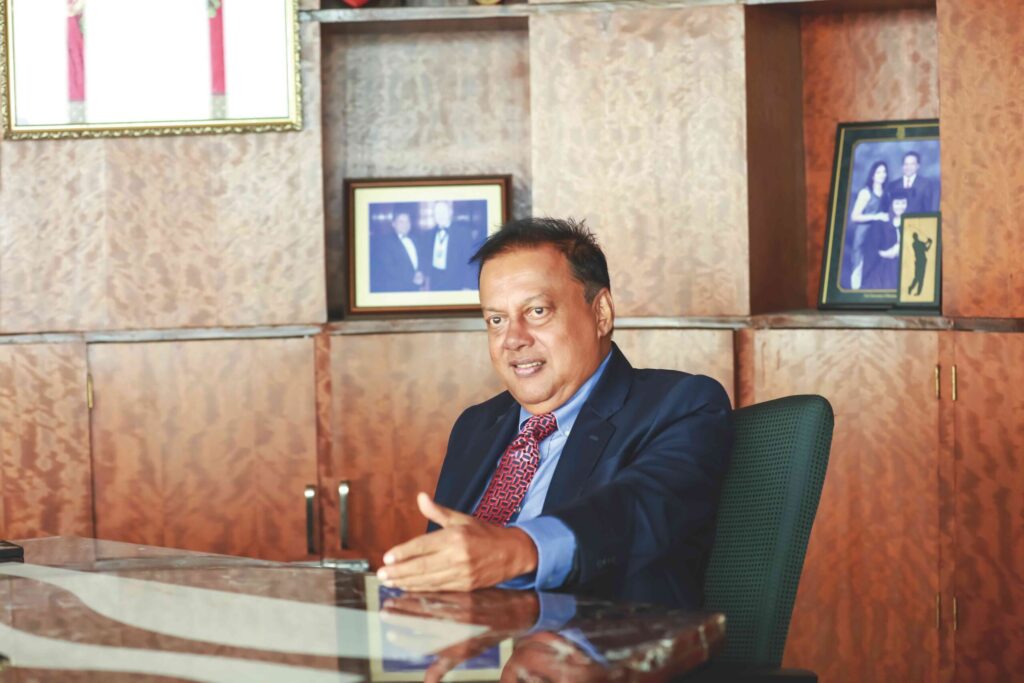
Speaking with Business Today, Chairman Sumal Perera focused on strategy, leadership, and values, outlining how disciplined financial management, operational efficiency, and diversification have enabled the Group to remain resilient through industry cycles while sustaining growth and profitability.
He spoke on the philosophy that has shaped Access Engineering’s journey — from its early days of entrepreneurial risk-taking to its current standing as a multi-sector player in engineering, logistics, energy, and healthcare. Equally central to the conversation is his people-centric leadership approach, which emphasizes shared success, employee empowerment, and strong internal culture as key drivers of performance. Perera’s leadership philosophy is grounded in trust, humility, and long-term thinking — where business success is measured not only in financial outcomes, but in people, partnerships, and lasting impact.
Words: Jennifer Paldano Goonewardane.
Photography: Sujith Heenatigala and Dinesh Fernando.
With Access Engineering demonstrating notable resilience despite a prolonged downturn in the construction sector, what were the most critical strategic decisions that enabled the Group to sustain both growth and profitability during this period?
For us, three decisions were critical: maintaining balance sheet discipline, diversifying revenue streams beyond core construction, and sharpening our focus on execution efficiency. At the same time, we expanded into complementary sectors to reduce exposure to industry cycles and volatility, while tightening project selection and cost controls. This combination allowed us to protect margins while continuing to grow.
As the Group recorded strong profitability in FY 2024/25, how much of this performance would you attribute to operational efficiency versus diversification into newer sectors?
It is a combination of both, but if I were to prioritize, operational efficiency has been the foundation. Over the past few years, we have institutionalized stronger project management systems, procurement discipline, and cost optimization practices. Diversification has complemented this by providing new revenue streams and reducing reliance on any single sector. In essence, efficiency protected profitability, while diversification supported growth.
Looking at the first nine months of FY 2025/26, what trends are you seeing in terms of revenue mix and margin stability? Are these trends sustainable?
We are seeing a gradual shift toward a more balanced revenue mix, with non-construction segments contributing an increasing share of revenue. Margins have remained relatively stable, driven by prudent project selection and enhanced cost control practices. While some volatility is inevitable given macro conditions, we believe these trends are sustainable, provided we maintain our focus on execution and continue building resilience across sectors.
With your expansion into sectors like Renewable Energy and Radiopharmaceuticals signaling a shift toward future-oriented industries, what prompted these strategic moves, and how significant are they expected to become within the Group portfolio?
Our move into Renewable Energy and Radiopharmaceuticals is driven by a long-term view of where value will be created. These sectors offer structural growth, higher value addition, and alignment with global trends. Over time, we expect them to become meaningful contributors, not necessarily replacing our core, but strengthening and future-proofing the portfolio.
Radiopharmaceuticals, in particular, are a highly specialized field. What synergies or long-term value do you see this segment bringing to a traditionally engineering-focused group?
We see significant long-term potential in the radiopharmaceuticals sector, particularly in early cancer diagnosis and advanced medical imaging. We are proud to be among the first in Sri Lanka to produce FDG-18 locally, which is a critical component used in PET imaging for cancer detection.
Although Access Engineering is traditionally known as an engineering-focused group, there are strong synergies in technical capability, infrastructure development, and the management of highly specialized projects. Establishing a cyclotron facility is an extremely sophisticated undertaking. The vault construction itself is highly engineered, while the cyclotron technology — supplied by GE HealthCare — requires advanced technical expertise and operational precision. Our entry into this field was also driven by a strong strategic partnership and a long-term vision for healthcare.
My son, whose primary passion is the healthcare sector, played a key role in forging relationships with international healthcare leaders, including GE HealthCare, one of the world’s foremost companies advancing radiopharmaceutical technology. Through those collaborations, we recognized the urgent need for local production.
Previously, FDG had to be imported from India, but due to the nature of the radioactive material and the time required for transportation, nearly 80 percent of its efficacy would be lost before reaching patients in Sri Lanka. Producing it locally, therefore, became both a medical necessity and a strategic opportunity.
The project was established through a public-private partnership, with the Ministry of Health and the Atomic Energy Authority also participating, as these are highly regulated nuclear medicine products. Today, we are in commercial production of FDG, with a capacity that is more than sufficient for Sri Lanka’s current needs. More importantly, this venture goes beyond commercial value. FDG is essential for PET scans and early cancer detection, and early detection can significantly improve treatment outcomes.
Cancer is increasingly becoming one of the leading terminal illnesses in the country, and we believe this investment helps address a critical gap in Sri Lanka’s healthcare system. So while the venture makes strong business sense and opens a highly specialized growth avenue for the group, it also reflects our broader philosophy of investing in sectors that can create meaningful long-term impact for the country.
With projects such as the Colombo West International Terminal and Kohuwala Flyover highlighting your role in national development, how do you evaluate the balance between commercial returns and strategic national importance when selecting projects?
Every project we undertake must meet a baseline commercial threshold. However, we also recognize our role in national development. In such cases, we consider the broader strategic value, long-term relationships, capability building, and contributions to the country’s growth. The balance lies in ensuring that even strategically important projects are executed efficiently and sustainably.
As you have emphasized disciplined execution as a cornerstone of performance, what internal systems enable consistency across such a wide portfolio?
Consistency comes from systems and is not dependent on individuals alone. Our investments in ERP platforms such as SAP, supported by digital monitoring tools, strong internal controls, and clear accountability, ensure consistency across a diverse portfolio.
Given the challenges in the construction sector, how have you managed cost pressures, supply chain disruptions, and contractor ecosystems over the past year?
The past year required a proactive and disciplined approach. We strengthened supplier relationships, centralized sourcing through our Central Procurement Division, and improved inventory planning to manage disruptions. In most of our projects, we incorporate price fluctuation mechanisms to mitigate and recover from abnormal cost escalations.
Are there plans to pursue strategic partnerships, joint ventures, or acquisitions to accelerate growth in emerging sectors?
Yes, we continuously explore strategic partnerships, joint ventures, acquisitions, and new growth opportunities. It is not a new direction for us — it has always been part of our ethos and a key reason behind our success. Growth and diversification are central to our long-term strategy, and I constantly encourage people within the organization to bring forward ideas, take ownership of them, and pursue them with conviction.
I strongly believe that if a company remains in the same business for too long without evolving, it risks stagnation. Every business eventually reaches a point where it can outgrow its original model, which is why diversification is essential for sustained growth. At the same time, expansion alone is not enough. Our profitability comes from disciplined management, operational efficiency, and strong execution. You cannot sacrifice one for the other. Existing businesses must be run exceptionally well, even as you diversify into new sectors. Sustainable growth comes from balancing both.
When people speak about sustainability, they often associate it only with environmental concerns. But sustainability must first apply to the business itself. Have you built the systems, culture, and people needed to ensure long-term continuity? That includes training employees, motivating them, creating clear communication channels, and maintaining strong appraisal processes that allow feedback to flow both ways. Employees understand management’s direction, while leadership gains insight into what people on the ground are thinking and aspiring toward.
In fact, one of the best examples of this culture is Access Engineering itself. During an appraisal discussion, our current Managing Director, Rohana Fernando, suggested that we establish a separate engineering company. That idea eventually became Access Engineering, which today is the largest company within our group. It was established only around 2004 or 2005, yet it has grown into the company most closely associated with our identity and expansion. Its success is not only about profitability, but also about positioning ourselves in sectors critical to national development and investment, while embracing transparency by becoming a publicly listed company. That combination of diversification, disciplined management, and openness is what has driven our growth over the years.
With increasing global emphasis on ESG standards, how is Access Engineering embedding sustainability into its operations and long-term strategy?
Sustainability is an integral part of our long-term strategy. In engineering projects and construction material production, we focus on environmentally responsible practices and improving resource efficiency, while in sectors such as renewable energy, sustainability is embedded in the business model itself. At the same time, we place equal emphasis on how we engage with employees, communities, and stakeholders, as well as on maintaining strong governance through transparency, accountability, and ethical decision-making. Together, these elements support sustainable and responsible long-term value creation.
Although Access Engineering is traditionally known as an engineering-focused group, there are strong synergies in technical capability, infrastructure development, and the management of highly specialized projects.
As Sri Lanka transitions into a more stable phase, where do you see the biggest opportunities for Access Engineering over the next three to five years?
Our biggest opportunities over the next three to five years lie primarily in the logistics and ports sector. We have already made significant investments in this space and today operate one of the largest warehousing facilities in the country.
One of our most strategic investments has been our long-term partnership with Michelin, supported by a 15-year agreement and infrastructure located close to the airport.
We are also heavily involved in dollar-based rental and logistics operations, which positions us strongly for future growth. I believe the ports sector is the heartbeat of Sri Lanka’s economy, given our strategic geographic location. Logistics and ports naturally go hand in hand, and that is why we are deeply engaged with both the Port of Colombo and the Port of Hambantota.
I also believe the development of the Port of Trincomalee presents a major opportunity for the country, particularly through collaboration with India. India today is vastly different from what it was two decades ago. It has emerged as one of the world’s largest economies, and when you consider the combined economic influence of India, China, and the broader Asian region, this part of the world represents nearly 60 percent of the global population. Naturally, much of the world’s future growth will come from Asia.
Sri Lanka is uniquely positioned within that growth story, provided we make the right strategic decisions and build strong regional partnerships.
We have developed excellent relationships with leading Chinese and Indian companies over many years. Groups such as the Tata Group and the Adani Group are among our partners, and these relationships have become an important part of our long-term growth strategy.
Many of these strategic partnerships are not reflected on a balance sheet or are not always visible to the public, but they play a critical role in helping us grow, evolve, and access new opportunities. At the same time, none of this can be achieved by a single individual. While I may be the founder and leader, Access Engineering’s growth has always been a collective effort. Strong teams, trusted partnerships, and capable leadership across the organization are what have enabled us to reach where we are today and continue positioning ourselves for the future.
We continuously explore strategic partnerships, joint ventures, acquisitions, and new growth opportunities. It is not a new direction for us — it has always been part of our ethos and a key reason behind our success.
If you were to identify one structural change needed in Sri Lanka’s business environment to unlock faster growth, what would it be?
One structural change Sri Lanka needs to unlock faster growth is a stronger recognition and acceptance of entrepreneurship. Too often, entrepreneurs are viewed with suspicion, as though success must have come through political connections or unfair advantage rather than hard work, risk-taking, and long-term vision.
There is a tendency to question how a person or business has grown, with the immediate assumption being that there must have been some political deal behind it. That mindset needs to change if we are serious about encouraging enterprise and investment.
For my part, I have always believed in operating transparently. That is one of the reasons we chose to go public — so that our business remains open to scrutiny, with accounts published quarterly and governed through independent oversight.
I also moved from our traditional auditors to KPMG because, if you are expanding and building for the long term, you need the highest standards of governance and credibility, not just firms that sign off on accounts.
Creating an environment where entrepreneurs are respected while also held to strong standards of transparency and accountability is essential to the country’s economic progress.
What are your concerns about Sri Lanka’s current tax structure, particularly in relation to talent retention, entrepreneurship, and long-term economic growth?
At the moment, one of the biggest challenges we face is what I believe to be an extremely counterproductive tax structure. Salaried professionals are taxed at rates as high as 36 percent, while companies are also taxed heavily. The result is an inevitable brain drain. For a developing country like Sri Lanka, this is deeply concerning because our greatest asset is our human capital.
We should be encouraging skilled professionals, entrepreneurs, and innovators to remain in the country and contribute to economic growth, not creating conditions that push them away. Without strong economic growth, we cannot move forward as a nation. Developing entrepreneurship and supporting private sector expansion must become a national priority. I hope policymakers, including institutions such as the IMF, recognize that a sustainable economic recovery cannot occur without empowering businesses and retaining talent.
Around the world, even countries that once followed highly controlled economic models have embraced open-market principles because they understand that growth and innovation are driven by enterprise. China is a prime example.
Over time, they recognized that while no economic system is perfect, open economic policies create the strongest foundation for growth and development. Today, most major economies, including China and Russia, operate within varying forms of open economic systems.
In Sri Lanka’s case, heavily taxing skilled professionals and intellectual capital is counterproductive. If we continue down that path, we risk losing the very people needed to build the economy. As a company, we have therefore taken a conscious decision to invest more in our employees and ease some of that burden where possible, including through incentives and enhanced compensation structures. We believe supporting and retaining talent is essential not only for our business sustainability, but also for the country’s long-term progress.
In business, you must constantly identify where you have a competitive advantage and use it responsibly — not only to grow your company, but also to create value for the country, your employees, and society at large.
How important have honesty, transparency, and long-term trust been in building Access Engineering’s partnerships and sustaining the group’s growth over the years?
What many people do not fully appreciate is the immense value of relationships in business — both internally and externally. Long-term success is built on trust, credibility, and consistency.
For example, we have maintained relationships with companies such as Isuzu and Itochu Corporation for nearly 30 to 40 years. Those relationships have endured because there has always been mutual trust. I have never cheated them, and they have never cheated me. That foundation of integrity is priceless. The same applies to our partnerships with major international players such as China Harbor Engineering Company, China Merchants Group, and the Colombo Port City project. The cranes visible at the port are supplied by ZPMC, with whom we have formed a joint venture not only in Sri Lanka, but also across parts of Asia, including Pakistan, to maintain those operations. These are relationships that cannot be measured purely in financial terms. They are a major reason why Access has grown the way it has. Without strong partners, we are nothing.
Another example is our relationship with GE HealthCare, which my son helped bring into the group. GE HealthCare is a global leader in radiopharmaceuticals and accounts for a significant share of FDG production worldwide. Partnerships like these create strategic advantages that differentiate you from other players in the market. In business, you must constantly identify where you have a competitive advantage and use it responsibly — not only to grow your company, but also to create value for the country, your employees, and society at large.
At the same time, I believe humility and perspective are equally important. Entrepreneurs must understand that wealth and success are not infinite pursuits. If greed takes over, people begin to believe they must own everything, and that is where many businesses lose their way. Some entrepreneurs make the mistake of trying to control too much instead of building sustainably and sharing success with others.
If you conduct business ethically, people will stay with you. If you share success and genuinely care for people, loyalty naturally follows. The best measure of that is employee retention, particularly within senior management. When leadership upholds the right values and standards, the rest of the organization follows. The success of Access has come down to one thing: people. Our people, our partners, and the trust we have built with them over decades.
What philosophy guides your approach to debt, reinvestment, and long-term sustainability?
There are certain financial principles we consider sacrosanct. One of them is maintaining very low levels of debt. In a country like Sri Lanka, interest rates can change dramatically in a short period. You may borrow at seven percent today, but within two years that rate could rise to twenty-five or even thirty percent. If that happens, sustaining the business becomes extremely difficult. Because of that reality, we are always very conscious not only of growth but also of how that growth is financed.
We have deliberately maintained a low-geared structure and adopted a disciplined approach to capital management. A key part of that philosophy stems from how we live and operate. We lead relatively simple lives, which allows us — not only myself, but also the other shareholders — to reinvest a significant portion of profits back into the business to support future growth. We strongly believe that if the company grows, all stakeholders will grow with it. If the company does not progress, individual growth cannot be sustained either. That mindset has become part of Access’s culture.
As the founder, I have consistently shared this philosophy with our main shareholders, directors, and senior management team. They understand the long-term vision and have supported us in carrying it forward with discipline and commitment.
Access Engineering has often been described as resilient—but what is one vulnerability or blind spot that keeps you cautious as a leader?
One vulnerability that keeps me cautious is that we are still largely Sri Lanka-centric as a business. While we have expanded into markets such as Kenya, Djibouti, and parts of Africa, and built partnerships across the world, our international footprint still accounts for less than ten percent of the business.
For long-term resilience and stability, I believe Access Engineering must evolve into a truly global company over the next few generations. It is not a question of lacking faith in the Sri Lankan economy, but rather a matter of sound business strategy. Diversifying beyond a single market is essential for sustainable growth and reduced economic dependence. That is the direction we have already begun pursuing through our overseas ventures, and it is a journey the next generation will need to take forward.
For long-term resilience and stability, I believe Access Engineering must evolve into a truly global company over the next few generations. It is not a question of lacking faith in the Sri Lankan economy, but rather a matter of sound business strategy.
How important has people management and employee well-being been to Access Engineering’s success, and how do you translate that philosophy into practice within the organization?
I have always believed that without people, there is no business. That is a core principle I strongly hold. What differentiates us from many other organizations is our commitment to our employees — and importantly, we do not just speak about it, we live it.
We are proud, in a very humble way, to say that we have created more millionaires within our organization than perhaps any other company in the country. Many of our employees have been with us for over 30 years, which is remarkable given that the company is 37 years old. Retaining people for that long is not possible unless you are continuously engaged, proactive, and genuinely committed to their well-being.
Our real strength is our people. Financial statements and balance sheets do not fully capture this, but we have built an extraordinary team. I have complete faith in the Sri Lankan workforce — their capacity for hard work, loyalty, and dedication is exceptional when they are treated fairly and with respect. To me, compensation is not just about salary alone. It is about sharing and caring.
For instance, we recently completed an apartment project where I was personally delighted that we were able to grant a project director a bonus of 100 million rupees. The Board and I agreed that if he had delivered the project even four or five billion rupees under budget, he deserved to be rewarded substantially. The company had performed well, and this was our way of expressing gratitude for that achievement. That is the culture we try to foster — a culture of sharing success.
It is also one of the key reasons I have been comfortable planning a transition of leadership to the next generation. The foundation of Access has always been simple: when our people succeed, the company succeeds. Their progress naturally drives the organization forward. At the same time, I am very clear that this philosophy must be grounded in financial discipline.
A company cannot function without profitability. You cannot sustain salaries or growth without a strong and well-run business. Looking back, I am deeply satisfied with what we have built — from nothing to what Access is today. And I am confident that, even in my absence, the organization will continue for generations to come because it has enough talent, structure, and opportunity embedded within it. For me, Access has always been, and will always remain, a family. And above all, we believe in not just talking about values, but living them every day.
You are perhaps one of the few qualified accountants in Sri Lanka to build such a large entrepreneurial legacy. Yet there is a common perception that accountants are more suited to structure and compliance than entrepreneurship. How do you view that contrast in your own journey?
I often joke that I was actually a bad accountant — and I say that quite happily. My brother is an excellent accountant in the family. I have always considered myself, first and foremost, an entrepreneur. From a young age, I believe I had the instinct to build, take risks, and think beyond conventional structures. Entrepreneurship has always been my strongest suit. What many people may not realize is that I do not handle the day-to-day management of these companies.
I am not the Managing Director or CEO of any of them; I serve as Chairman. That is a very conscious decision because I understand my own strengths and weaknesses. I am not particularly interested in operational management, nor do I believe I am the best person for that role. Instead, I focus on vision, growth, expansion, and identifying new opportunities.
For execution and day-to-day operations, I surround myself with highly capable professionals and corporate leaders who are far better equipped to manage those responsibilities. One of the most important lessons in business is that you must not only understand your strengths, but also recognize your limitations. Once you do that, you can build teams with complementary strengths that fill those gaps. There is no value in trying to do everything yourself, especially when others can do certain aspects far better.
My role has always been to drive growth, create opportunities, and empower strong management teams to take businesses forward. I believe that balance has been a key factor in our success.
Can you walk us through your entrepreneurial journey—from your early career decisions after qualifying as an accountant to building Access into a listed group—and how your philosophy on ownership and growth has evolved over time?
Looking back on my journey, I faced two clear options after qualifying as an accountant. Many of my peers chose to go overseas, particularly to places like Zambia, to pursue careers abroad.
For me, that was never the direction I wanted to go. I was not interested in simply taking up employment. From the very beginning, I made a conscious decision that, despite not having a foreign passport or an overseas pathway, I would stay in Sri Lanka and build something of my own for my family and myself. I also felt that, in this country, working for someone else offered very limited growth. Any increments you received were often insufficient to keep up with inflation. That reality reinforced my desire to enter the business world. My ambition was always entrepreneurial.
When I started out around the age of 31, I set myself a clear goal — to build a business that would make one million dollars by the time I turned 40. The amount was equivalent to about 40 million rupees at the time. By the age of 40, I had already exceeded that target, and on my 40th birthday, we opened Access Towers — a milestone that symbolized that early journey.
However, it is important to say that I did not achieve this alone. I had founder partners and directors who believed in the vision and grew with me, later becoming co-shareholders in the business. With Access International, I initially held 100 percent ownership. But when we established Access Engineering, I took a different approach. I deliberately shared ownership, giving my two main partners, Ranjan Gomez and Christopher Joshua, 50 percent of the company, while retaining the remaining 50 percent. That decision reflected an important principle for me — that growth should be shared, not concentrated.
As the country transitioned after the end of the war in 2009, we recognized significant potential in engineering and infrastructure development. That was when we decided to take Access Engineering public. We raised approximately five billion rupees by offering a 25 percent stake in the company.
At that time, the business was already generating around 800 million rupees in profits. What was important to me was not just raising capital, but bringing in the right kind of long-term investors.
I personally engaged with several leading corporates, and we successfully secured major participation from institutions such as John Keells Holdings, MAS Holdings, and Brandix, among others, through a private placement at 25 rupees per share. Only a smaller portion was later offered to the public. We were then listed on the stock exchange within the required year. Today, the share price has appreciated significantly, and those who believed in us early — including employees and long-term shareholders — have benefited both from dividends and capital growth. For me, that represents a true win-win outcome.
Importantly, I have always believed in growing alongside others, not in a way that benefits the entrepreneur disproportionately while leaving everyone else behind. That philosophy has shaped how we have structured ownership over time. Today, my original company, Access International, has transitioned to my son, although I continue to guide it as Chairman.
In Access Engineering, I retain approximately 40 percent ownership, while the remaining 60 percent is held collectively by directors, shareholders, and institutional investors. Across the group’s listed entities, I personally hold around 25 percent, with the remainder held by my family and senior leadership. At this stage of my life, I am not concerned about maintaining a controlling 51 percent stake. I have come to believe that if you do the right thing, control becomes less important.
Unlike the traditional mindset of always seeking dominance and control, I have no hesitation in sharing ownership and responsibility with partners, directors, management, and shareholders. That shift in thinking — from control to trust and shared success — has been a defining part of my entrepreneurial evolution.
I believe I had the instinct to build, take risks, and think beyond conventional structures. Entrepreneurship has always been my strongest suit. My role has always been to drive growth, create opportunities, and empower strong management teams to take businesses forward.
How have your philosophy of life and faith shaped the way you define success, especially given that your approach to success has often been described as unassuming and grounded rather than outwardly demonstrative?
I believe the fundamental difference in my approach has always been that I was driven more by a sense of achievement and fulfillment than by a desire to build an empire. Empire-building, for its own sake, has never been part of our culture or philosophy.
I strongly believe that life is a journey with a beginning and an end. Once you truly understand that, your priorities begin to change.
Many people become consumed by the pursuit of power, wealth, or control, losing sight of life’s temporary nature. But for me, that perspective has always been very clear. My faith has also played a major role in shaping that outlook. As a Catholic, I believe that this life is only part of a larger spiritual journey and that the ultimate goal is eternal life.
Because of that belief, I have always tried to focus not only on material success, but also on the values, relationships, and purpose that define how we live and contribute during our time here. That philosophy naturally influences the way I approach business as well.
Success, to me, is not simply about building the biggest company or owning the most assets. It is about creating something meaningful, sustaining it responsibly, empowering people, and finding fulfillment in the journey itself.
It’s been a very rewarding entrepreneurial journey that brings me immense happiness. Today, my happiness is shared between leading Access and spending time with my four grandchildren, whose company I cherish immensely. When people ask me about my greatest achievement, I always say it is my family. My children and their families live close to me, as do my siblings, which I consider a true blessing.