

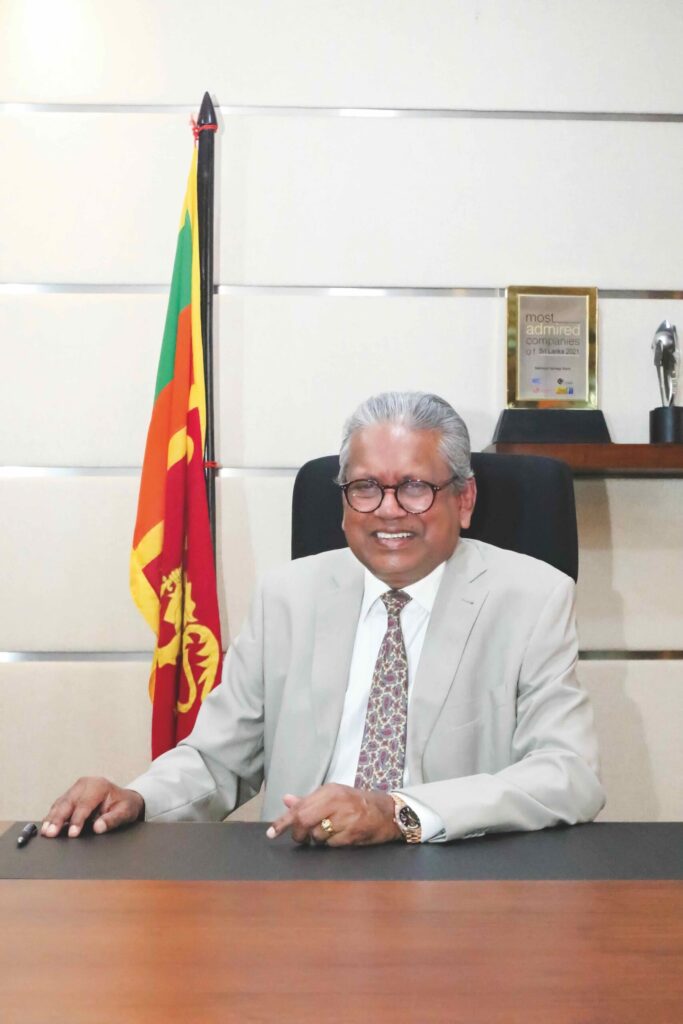
Few individuals in Sri Lanka have successfully bridged the worlds of law, corporate governance, academia, and public sector leadership as comprehensively as Dr. Harsha Cabral, PC. A distinguished President’s Counsel, corporate governance expert, academic, and Chairman of the National Savings Bank, he has played a pivotal role in shaping key areas of Sri Lanka’s legal and regulatory landscape, including commercial arbitration, intellectual property law, corporate governance, and company law reform. Speaking with Business Today, Dr. Cabral reflects on NSB’s transformation journey, the importance of discipline and governance in building resilient institutions, the evolving role of technology in banking, and the challenges facing Sri Lanka’s corporate sector. He also shares his perspectives on economic reforms, intellectual property, risk management, and the leadership principles that have guided his nearly four-decade-long professional career.
Words: Jennifer Paldano Goonewardane.
Photography: Sujith Heenatigala and Dinesh Fernando.
As the Chairman of the National Savings Bank, how do you assess the bank’s performance, and what have been the key priorities for NSB during your tenure as chair?
When I assumed the Chairmanship of NSB in May 2023, the Bank was facing significant challenges. The combined impact of the 2019 Easter Sunday attacks, the COVID-19 pandemic, and the economic crisis had affected operations and financial performance. Like much of the public and private sectors, NSB was navigating a difficult environment, making stabilization and recovery the immediate priorities. This was also my first major leadership role within a large public sector institution.
While I had experience with the Board of Investment and several corporate entities, the public sector operates differently. One of my key objectives was to introduce greater efficiency, accountability, and financial discipline into the organization.
At the time, NSB had approximately 4,700 employees and an extensive branch network. Drawing on private sector management principles, we focused on productivity, cost efficiency, and optimal resource utilization. We limited new recruitment, encouraged internal mobility, and managed our workforce prudently.
Over two years, we reduced staff numbers by approximately 400 through natural attrition and careful workforce management. Implementing change within a large public sector institution is never easy, particularly with multiple trade unions and stakeholder interests. However, we engaged constructively with employees and unions while remaining committed to reform. Importantly, political interference in operational matters was minimal, allowing us to focus on the Bank’s long-term strategic objectives.
Another major priority was cost rationalization. We reviewed expenditure across the organization and adopted a lean management approach, ensuring that every expense was carefully evaluated. This culture of financial discipline was reinforced across all levels of the Bank. Throughout this process, we aligned our efforts closely with the Central Bank ’s regulatory guidance, strengthening governance, operational resilience, and overall performance. The results became evident over time. While 2023 was largely a transition year focused on restructuring and stabilization, NSB recorded a profit before tax of approximately 24 billion rupees in 2024. In 2025, this increased significantly to around 55 billion rupees, positioning NSB among the top-performing State-owned enterprises. This was the highest-ever profit NSB has made from its inception in 1971.
We also focused on strengthening the NSB brand through strategic marketing and improved customer engagement. As a result, the Bank’s brand value and market positioning improved significantly, rising from seventh to fifth place in national rankings.
The transformation of NSB has been driven by three key principles: discipline, lean management, and growth through the effective utilization of existing talent. Supported by a more favorable macroeconomic environment, including lower interest rates and moderating inflation, these efforts have helped make NSB a stronger, healthier, and more resilient institution. The progress achieved demonstrates the value of sound governance, disciplined management, and a clear strategic focus.
How is NSB adapting to changing customer expectations, particularly in digital banking and financial technology?
Digital banking is one of NSB’s most important strategic priorities. Like many long-established institutions, NSB has faced certain legacy challenges in its digital transformation journey.
One of the major initiatives undertaken was the implementation of a new core banking system, a process that commenced in 2018 and was successfully launched only last year. The delays were attributable to a range of factors, including the disruptions caused by the COVID-19 pandemic and the economic crisis.
However, given the pace of technological evolution, a seven-year implementation period inevitably creates a gap between the original solution and current market expectations.
Digital technology advances rapidly, and what may have been considered cutting-edge several years ago can quickly become outdated. Nevertheless, our focus has been on maximizing the value of the platform we now have while continuing to enhance and expand our digital capabilities.
We have embarked on a comprehensive digital transformation journey, supported by significant investments in technology, customer engagement, and brand-building initiatives. Today, our digital banking capabilities are comparable to those of many leading private-sector banks, and our digital footprint has strengthened considerably.
We have also introduced several new digital products and services in recent years, reflecting our commitment to providing customers with greater convenience, accessibility, and efficiency. The reality is that customer behavior has fundamentally changed. Increasingly, customers—particularly younger generations—prefer to conduct their banking activities through mobile devices rather than visiting physical branches.
As a state-owned financial institution, it is imperative that we adapt to these changing expectations.
Digital transformation is essential for long-term sustainability and growth. We have therefore placed considerable emphasis on strengthening our digital ecosystem and enhancing the overall customer experience. The progress achieved is already becoming evident. Alongside improvements in our brand value and market positioning, NSB has also received recognition through several awards for its achievements in digital banking. While there is still much more to accomplish, we remain firmly committed to accelerating our digital transformation agenda and expanding our digital footprint in the years ahead.
How do you see the future of state-owned financial institutions evolving in a more competitive and technology-driven banking landscape?
I do not believe there should be a distinction between State-owned and private sector banks when it comes to competitiveness. We operate within the same industry, serve the same customers, and face the same market realities. Therefore, State-owned financial institutions must benchmark themselves against the best in the industry rather than rely on their public sector status.
We have consciously adopted this mindset at NSB. I encourage our management team to operate with the discipline, efficiency, and customer focus associated with leading private sector organizations. This approach is reflected in our achievements, including NSB becoming the first State-owned bank to win the Gold Award in the State Bank category at the TAGS Awards 2025, organized by CA Sri Lanka for excellence in financial reporting and corporate disclosure, overtaking the Bank of Ceylon and People’s Bank. Such recognition demonstrates that a State-owned enterprise can compete effectively while maintaining high standards of governance, transparency, and accountability.
We have also strengthened our market position and, in several areas, outperformed private sector institutions, reinforcing the importance of maintaining a competitive outlook regardless of ownership structure.
Technology will be one of the defining factors shaping the future of banking. Public sector banks must ensure that their technology platforms, customer experience, and service delivery are on par with, or exceed, industry standards. Customers today expect speed, convenience, accessibility, and innovation, and institutions that fail to adapt risk becoming irrelevant.
Operational sustainability is equally important. Historically, many public sector organizations have operated with large workforces and complex structures. In today’s environment, efficiency and productivity must become central considerations. Every recruitment decision must be evaluated not only in terms of immediate needs but also in terms of long-term financial commitments and sustainability.
In my view, the future success of State-owned financial institutions will rest on two key pillars: discipline and lean management. These principles have long driven success in the private sector and are equally relevant in public institutions. Particularly during periods of economic uncertainty, organizations must remain focused on efficiency, cost management, and financial resilience.
The broader economic environment also highlights the importance of prudent financial management. Global geopolitical developments, inflationary pressures, and external shocks can significantly affect countries such as Sri Lanka. Therefore, institutions must prioritize long-term sustainability and maintain strong financial foundations.
Stability, ultimately remains paramount. The failure of any financial institution would have serious consequences for public confidence and the economy. Strong governance, sound risk management, accountability, and a culture of professionalism are therefore essential. While cultural transformation takes time, institutions that embed these values will be better positioned to succeed in an increasingly competitive and technology-driven banking landscape.
How important is governance and risk management in maintaining public confidence in institutions such as NSB?
Governance and risk management are fundamental to maintaining public confidence in any financial institution, particularly one such as NSB, which safeguards the savings of millions of Sri Lankans. They are essential pillars of long-term sustainability, credibility, and trust.
Corporate governance has evolved significantly over time. Today, organizations are expected to be accountable not only to shareholders but also to a broader range of stakeholders. In Sri Lanka, governance standards have strengthened through regulators, professional bodies, and market institutions, promoting greater transparency, accountability, and integrity.
Governance now extends beyond financial reporting and regulatory compliance. Stakeholders assess organizations on employee welfare, diversity and inclusion, ethical conduct, environmental stewardship, and social responsibility.
As a result, ESG principles and CSR initiatives have become increasingly important. Organizations are expected to create sustainable value while balancing the interests of shareholders, employees, customers, creditors, and society.
At NSB, we place strong emphasis on these responsibilities through initiatives supporting education, community development, and financial inclusion. Risk management is equally critical in today’s complex and unpredictable environment. Traditionally, organizations focused on financial, operational, regulatory, and political risks. However, recent global events have shown how quickly unforeseen developments can disrupt economies, supply chains, and business operations.
This underscores the need for resilient institutions that can anticipate, assess, and respond to both existing and emerging risks. Risk management must therefore go beyond known threats and include preparedness, scenario planning, and adaptability. For financial institutions, this is particularly important.
Banks operate in a highly regulated environment and are entrusted with protecting public funds. With the growth of digital banking, institutions must also manage cyber risks, digital fraud, data security threats, and other technology-related risks. This requires continuous investment in systems, controls, monitoring mechanisms, and staff awareness. It is also important to recognize that risks can arise from within the organization as well as from external sources. Strong internal controls, effective oversight, and a culture of accountability are therefore essential. Governance frameworks, audit functions, and risk management systems must be able to identify vulnerabilities early and prevent escalation. We must keep in mind that governance and risk management are inseparable from public trust.
A well-governed institution with a strong risk culture inspires confidence among customers, regulators, investors, and employees.
In banking, where trust is the foundation of every relationship, maintaining high standards of governance and risk management is indispensable.
Apart from serving as Chairman of NSB, you also serve on the boards of numerous listed companies and multinationals. What are the most common governance weaknesses you observe in Sri Lankan boardrooms, and what separates a high-performing board from one that merely fulfills its compliance obligations?
Having served on the boards of nearly 20 companies, including listed entities, multinational corporations, and regulated institutions, I have observed a wide range of governance practices.
One of the most common weaknesses in Sri Lankan boardrooms is overexpansion driven by excessive optimism rather than disciplined strategic planning. Growth is important, but sustainable growth is even more important. During periods of strong profitability, organizations can become overly ambitious and pursue expansion projects without fully assessing long-term risks, market conditions, or potential external shocks.
A single poorly conceived investment can have significant consequences for an entire business group. High-performing organizations, by contrast, build resilience through diversification and prudent portfolio management.
Large conglomerates, for example, are often better able to withstand economic downturns because they operate across multiple sectors. When one sector underperforms, another may provide stability. This ability to balance risk while maintaining strategic discipline is a hallmark of sound governance.
Boards today must also remain conscious of external risks. Geopolitical developments, supply chain disruptions, currency fluctuations, inflation, and changing trade dynamics can rapidly alter the business environment. Expansion decisions should therefore be evaluated within the broader economic context rather than based solely on immediate opportunities. Another important factor is stability.
Businesses and investors are more willing to commit capital when there is policy consistency, economic stability, and confidence in the rule of law. Strategic decisions should always be grounded in realistic assessments of future conditions. One of the defining characteristics of a high-performing board is its willingness to challenge management when necessary.
Independent directors play a critical role in this regard. Effective boards do not approve every proposal placed before them. They scrutinize investments, test assumptions, evaluate risks, and ensure capital is allocated prudently. I have seen instances where independent directors have prevented companies from pursuing projects that appeared attractive on the surface but lacked strong fundamentals.
In many cases, this discipline protected organizations from significant losses. Good governance is not about saying yes to every opportunity; it is about knowing when to say no. A related weakness is the tendency to prioritize speed over due diligence. There can be pressure to move quickly on acquisitions or investments, but legal, financial, operational, and commercial due diligence should never be compromised. If an opportunity cannot withstand thorough scrutiny, it is unlikely to be a sound investment.
A high-performing board will always provide strategic oversight, exercise independent judgment, challenge assumptions, and safeguard the long-term interests of the organization. Compliance is the foundation; true governance excellence lies in creating sustainable value through disciplined and responsible decision-making.

What governance lessons has Sri Lanka learned from corporate failures and crises over the past two decades?
I believe, the real challenge is not just identifying the lessons, but consistently applying them over the long term. There is a tendency to revert to familiar practices once immediate challenges subside.
As a result, some of the structural weaknesses that contributed to previous difficulties can re-emerge over time. This is not unique to Sri Lanka, but it is an area where we need to be more disciplined and consistent in our approach.
One of the key governance lessons from past crises is the importance of strong institutions and robust oversight mechanisms. Whether in the public or private sector, sustainable success depends on accountability, transparency, prudent decision-making, and a willingness to address issues before they become larger problems. Governance frameworks must not only exist on paper; they must be actively implemented and embedded within organizational culture.
Another important lesson is that organizations and economies cannot rely indefinitely on protective measures or short-term interventions. Support mechanisms may be necessary during periods of difficulty, but they should not replace the need for operational efficiency, competitiveness, and long-term sustainability. Institutions must be encouraged to strengthen their fundamentals and develop the resilience needed to withstand future challenges.
In 2025, this increased significantly to around 55 billion rupees, positioning NSB among the top-performing State-owned enterprises. This was the highest-ever profit NSB has made from its inception in 1971.
You have spoken extensively on the Companies Act amendment number 12 of 2025. What are the most significant changes proposed under this amendment?
The Companies Act No. 7 of 2007 has served Sri Lanka well for many years and remains a strong piece of legislation. Having been involved in its drafting, I can say that there have been relatively few substantive amendments since its enactment. While the Companies (Amendment) Act No. 12 of 2025 introduces several technical and procedural updates, its most significant reform relates to the disclosure of beneficial ownership of shares. This amendment is largely driven by evolving international standards on transparency, anti-money laundering (AML), and the prevention of illicit financial flows.
Globally, regulators are placing greater emphasis on identifying the ultimate beneficial owners behind corporate structures to ensure that companies are not used to conceal unlawful activities or undisclosed financial interests. The primary objective of the amendment is to identify the natural persons who ultimately own or control significant shareholdings in companies.
Where a shareholder is itself a corporate entity, the ownership chain must be traced to identify the ultimate beneficial owner. This can be challenging, particularly when ownership structures extend across multiple jurisdictions and involve several layers of companies. To address this, the amendment requires companies to maintain accurate records of beneficial ownership and designate responsible officers to ensure compliance. Any material changes in ownership must also be reported promptly to the Registrar of Companies, who is required to maintain these records as part of a broader effort to strengthen corporate transparency and regulatory oversight.
One of the most significant aspects of the amendment is its impact on the traditional concept of the corporate veil. Historically, companies existed as separate legal entities, and the identities of ultimate owners were often shielded behind layers of corporate structures. The new provisions introduce greater transparency by enabling regulators, law enforcement agencies, and other authorized parties to identify the individuals who ultimately control or benefit from corporate entities.
The amendment also has important implications for listed companies and capital markets. Given the dynamic nature of share ownership in publicly traded companies, maintaining accurate and up-to-date beneficial ownership information may present practical challenges. Consequently, regulators, companies, company secretaries, and market participants will need to work closely together to ensure effective implementation.
At its core, the amendment is designed to strengthen transparency, enhance investor confidence, support anti-money laundering efforts, and align Sri Lanka’s corporate framework with international best practices. While implementation may take time, particularly during the initial stages, these reforms represent an important step towards greater accountability, stronger corporate governance, and a more transparent business environment.
What practical impact will these amendments have on companies, directors, shareholders, and investors?
As I said, one of the central features of the amendment is that it creates clear obligations regarding the disclosure of beneficial ownership information. Where shareholders fail to comply with these requirements, the legislation provides for consequences that may affect the rights attached to those shares. For example, voting rights and other shareholder privileges may be restricted until the necessary disclosures are made.
As a result, compliance becomes essential for shareholders seeking to fully exercise their ownership rights. For investors, the amendment introduces a new level of transparency and accountability.
Prospective investors will need to carefully consider the disclosure requirements associated with significant shareholdings and ensure they are prepared to comply with the regulatory framework. While some may view these obligations as an additional compliance requirement, they are ultimately intended to strengthen confidence in the corporate sector and improve the integrity of ownership structures.
The responsibilities placed on companies and directors are also considerable. Under the Companies Act, directors already carry significant fiduciary and statutory obligations, and the amendment further reinforces the importance of ensuring that companies maintain accurate beneficial ownership records and comply with reporting requirements.
Boards will need to establish appropriate governance processes, internal controls, and monitoring mechanisms to ensure compliance with the new provisions.
In practical terms, responsibility will extend beyond the board to designated officers within the company, including company secretaries and other individuals tasked with maintaining records and managing regulatory filings.
The effectiveness of the new framework will depend on organizations’ ability to implement robust compliance procedures and maintain accurate, up-to-date information.
For shareholders, particularly those holding significant stakes through corporate structures, the amendment may require greater transparency regarding ownership arrangements. This reflects a broader global trend towards enhanced disclosure and stronger anti-money laundering controls.
As international regulatory expectations continue to evolve, transparency around beneficial ownership is increasingly becoming a standard feature of modern corporate governance frameworks.
The future success of State-owned financial institutions will rest on two key pillars: discipline and lean management. These principles have long driven success in the private sector and are equally relevant in public institutions.
Do the proposed amendments bring Sri Lanka closer to international best practices and corporate governance?
Yes, I believe these amendments bring Sri Lanka significantly closer to international best practices in corporate governance, transparency, and regulatory compliance. The primary objective is to align the country’s corporate framework with evolving global standards, particularly in beneficial ownership disclosure, anti-money laundering (AML), and the prevention of illicit financial flows.
As a member of the international community, Sri Lanka is increasingly expected to comply with global conventions and governance standards. Many jurisdictions, including highly regulated markets such as Singapore and Malaysia, have already implemented similar frameworks to enhance transparency and accountability. These reforms represent an important step in that direction.
A key principle underpinning the amendment is transparency. In the banking sector, Know Your Customer (KYC) requirements are fundamental to understanding who institutions are dealing with and the source of funds. The beneficial ownership provisions apply a similar concept to corporate ownership structures, ensuring that the individuals who ultimately own or control significant shareholdings (10 percent or more) can be identified. This increased transparency is particularly important in addressing risks associated with money laundering, financial crime, and the misuse of corporate entities.
By requiring the disclosure of beneficial ownership information, regulators and other authorized authorities gain greater visibility into corporate structures and the individuals behind them. This strengthens accountability and helps protect the integrity of the corporate sector.
The amendment is also supported by meaningful enforcement mechanisms. It clearly outlines the consequences of non-compliance, including restrictions on the rights attached to shares. Shareholders who fail to provide the required information may lose certain rights, such as voting privileges, until they comply.
Overall, these reforms strengthen corporate governance and align Sri Lanka more closely with international regulatory expectations.
Intellectual property is increasingly becoming a driver of economic value. How would you assess Sri Lanka’s current intellectual property regime?
Sri Lanka’s intellectual property (IP) framework is built on a strong legislative foundation. The current Intellectual Property Act No. 36 of 2003 is a comprehensive and modern piece of legislation that aligns closely with international standards and provides protection across the full spectrum of intellectual property rights.
Prior to this, the Code of Intellectual Property Act No. 52 of 1979 was a landmark law that consolidated various aspects of intellectual property under a single framework.
Sri Lanka was among the early developing countries to adopt a legal model influenced by the World Intellectual Property Organization (WIPO).
With the establishment of the World Trade Organization (WTO) and the introduction of the TRIPS Agreement, countries were required to align their IP regimes with global standards.
The 2003 Act, based on the TRIPS model reflects these obligations and continues to serve as an effective legal framework.
One of the Act’s key strengths is its comprehensive coverage. It protects copyrights, industrial designs, patents, trademarks, integrated circuits, trade secrets, undisclosed information, and geographical indications. It also provides strong enforcement mechanisms, including civil remedies, criminal sanctions, and border controls to combat counterfeit goods.
Particularly important is the protection afforded to computer software and digital creations under copyright law.
In today’s technology-driven economy, software, digital content, and innovation are increasingly valuable assets, making intellectual property protection more relevant than ever. Geographical indications are another strategic area for Sri Lanka. Products such as Ceylon Tea and Ceylon Cinnamon derive significant value from their origin and reputation. Protecting these indications helps preserve their uniqueness, strengthen international market positioning, and create greater economic value for producers and exporters.
More broadly, intellectual property has become a major driver of economic value worldwide. Many of the world’s most valuable companies derive a significant portion of their worth from intangible assets such as brands, patents, technology, and intellectual property rather than physical infrastructure. In many cases, the value of a globally recognized brand exceeds the value of its tangible assets.
For this reason, intellectual property should be viewed not merely as a legal concept but as a strategic economic asset. Effective IP protection encourages innovation, rewards creativity, attracts investment, and supports the growth of knowledge-based industries.
While Sri Lanka’s legal framework is strong, greater awareness and utilization are still needed. Many businesses, entrepreneurs, and innovators do not fully appreciate the value of intellectual property. Continued education, capacity-building, and awareness initiatives are essential to help businesses recognize IP as a strategic asset. The National Intellectual Property Office has played an important role in this regard, but there remains considerable potential to further strengthen understanding and adoption across the wider business community.
I believe these amendments bring Sri Lanka significantly closer to international best practices in corporate governance, transparency, and regulatory compliance.
As you said, many Sri Lankan businesses undervalue their intellectual property assets. How can this mindset be changed?
One of the key challenges in Sri Lanka is that intellectual property is not yet widely recognized as a strategic business asset in the same way it is in many developed economies. In several countries, intellectual property assets such as trademarks, patents, and brands can be valued, leveraged, and even used as collateral for financing. While its importance is acknowledged locally, its economic value is not fully embedded in business and financial decision-making.
Changing this mindset requires a fundamental shift in how businesses view value creation. Intellectual property is often among the most valuable assets a company owns. In many cases, a strong brand can be worth more than physical infrastructure, equipment, or other tangible assets. Globally, leading corporations derive much of their market value from intangible assets such as brands, technology, intellectual property, and reputation. There are already examples in Sri Lanka where brand value has been recognized as a distinct asset. During corporate restructuring or separations, established brands have been independently valued due to their significant commercial worth. This reflects the reality that a trusted brand represents years of investment, customer loyalty, and market positioning.
Today, many organizations actively monitor brand value as part of their broader strategy. Investments in reputation, customer trust, and market presence effectively build intangible assets that contribute to long-term value creation. However, Sri Lanka still needs more developed frameworks for valuing and monetizing intellectual property in a consistent and structured manner.
We also have strong local brands that demonstrate the power of intellectual property as a competitive advantage. In many cases, these brands have become a company’s most valuable asset, reflecting sustained effort in building recognition and trust. Education and awareness are critical to driving this change.
Business leaders, investors, accountants, and financial institutions must begin to view intellectual property not only as a legal right to be protected, but as an economic asset capable of generating measurable value.
As Sri Lanka transitions toward a more knowledge-driven economy, the importance of intellectual property valuation will continue to grow significantly.
Having played a role in developing Sri Lanka’s Arbitration Act, looking back, how successful has the framework been?
I had the privilege of assisting in drafting the Arbitration Act No. 11 of 1995, which marked an important milestone in the development of commercial dispute resolution in Sri Lanka. Prior to this, arbitration was largely governed by the Civil Procedure Code and was not widely used as a mechanism for resolving commercial disputes. Arbitration is part of the broader framework of Alternative Dispute Resolution (ADR), which includes negotiation, mediation, conciliation, and arbitration, all aimed at providing more efficient and flexible alternatives to litigation.
The Act was developed with technical assistance from the Swedish Institute for Legal Development (SILD) and the Institute for the Development of Commercial Law and Practice (ICLP). It was also the first legislation in South Asia based on the UNCITRAL Model Law on International Commercial Arbitration, which is the global benchmark for modern arbitration frameworks.
Following its enactment, practitioners received training in its application, helping to establish a strong legal foundation. From a legislative standpoint, the framework has been highly successful.
The Act remains well-structured, internationally aligned, and continues to provide a solid basis for both domestic and international arbitration. While there is always scope for refinement in line with global developments, the core structure remains sound and relevant. The main challenge has not been the law itself, but the development of an effective arbitration culture.
Globally, arbitration is valued because it allows disputes to be resolved before neutral tribunals, often under neutral laws and in neutral venues, ensuring efficiency, predictability, and commercial confidence. Leading arbitration centers such as Singapore (SIAC), London (LCIA), Hong Kong (HKIAC), Dubai (DIAC), Malaysia, and Australia have demonstrated how strong institutional ecosystems can support commerce and attract international business through speed and expertise in dispute resolution. Sri Lanka has the legal foundation to participate effectively in this space, but in practice, arbitration proceedings can sometimes become prolonged, which undermines one of its key advantages—timely resolution.
Strengthening institutional capacity and streamlining procedures remains essential. Nevertheless, Sri Lanka has a pool of capable arbitrators, retired judges, and practitioners who have contributed meaningfully to the field. The focus now should be on improving efficiency and fostering a stronger arbitration culture aligned with international best practices.
Which areas of commercial law in Sri Lanka are most in need of modernization?
Overall, Sri Lanka’s commercial law framework is relatively sound, and many of the key statutes remain fit for purpose. The greater need for modernization lies in improving the efficiency of dispute resolution rather than undertaking extensive legislative reform.
The priority should be on enhancing the speed and efficiency of the judicial process, reducing case backlogs, and ensuring the timely resolution of commercial disputes.
Sri Lanka has a pool of capable arbitrators, retired judges, and practitioners who have contributed meaningfully to the field. The focus now should be on improving efficiency and fostering a stronger arbitration culture aligned with international best practices.
Do you think policymakers must better engage legal and business professionals when designing economic reforms?
Policymakers must remember that the value of professional expertise lies not only in theoretical knowledge but also in practical experience and industry insight. When experts are brought into the policymaking process, their views must be given due consideration, and they must be empowered to contribute meaningfully without undue interference.
Successful reforms often combine sound policy objectives with the practical knowledge of professionals who understand the realities of business, finance, and economic management. Effective collaboration leads to more informed decision-making, stronger policy outcomes, and greater confidence among stakeholders.
How do you expect corporate governance standards in Sri Lanka to evolve over the next decade?
Sri Lanka already has a strong corporate governance framework and a Code of Best Practice that compares favorably with many jurisdictions in the region. The challenge is not the absence of standards, but the consistent implementation of those standards in practice.
Over the next decade, the evolution of corporate governance will depend largely on the next generation of business leaders and professionals. Governance is ultimately driven by culture, discipline, accountability, and professionalism.
As professionals, individuals must uphold the highest standards of integrity, competence, and conduct in their respective fields. If organizations can foster a culture that values professionalism, ethical leadership, and accountability, corporate governance standards in Sri Lanka will continue to strengthen and align more closely with global best practices.
You have successfully navigated legal practice, academia, public policy, and corporate leadership. What has enabled you to remain effective across such diverse fields?
The key factors have been discipline, hard work, continuous learning, a clear sense of purpose, and humility.
Over nearly four decades in legal practice, I have always set long-term goals and remained focused on achieving them. Then there is also God’s grace that has brought me thus far.
Pursuing my PhD at 40, expanded my professional perspective and enabled me to contribute across multiple fields, whether through legal practice, board leadership, teaching, or writing.
I have always believed that learning is a lifelong process. The ability to seize opportunities when they arise have been important throughout my journey.
Sri Lanka already has a strong corporate governance framework and a Code of Best Practice that compares favorably with many jurisdictions in the region. The challenge is not the absence of standards, but the consistent implementation of those standards in practice.
Outside the boardroom and courtroom, what interests and pursuits help you maintain balance?
Travel is one of my greatest interests. I have visited more than 50 countries, and I value the opportunity to experience different cultures, perspectives, and ways of life. I believe it’s important to make time for such experiences while one has the health and opportunity to do so. I am also passionate about classic automobiles and enjoy maintaining and driving them as a hobby.
In addition, music has always been an important part of my life and provides a welcome source of relaxation and balance. I believe it’s essential to cultivate interests beyond one’s professional responsibilities. They provide perspective, help maintain balance, and contribute to overall well-being, particularly as one progresses through different stages of life and career.