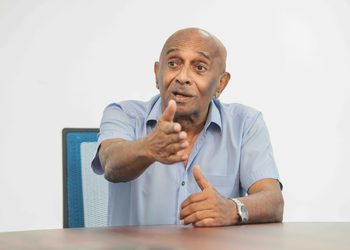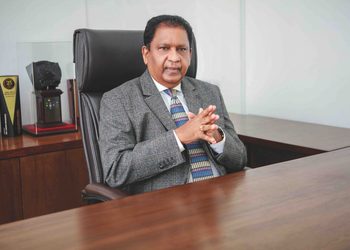

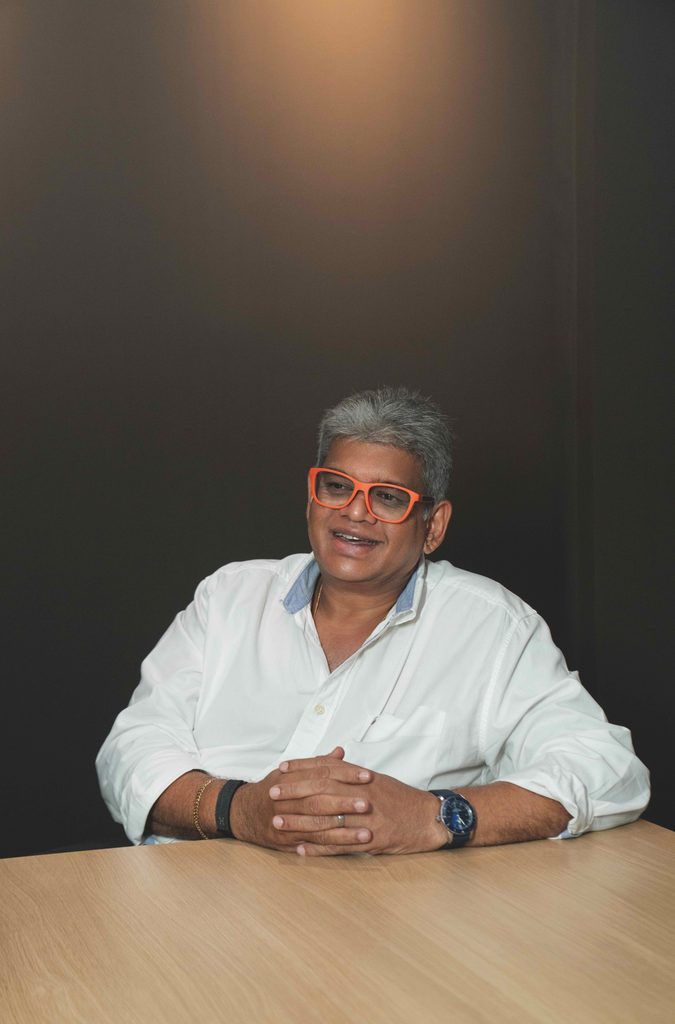
Architect Rajiv Senanayake, Managing Director/Principal Architect, Design Forum.
As Design Forum enters its next chapter, architect Rajiv Senanayake reflects on the practice’s evolution, resilience amid Sri Lanka’s economic crises, and growing international ambitions.
Speaking with Business Today, he discusses the firm’s expansion into Ghana and West Africa, plans to develop its interior design and project management capabilities, and the opportunities and challenges facing Sri Lanka’s architectural profession.
Words: Jennifer Paldano Goonewardane.
Photography: Rasanga Dissanayake and Dinesh Fernando.
Design Forum has now entered a new chapter with you as its sole owner. What does this transition mean for the company, and how do you see the business evolving under your leadership?
It was a significant change after 23 years of working with a partner, but when I took over as the sole owner, the team remained together. We have always worked as a family, and that continuity made the transition much smoother. The responsibilities were now entirely mine, but the staff supported me through it, particularly as we were coming out of COVID and the economic crisis.
Fortunately, we continued to receive work, which allowed us to sustain the business through that period. We managed to pay everyone without cutting salaries and continued operating every month, even during the most difficult periods. Apart from a few team members who left to pursue opportunities overseas, the rest of our staff remained committed, determined, and understanding of the challenging circumstances we were facing.
Now, as we enter our 26th year, the transition feels seamless. The team has remained intact, and we have also welcomed the next generation, with my son joining the practice as an architect, spearheading the next chapter of Design Forum and expanding the business into new dimensions. So, while the ownership structure has changed, the way we work has not. We have remained a team, and that continuity has been central to how Design Forum has moved into this next chapter.
Design Forum has survived several difficult economic cycles, but the 2022 crisis was arguably the most severe challenge Sri Lankan businesses faced. How did you navigate the company through that period?
Even before the crisis, my approach was that we should not try to grow too quickly. We needed to maintain a steady pace rather than take on excessive risk. That approach helped us during the 2022 crisis because we were operating at a sustainable level and did not have to make drastic adjustments. We continued to secure work and maintain our operations.
Some clients were understandably concerned and scaled back their projects. We responded by encouraging them to continue with renovations and improvements to their existing properties rather than invest in new buildings. This led us to expand our focus to renovations, including upgrades to offices and commercial premises. Clients who were reluctant to move into new buildings were instead willing to invest in improving the spaces they already had.
We also saw an opportunity in the hospitality sector. During COVID, Browns Hotels acquired several properties and began preparing them for the recovery of tourism. We became involved in the renovation of around three of their hotels. This shift towards renovations and hospitality projects helped us maintain our workflow. So, navigating the crisis was largely about staying at a sustainable level, understanding how our clients were responding to the situation, and adapting our services to meet their changing needs.
We have always had an interior design presence within Design Forum, but with the growth of our architectural work, particularly in Ghana, we feel this is the right time to establish it as a more defined arm of the business. The objective is to create two specialized areas that can work together and offer clients a complete solution, without one overlapping with the other.
Did the crisis also force you to reconsider the concentration risk of relying predominantly on the Sri Lankan market? Was international expansion partly a response to that realization?
Yes. We had undertaken international work before, including projects in Bangladesh, Kenya, and India, but these were largely one-off projects that came through Sri Lankan contacts and businesses operating in those markets. We had not actively pursued an international presence.
The crisis coincided with a shift towards greater digital engagement. As businesses moved online, we also strengthened our presence on social media. This gave Design Forum greater visibility beyond Sri Lanka and enabled potential clients unfamiliar with our work to discover what we had done.
That exposure led to new opportunities and eventually encouraged us to look towards establishing a more sustained international presence. This is how we began exploring markets in Ghana and across West Africa.
With Ghana representing a significant new direction for Design Forum, what initially drew your attention to Ghana, and what convinced you that it was a market worth entering?
We entered Ghana in 2023 after I was invited there by a Sri Lankan who had moved into the garment sector in Ghana. He invited me to see whether we could support the industry, as there was an opportunity to develop garment manufacturing in the country. That first visit made me recognize the potential in Ghana, and we subsequently undertook a project there and then expanded our work into neighboring Togo.
As we became more familiar with the market, we saw that Chinese and Indian companies were already active in Ghana, particularly in investment and construction. However, there was a limited presence of international architectural and design firms. We saw an opportunity to bring our experience into that space.
Our first project created visibility for the Design Forum. That led to further inquiries and projects. I also sent my son, Aakaash, to Ghana to work with a construction company for six to eight months. The intention was to give him exposure, but it also helped us understand the local construction processes, business environment, and way of working. When he returned, we had a clearer understanding of how to approach the market.
From there, one project led to another, largely through word of mouth. We have since become involved in a 2.3 billion euro project that was opened by the Ghanaian leadership in August. Being associated with a project of that scale has also given us visibility among investors and other businesses looking at opportunities in Ghana.
I now travel to Ghana roughly every six weeks, usually to meet new clients and explore potential projects. We are still assessing the right structure for a permanent presence there, particularly given the weakness of the Ghanaian cedi and the challenges of moving funds out of the country. For now, we are managing the projects from Sri Lanka, which also works well because of the time difference.
So, our entry into Ghana developed from an initial opportunity, followed by our recognition of the market’s potential and the demand for architectural and design expertise.
So the longer-term vision is to create a consortium under the Design Forum umbrella, with architecture, interiors, and professional project management working as specialized but integrated disciplines.
How did you manage to establish credibility in Ghana as a Sri Lankan architectural practice?
I think our credibility came through the work itself. In Ghana, clients respond strongly to visual presentations, so our 3D designs and perspectives played an important role in demonstrating what we could deliver. Once the first projects were completed, people could see the work rather than simply read about the company. That led to referrals and introductions to new clients.
Our first client has also been an important part of that process. He has become a good friend and continues to introduce us to other investors and businesses. As architects, our work is our best form of advertising, and that has been particularly true in Ghana. We have not relied heavily on formal company profiles; the projects themselves have created the credibility and visibility we needed. We are now receiving inquiries from new clients, which gives us confidence in the market.
Our next step is to establish a small presence in Ghana, hopefully by next year, with a local team supported by two people from Sri Lanka. We would continue to undertake the majority of the design work from Sri Lanka, while the Ghana office would allow us to handle site visits, meetings, and presentations more efficiently.
There are similarities between Ghana and Sri Lanka in how business and government relations operate, so the market is not entirely unfamiliar to us. It has its challenges, but our experience in Sri Lanka has helped us understand and navigate them. For now, our focus is on building on the credibility we have established through our projects and developing a sustainable presence in the market.
Could we say that your entry into Ghana has given you the opportunity to establish a platform for wider African expansion?
Yes, Ghana gives us a base from which we can explore the wider West African market. We have already undertaken work in neighboring Togo and are exploring other opportunities across the region.
Ghana is particularly useful as a starting point because it is an English-speaking market, making communication and the establishment of business relationships easier for us. We feel confident and see greater opportunities in the West African market.
There is also increasing Asian investment in the region, particularly from India, which is creating opportunities for Asian professionals and businesses.
Sri Lankan architecture is not widely known in Africa, so we have had to establish our identity and demonstrate what we can bring to the market.
Our approach is also to understand the local context rather than impose an Asian architectural style. In industrial projects, for example, the factory itself is largely driven by function and process. We can introduce local character through the administrative and entrance buildings, incorporating elements of Ghanaian art, culture, patterns, and colors. That allows the projects to reflect their environment while retaining the functionality required by the client.
The garment industry is one area where we see potential. Ghana has a long tradition of textiles and printing, and there is now an effort to scale up production. We are also encouraging our clients to look beyond industrial development and consider opportunities in leisure and tourism.
You are also looking at introducing an interior design arm into the company’s operations. Why is this the right time to make that move?
We have always had an interior design presence within Design Forum, but with the growth of our architectural work, particularly in Ghana, we feel this is the right time to establish it as a more defined arm of the business. The objective is to create two specialized areas that can work together and offer clients a complete solution, without one overlapping with the other.
Historically, when the building sector slowed, we relied more on interiors to sustain the business.
Now that our architectural work is growing and we have an overseas presence, we can develop architecture and interiors as two complementary areas rather than depending on one to support the other.
Internationally, it is common for architecture and interior design to operate as distinct disciplines that collaborate on projects. I think we should move in that direction as well, rather than expecting one team to do everything.
It will also allow us to take on smaller interior projects that we might otherwise overlook. We do not want to reach a point where we say we are too large for a small café, shop, or other interior project. These projects are important for the business and, equally, they give younger members of the team an opportunity to take responsibility and develop their design skills.
My role will continue to be one of oversight, particularly at the initial stages, while giving the team greater ownership of their projects.
The intention is to create two specialized teams under the same roof that can collaborate to provide clients with an integrated architectural and interior design solution.
One project led to another, largely through word of mouth. We have since become involved in a 2.3 billion euro project that was opened by the Ghanaian leadership in August. Being associated with a project of that scale has also given us visibility among investors and other businesses looking at opportunities in Ghana.
Is diversification primarily about creating new revenue streams, or is it part of a larger strategy to reposition Design Forum as a multidisciplinary design and consultancy business?
It is primarily about repositioning Design Forum as a multidisciplinary organization. We have always worked across different areas, but we want to make that more visible and accessible. There is a perception that Design Forum only takes on large projects, and we want to change that. Clients can approach us for larger projects, such as major buildings, while also feeling comfortable engaging us for more intimate, smaller-scale projects.
Ultimately, I would like Design Forum to operate as a parent or holding company with specialized arms. The first would be the interior design arm, followed by a professional project management arm. This would allow us to take on projects in architecture, interiors, or project management individually, while also bringing all three together when a client requires a complete solution.
We have deliberately stayed away from construction. I believe an architect needs to maintain independence in order to give the best professional advice. However, internationally, there is strong demand for design-and-build solutions, and the younger generation within the business sees potential in that model. If we eventually move towards design and build, I would want the project management function to be professionally managed rather than having architects take on that role themselves. In markets such as India, design and build is well established, supported by strong project management teams. That is an area we need to develop further in Sri Lanka.
So the longer-term vision is to create a consortium under the Design Forum umbrella, with architecture, interiors, and professional project management working as specialized but integrated disciplines. A design-and-build offering could eventually emerge from that structure, although that is still a longer-term plan.
Do you believe Sri Lanka has the architectural talent and professional capability to export design services internationally? If so, what is preventing more firms from doing it?
Yes, Sri Lanka has the talent and professional capability to export architectural services. In fact, many Sri Lankan firms already provide drafting and architectural support to overseas practices, while Sri Lankan architects working abroad also outsource work to teams here.
The main challenge is that our professionals need to work in accordance with the standards, regulations, and software requirements of each foreign market. A firm working for the US, for example, has to understand US building codes and standards, while other markets have their own requirements. This means our teams need to continually develop their knowledge to serve different markets.
Software licensing is another significant barrier. International clients require licensed software, but the cost of maintaining multiple licenses can be substantial, making the business model less viable for smaller firms. At Design Forum, all our computers now use licensed software because without that, it is simply not possible to work effectively with international clients.
There is also a shift in the technology being used. The industry is moving from AutoCAD towards platforms such as Revit, which integrates design, quantities, sections, and other building information. Younger professionals are adapting to this more easily, but experienced draftsmen who have worked with AutoCAD for years need retraining.
Countries such as the Philippines and Thailand have built strong outsourcing industries around architectural drafting, partly because they have developed the systems and infrastructure to support this model. Sri Lanka has the human resources to do the same, but we need to address software costs and provide better access to international standards and training.
The Institute of Architects could play a role by negotiating more affordable software packages for Sri Lankan practices. If hundreds or thousands of architects could access licensed software at a more reasonable cost, exporting these services would become more viable.
Professional registration is another issue. Sri Lankan architects who want to practice as architects in foreign markets often face lengthy licensing and registration processes. That can discourage professionals from pursuing international opportunities, even when they have the necessary skills.
Architectural services and drafting can be a source of foreign exchange for Sri Lanka. We already have the talent; what we need is the infrastructure, technology, training, and regulatory support to turn that capability into a larger export industry.
As tourism remains one of Sri Lanka’s major growth sectors, what should the next generation of hotels and tourism developments look like if Sri Lanka wants to differentiate itself rather than simply add more rooms?
The future of tourism must focus on quality, consistency, and creating experiences that justify a premium. Even if a hotel has 100 rooms, all 100 need to be maintained to the same standard rather than closing rooms during quieter periods and reopening them when demand increases.
We also need to raise standards across smaller hotels, guesthouses, and boutique properties. A small hotel does not need to be large to offer a five-star experience. It should meet clear standards for design, service, and facilities, and this is where architects and proper regulation play a role.
Sri Lanka should also look beyond simply competing on price. We have the potential to attract premium travelers, as the Maldives has done, but local investors need support to develop properties to that standard. Differences in duties and other costs can make it harder for smaller local investors to compete with larger or foreign-backed developments.
We need a clear vision for what Sri Lankan tourism should become. If we focus on quality rather than room numbers, support local investment, and maintain consistent standards, we can create tourism developments that are distinctive and attract higher-value visitors.
What concerns you most about the direction of Sri Lanka’s built environment over the next ten years? And conversely, what gives you the greatest optimism?
My biggest concern is infrastructure. We need to improve stormwater management, drainage, sewage, water supply, and electricity infrastructure. Power generation is improving with the growth of solar, but our existing power plants and networks also need to be upgraded.
Transport is another priority. Our road network has improved significantly with the highways, but we have not expanded our railway network sufficiently. We need to invest in new railway lines and better public transport if we want development to spread beyond Colombo. Similarly, we need to move beyond individual septic tanks and invest in proper, centralized wastewater treatment systems. These investments are important not only for the quality of life but also for attracting investors. No investor will look at a development in isolation; they need confidence that the surrounding infrastructure can support it. Despite these concerns, I remain optimistic. I have always believed that tomorrow can be better than today, which is why I have continued to build my business and career in Sri Lanka. If we make the right infrastructure decisions now, they can shape the country’s development for the next generation.
Design Forum is now entering its next 25 years. What do you want the company to be known for — in Sri Lanka and internationally?
Over the next five years, I would like Design Forum to be known as a practice with one or two international offices, while continuing to make a meaningful contribution to the communities in which we work. I do not want us to be known simply as a business that exports architectural services. I want us to be known as responsible architects.
For me, responsible architecture means designing buildings and spaces that can be maintained, sustained, and operated efficiently over time. I tell our younger architects that a good design should not require high cost to maintain it or preserve its appearance.
I would like people to look at a Design Forum building two decades later and still recognize the quality of the original design. That, ultimately, is what I want the practice to be known for — architecture that is responsible, practical, and built to last.
You have always maintained a very hands-on involvement in projects. At this stage of the company’s evolution, is remaining hands-on still sustainable, or does the next phase require you to become more of a strategic leader than a practicing architect?
I will always be a practicing architect involved in the work, including being on-site and engaging with the client, contractor, and workers. That is where my passion for architecture comes from.
I am happy to give my team the freedom to lead projects, but I still want to remain involved. I will visit a site in the evening or on a weekend, review progress, and stay connected to the work. I do the same with our projects in Ghana, regularly asking for updates and studying the progress remotely.
I do not see myself moving entirely into a strategic role. For me, every project needs personal involvement, and that is something I want to continue for as long as I practice architecture.