
The International Academy of Fashion (IAF), which began its journey in 2000 as the Lanka Institute of Fashion Technology (LIFT), was the pioneering vision of Niroshani Leanage at a time when fashion education was still considered an unconventional career choice in Sri Lanka. Over the past 25 years, IAF has reshaped perceptions, championing fashion as a respected discipline that blends creativity, professionalism, and global relevance. As it celebrates 25 years, Niroshani, the institute’s Managing Director, spoke with Business Today, reflecting on a transformative journey that has expanded opportunities for aspiring designers and elevated Sri Lanka’s global standing in the fashion arena. Through franchise partnerships with MODART International Paris and OTHM UK, IAF has brought internationally benchmarked education to the country. Their curriculum strikes a balance between artistic expression and business acumen. At the same time, their distinctive approach includes international study tours and insights into manufacturing processes in fashion capitals, enabling students to experience the industry first-hand. Importantly, Niroshani explained that IAF has broadened the scope of fashion education beyond designing by cultivating expertise in fashion management, marketing, textiles, and creative entrepreneurship.
Words Jennifer Paldano Goonewardane.
Photography Sujith Heenatigala and Dinesh Fernando.

Niroshani Leanage, Managing Director, International Academy of Fashion.
How do you reflect on the institute’s journey over the past two decades?
The international Academy of Fashion (IAF), which began as the Lanka Institute of Fashion Technology (LIFT), has experienced steady growth since 2000, with significant changes every five years. We have maintained a decade-long franchise partnership with MODART International from Paris, which has created numerous opportunities for students. In recent years, we have welcomed international students from Singapore’s Tembusu Institute to complete their studies here with us and receive a qualification from MODART International. In recognition of our contribution to the fashion industry and for promoting French culture, the French Government awarded the rank of Knight of the Order of Arts and Letters in 2021 to my mother and me. Another milestone of the last two and a half decades is our expansion, opening our first international branch in Dubai in 2023.
How has fashion education in Sri Lanka evolved since your institution opened?
When we launched fashion education in Sri Lanka 25 years ago, we began as a small program. However, we understood the importance of establishing fashion education as a formal education pathway with viable career prospects. As we forged partnerships with international institutions over the past 25 years, fashion education has gained recognition as a professional program that provides valuable skills. Since 2010, our focus has shifted toward entrepreneurship, with about 80 percent of our diploma, degree, and master’s programs now emphasizing entrepreneurship to help Sri Lankan labels reach global markets.
What career pathways are available to young people pursuing fashion design, and how does your institution prepare them for these roles?
It’s important to understand that fashion design is vast beyond dress design. The potential is enormous and varied. Today, graduates can work as designers in the apparel industry, enter marketing divisions, contribute to fashion buying and sourcing, pursue entrepreneurship with their own labels, work in retail, become fashion buyers for specific brands, or specialize in visual merchandising. Our diploma focuses on fashion and textiles, which the OTHM UK awards. At the same time, our degree program from MODART International Paris prepares students for careers in fashion design, styling, and digital media marketing. We take every student enrolled in our programs beyond the classroom, offering hands-on learning and real industry opportunities through internships and tours to the world’s fashion capitals.
How do you balance creativity with the business side of fashion, preparing students for the realities of the industry?
We aim for a 50-50 balance between creativity and business knowledge. From day one, students learn to consider whether their designs are for creative/conceptual purposes or for selling to customers. Producing a highly creative individual who lacks business acumen means they will depend on someone else’s business knowledge to help them move forward. While some students have entrepreneurial parents who can provide business guidance, many don’t, making business education crucial. With today’s AI technology and freely available information, training students with balanced knowledge is easier.
How do your institution’s global connections with fashion capitals like London, Paris, and Dubai enhance the education students receive?
Our connections with fashion capitals provide students with invaluable exposure and experience. Since 2015, we have organized international tours to fashion capitals, allowing students to visit high streets, luxury stores, and manufacturing facilities. Through our MODART International Paris franchise, students gain access to lectures from professionals at top brands like Louis Vuitton and L’Oreal. These experiences help students understand different markets, customer behaviors, and the full spectrum of the fashion industry, from luxury to affordable segments.
How do these partnerships with MODART International, University of Northampton, and MPA Style shape the curriculum and opportunities for students?
Indeed, these partnerships facilitate unique student opportunities, including visits to manufacturing facilities for luxury brands like Chanel, Giorgio Armani, Prada, and Christian Louboutin, accessible only through prior appointment and limited numbers. We have taken our students to Paris and Milan, mainly to Paris. Because of IAF’s partnerships, we can provide our students with the rare opportunity to witness the techniques and the types of materials these global fashion brands work with. These factories organize special demos just for our students. These tours allow our students to witness the contrast between European handmade production, where one pair of shoes might take 300 hours to make, and mass production in Asia, the contrast between durable products with a lifetime warranty versus fast fashion. We also take them to Champs-Élysées, the luxury shopping street, to expose them to its unique ecosystem of operations, from store décor to how some stores work on exclusivity, allowing a handful of customers simultaneously, while others have queues. We also take them to the markets to witness a different product offering, including products sourced from villages and home-based businesses. Our tours provide a complete exposure, witnessing products that range from thousands of euros to ten euros. Our partnerships also offer lifestyle experiences, business lectures from industry professionals, and organized store visits during international tours.
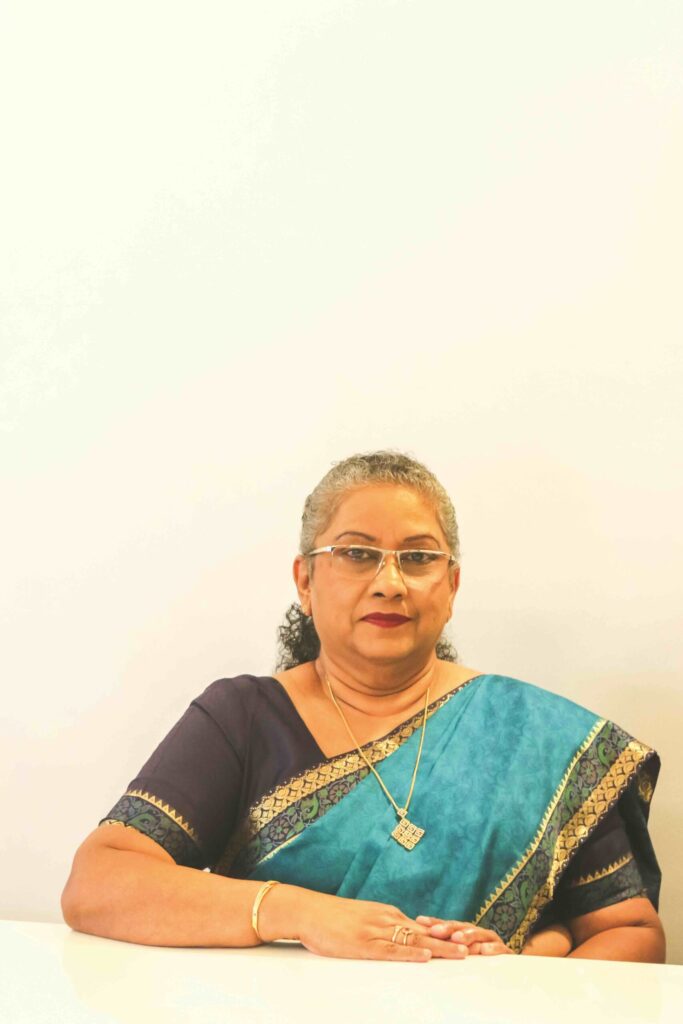
Roshani Leanage, Chairperson, International Academy of Fashion.
Are fashion shows also part of your program?
Fashion shows are part of our events and promotions for students. Since 2001, we’ve held fashion shows and exhibitions to promote new designers. From 2005 to 2010, we ran shows under “New Designers of LIFT,” then shifted to graduate fashion shows after 2010. In 2017 and 2018, we created the International Graduate Fashion Spectacle in partnership with the French Spring Festival, inviting graduating students worldwide to showcase their work in Sri Lanka. We introduced Sri Lanka to international students while allowing them to create partnerships. The IGFS provided a platform for European and Asian students to merge. These students considered Sri Lanka a manufacturing hub and a country experiencing growth in design development. The IGFS was a popular show for two consecutive years, in 2017 and 2018. Moreover, it facilitated student networking and building connections to the extent of entering into business collaborations. After COVID disruptions, we resumed events in 2021 as part of the French wine evening, providing a platform for our graduating students to showcase their creations to potential customers and business partners.
How do you see the role of Sri Lanka in the global fashion industry evolving in the coming years?
Sri Lanka’s potential in the global fashion industry is tremendous. I witness this potential even in our trained students. The international fashion industry is continuously evolving; hence, we must connect our education to global needs, which will equip Sri Lankan designers to contribute significantly. The MODART International Paris updates its syllabus annually, ensuring that students are abreast with evolving knowledge and prepared for the global industry. As Sri Lanka focuses more on tourism, developing original Sri Lankan products and labels is necessary to reach international markets.
How does AI impact education and the fashion industry?
As we all know, AI has negative and positive impacts. On the negative side, students use tools like ChatGPT for assignments, sometimes creating a disconnect between their written work and actual abilities. We subsequently introduced the necessary software to detect AI-generated content.
Mod Art Paris has guided us on this because students must use independent thinking and creativity for their assignments. After all, relying on AI to produce their study-based work would eventually kill their creativity. We receive finely written CVs and emails written in professional English, but when that individual comes to me, they can’t speak or elaborate on what they had submitted in their CVs. However, we have introduced a mechanism to detect AI-generated content in assignments. On the positive side, AI allows designers to visualize garments on different models without an expensive photoshoot. Today, we can choose the ideal model to fit the perfect garment, and by saving on the money invested to promote one’s designs, students can invest the savings in marketing. However, this threatens traditional modeling and photography industries.
Moreover, a garment on a human model will always show subtle creases and folds that will allow people to understand better how it wraps on a human body. In contrast, an AI-generated model can be misleading, as we often witness when purchasing from online platforms. So, while we teach students to use AI tools, we also stress the importance of originality and human creativity, believing that AI will never completely replace human creative thinking.
As we forged partnerships with international institutions over the past 25 years, fashion education has gained recognition as a professional program that provides valuable skills.
What would be your advice to young people in Sri Lanka considering a career in fashion today?
Having run this institute for 25 years, most of the students who come to us have no clue what they are getting into. I have a question for them. If you decided to enter medical school, would you know that you will work in a hospital or treat patients for the rest of your life? Likewise, anyone considering a career in the fashion field must focus on the future and realize that the field of fashion entails working in a glamorous field, contributing continuously, being creative, and understanding business. We conduct thorough interviews with prospective students, encouraging parents to be present, to ensure they know what they’re committing to. Some want a paper qualification or just subject knowledge. But to those who wish to pursue a career in fashion and design, I tell them first to know their end goal—whether they want to work for someone else, or work in the apparel industry, create their own label, or take another path—they must put their heart and soul and the number of hours to reach success.
Our counselors help students navigate these critical decisions by telling them about the opportunities out there on a professional level. Students must choose an institution that aligns with their goals, because the fashion field is vast and a single institution cannot cover the different paths that students wish to pursue in the future.

What is your vision for your institution in the next decade?
Our focus for the next decade will be professional-level courses and postgraduate education. While maintaining our strong foundation in diplomas and degrees, we plan to expand subject offerings at the postgraduate level to meet the needs of working professionals who want to advance their careers or pivot to new areas. We will focus our programs on flexible, online learning options that allow people to study without leaving their jobs, with internationally recognized qualifications from the UK to help graduates work globally. We will launch a new UK qualification course in strategic marketing in 2026, with options for specialization in fashion and luxury industries. We will continue to offer students internship opportunities with luxury brands like Chanel, Dior, and Hermes through the MODART International Paris collaboration.