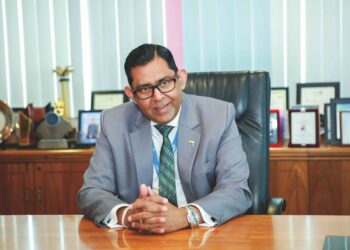

Hayleys Chairman and Chief Executive Mohan Pandithage reviews the Group’s strong FY2024/25 performance and shares his vision for growth. Driven by a focus on value-added products, market diversification, and digital transformation, Hayleys achieved record revenues while remaining resilient in the face of local and global challenges. Pandithage reinforces the Group’s commitment to renewable energy, and ESG, along with strategic investment in trade, technology, and expansion in Asia. He emphasizes talent development, innovation, and inclusive models as key to competitiveness. Looking ahead, he stresses Hayleys’ dual goal: delivering commercial results and supporting Sri Lanka’s growth, while encouraging entrepreneurs and investors to pursue opportunities in a stabilizing market.
Words Jennifer Paldano Goonewardane.
Photography Sujith Heenatigala and Dinesh Fernando.

Mohan Pandithage, Chairman and Chief Executive, Hayleys.
What do you think was the single biggest driver of Hayleys’ remarkable FY2024/25 performance?
The single biggest driver of Hayleys’ exceptional performance in FY2024/25 was the strong rebound and resilience demonstrated across both its domestic and export-oriented businesses. The Group achieved its highest-ever revenue of 492 billion rupees, underpinned by robust growth in local operations such as Singer, which benefited from a more stable macroeconomic environment and a noticeable improvement in consumer confidence. On the export front, Hayleys’ deliberate strategy of diversifying markets and expanding across multiple product verticals helped cushion the impact of ongoing global economic volatility. Our profitability was further strengthened through a sharper focus on innovation, the development of high–value–added products, and the realization of operational efficiencies driven by digitalization and continuous process improvements across the Group.
How has diversification protected and enabled the Group during Sri Lanka’s economic turbulence and the global supply chain risks?
Diversification is central to Hayleys’ ability to grow and withstand turbulence in Sri Lanka and global supply chains. The Group has consistently posted growth exceeding national GDP by expanding internationally through multi-dimensional diversification. Geographically, Hayleys is present in nearly 20 countries, targeting emerging markets with long-term potential. In industry terms, it invests in high-growth sectors while preserving returns from mature businesses. These strategies help Hayleys remain resilient through economic cycles and absorb shocks, as evidenced by its strong growth over the past decade.
Hayleys’ FY2025 performance narrative highlights a strategic shift towards value-added products and non-traditional markets — can you give a concrete example where this pivot delivered a margin advantage?
A clear example of how this strategic pivot has translated into margin advantages can be seen across both Hayleys’ value-added product initiatives and its expansion into non-traditional markets. Within value-added manufacturing, DPL has successfully moved into specialized sports gloves, a segment that commands superior margins compared to conventional apparel due to its technical complexity and niche positioning. Similarly, Haycarb has strengthened its innovation-led growth through the development of its Energy Storage Material Series, which caters to advanced applications such as supercapacitors and batteries, allowing the company to move up the value chain and capture higher returns. On the market diversification front, businesses such as Haycarb, DPL, and the Group’s tea export operations have expanded their footprint in non-traditional regions, including Asia, Eastern Europe, and Africa, reducing dependence on mature markets while unlocking new demand. In parallel, Hayleys Advantis is actively pursuing regional expansion to capitalize on growth opportunities across Asia. Together, these initiatives demonstrate how Hayleys’ focus on value addition and market diversification has delivered tangible margin benefits while strengthening long-term resilience.
Following a strong year, how is the Group considering buybacks, capital expenditures, and reinvestment in new growth areas?
Following a strong year, the Group’s approach to capital allocation is guided by a disciplined portfolio management strategy that seeks to strike a balance between investing in high-growth opportunities and maintaining steady cash flows from its mature businesses. This philosophy will shape Hayleys’ investment plans in the coming year, as the Group looks to channel capital into new growth verticals such as modern trade and mobility, while continuing to reinvent and strengthen its traditional businesses. These reinvestments include capacity expansions and the establishment of new factories across various sectors, such as DPL, purification, and tea exports, aimed at enhancing competitiveness and value creation. At the same time, as we continue to scale our export-oriented businesses, we intend to capitalize on Sri Lanka’s stabilizing macroeconomic conditions and the anticipated rise in disposable incomes, ensuring that capital deployment remains both growth-oriented and grounded in long-term sustainability.

A stronger export orientation helps when the rupee is volatile. What are you doing to grow foreign-currency earnings further, and how do you navigate foreign exchange/ commodity exposure?
With a stronger export orientation, managing currency volatility remains a critical focus for the Group. Exchange rate movements are recognized as a major risk factor and are closely monitored and managed through Hayleys’ enterprise-wide risk management framework. The Group’s investment strategy is designed to create a natural hedge between foreign currency inflows and outflows. We deploy capital only into businesses that inherently offer such protection, thereby reducing exposure to abrupt currency fluctuations. At the same time, efforts to grow foreign-currency earnings are being accelerated by expanding into non-traditional markets through businesses such as Haycarb, DPL, and tea exports, while also deepening participation in value-added product segments. This dual approach allows the Group to strengthen its foreign exchange earnings base while prudently navigating both currency and commodity exposure in an increasingly volatile global environment.
How does Hayleys’ sourcing, logistics, and market strategy adapt to geopolitical uncertainty and changing trade lanes, given that Hayleys often emphasizes its agility and logistical capabilities?
They are increasingly shaped by the need to respond to geopolitical uncertainty, shifting trade lanes, and the growing impact of climate change. Supply chain diversification has therefore become a strategic priority, not only to mitigate geopolitical and trade-related risks but also to address climate-related disruptions that are affecting the availability of agricultural raw materials. Leveraging its well-established logistical capabilities and operational agility, we continue to adapt our sourcing networks to ensure continuity and reliability. On the market side, Hayleys is deliberately expanding its presence in non-traditional regions, such as Asia and Africa, thereby reducing our reliance on conventional markets and enhancing resilience against volatile global trade dynamics. This integrated approach allows the Group to remain nimble and responsive in an increasingly uncertain global operating environment.

How is Hayleys mapping its priorities alongside a stabilizing Sri Lanka and improved policy predictability (manufacturing, exports, tourism, logistics, agriculture, and renewable power)?
As Sri Lanka’s economy stabilizes and policy predictability improves, Hayleys is aligning its strategic priorities to support long-term national development while strengthening its own growth platforms. In agriculture, the Group continues to focus on inclusive business models that integrate local out-growers into global value chains, ensuring broad-based value creation and sustainable livelihoods. In parallel, Hayleys is advancing its commitment to the green economy by embedding ESG principles across its businesses, with a strong emphasis on decarbonization, resource optimization, and biodiversity preservation to build resilient and future-ready enterprises. Digitalization serves as a critical, cross-cutting enabler across all these priorities, with the Group implementing a comprehensive digital transformation roadmap focused on converting data into value, accelerating digital product delivery, and driving end-to-end innovation across operations. Together, these focus areas reflect Hayleys’ intent to leverage a more stable macroeconomic and pol icy environment to deliver sustainable, inclusive, and technology-driven growth.
Hayleys has been steadily increasing its renewable energy portfolio. How do your new power projects, such as the 50MW wind farm in Mannar and 150MW in solar investments, support Sri Lanka’s long-term energy security agenda, and what opportunities do you see as the country accelerates into a cleaner energy mix?
Hayleys’ expanding renewable energy portfolio is closely aligned with Sri Lanka’s long-term energy security agenda and its transition to a cleaner energy mix. With the national target of generating 70 percent of electricity from renewable sources by 2030, the country must prioritize solutions such as residential solar with storage, wind power, and complementary avenues, including small-scale hydropower projects. In this context, Hayleys’ new power initiatives—such as the 50MW wind farm in Mannar and its broader pipeline of around 150MW in solar investments—make a meaningful contribution to strengthening energy resilience and reducing dependence on imported fossil fuels. Achieving these ambitious national goals will also require strong public–private partnerships, where the private sector can bring capital, expertise, and execution capability. For Hayleys, investments in renewable energy are compelling not only from a commercial standpoint but also from an environmental perspective, as they are firmly aligned with the Group’s ESG aspirations and its commitment to decarbonization and sustainable growth.
With Sri Lanka experiencing steady growth in tourist arrivals, how do you think the country can sustain this momentum? What are the areas for improvement, and their future trajectory amid unanticipated events?
Sustaining this momentum will depend on a combination of clear messaging, effective promotion, and long-term positioning. In the immediate term, it is crucial to consistently communicate that Sri Lanka is a safe and welcoming destination for travelers. This message needs to be reinforced through accelerated digital marketing campaigns that clearly showcase the country’s accessibility, emphasizing that key tourist destinations remain open, easily reachable, and secure. Looking beyond the short term, promotional efforts must evolve to position Sri Lanka as a compelling year-round destination, highlighting the diverse range of experiences available across the seasons. Such a balanced approach would help build resilience in the tourism sector, enabling it to better withstand unexpected events while sustaining long-term growth and stability.
What are the structural constraints impacting Sri Lanka’s corporate sector?
Sri Lanka’s corporate sector continues to face several structural constraints that affect its growth and competitiveness. One of the key challenges is talent migration and the difficulty in retaining skilled employees, which creates pressure on human capital and succession planning. Financial restrictions, such as the single-borrower limit, also constrain companies’ ability to access capital for expansion and investment. Additionally, aspects of the tax system, including delays in the SVAT recovery process, create operational and cash flow inefficiencies that require attention. Global geopolitical dynamics introduce an external layer of uncertainty, affecting trade, investment, and supply chain stability, and necessitating that businesses continually adjust their strategies to navigate an increasingly complex environment.
In terms of ESG leadership, given that Hayleys reports a significant share of group energy coming from renewables and a measurable reduction in emissions, how is the Group balancing fur ther decarbonization with commercial returns?
We actively balance our ESG ambitions, particularly decarbonization, with the pursuit of commercial returns through a structured and integrated approach. The Group has set a clear target to reduce absolute Scope 1 and 2 greenhouse gas emissions, driving progress through increased adoption of renewable energy, energy efficiency initiatives, and targeted interventions across its value chains. Achieving meaningful emission reductions while continuing to expand the business requires innovation, integrated thinking, and collaboration across all parts of the organization. Beyond our solar investments, we are exploring additional cleaner energy opportunities, including bio-diesel and green hydrogen, ensuring that our sustainability initiatives not only support environmental goals but also deliver long-term commercial value.
How do mergers and acquisitions fit the Group’s growth playbook for the near future?
Mergers and acquisitions form a crucial component of Hayleys’ growth strategy, particularly as the Group positions itself to benefit from Sri Lanka’s transition to an upper-middle-income economy and the accompanying rise in customer sophistication. In the near term, we are actively pursuing inorganic growth opportunities within the consumer goods sector, leveraging its well-established brands, extensive distribution networks, and robust supply chains to create additional value. Concurrently, the Group is directing investments into modern trade, aiming to strengthen market presence and capture emerging demand trends. Through this approach, mergers and acquisitions are not only a vehicle for expansion but also a strategic means to accelerate growth, enhance competitiveness, and consolidate the Group’s leadership in key sectors.
Looking ahead, Hayleys’ long-term priorities are centered on sustaining its role as a leading export conglomerate and continuing to be a significant foreign income earner for Sri Lanka.
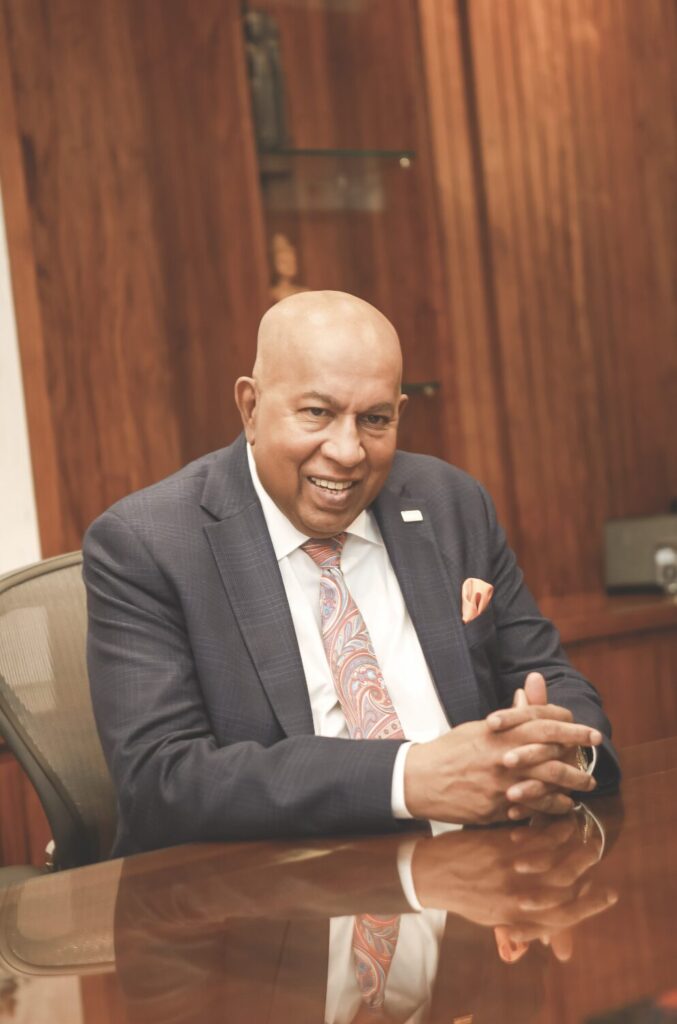
Which parts of the Group benefit most from digitalization, data analytics, or automation — and where are the biggest productivity gains expected?
Hayleys is leveraging digitalization, data analytics, and automation across the Group to drive significant productivity gains and enhance overall performance. The digital transformation roadmap focuses on several key outcomes: transforming customer interactions to deliver a superior experience, optimizing processes across production and service delivery, and supporting the achievement of sustainability goals through enhanced monitoring and measurement. To achieve these objectives, the Group is modernizing its applications, embedding AI-enabled solutions into critical processes, and leveraging data-driven insights to inform decision-making. These initiatives are expected to generate the most substantial productivity improvements in operational efficiency, customer engagement, and sustainability management, positioning Hayleys to extract maximum value from technology investments across its diverse businesses.
How are you building talent pipelines and leadership for a multi-country, tech-enabled future?
A key focus is managing a multi-generational workforce, with particular attention to the unique needs and aspirations of Gen Z, who are increasingly forming a significant portion of the talent pool. We are investing in skill development initiatives that emphasize digital proficiency, leadership, and communication, ensuring employees are equipped to thrive in a rapidly evolving business landscape.
At the same time, Hayleys is adapting to changing employee expectations by fostering alignment with the company’s purpose, promoting work-life balance, and creating opportunities for more meaningful and impactful work. Through these measures, the Group aims to develop a resilient, future-ready workforce that can drive sustained growth across its diverse operations.
Given years from now in terms of markets, sustainability, and returns, what are the outcomes you want to prioritize?
Looking ahead, Hayleys’ long-term priorities are centered on sustaining its role as a leading export conglomerate and continuing to be a significant foreign income earner for Sri Lanka. The Group will place a strategic emphasis on innovation and value addition across its key business verticals, ensuring that growth is both differentiated and resilient. Additionally, Hayleys aims to strengthen its presence in the Asian region, which it identifies as the primary growth engine over the coming decades. By focusing on these outcomes—market expansion, sustainable value creation, and superior returns—the Group aims to secure long-term competitiveness while making a meaningful contribution to national economic growth.
What message would you like to convey to young Sri Lankan entrepreneurs and foreign investors considering Sri Lanka today?
Sri Lanka offers immense potential for growth, especially as recent improvements in policy stability and the broader governance landscape position the country for sustainable and equitable development. For young Sri Lankan entrepreneurs, my message is to stay engaged, remain in the country, and contribute their talent and energy to supporting this growth trajectory. At the same time, I encourage foreign investors to explore the opportunities arising from a more stable and promising economic environment, where strategic investments can create meaningful value while contributing to the nation’s long-term development.