
By Clara Rodrigo.
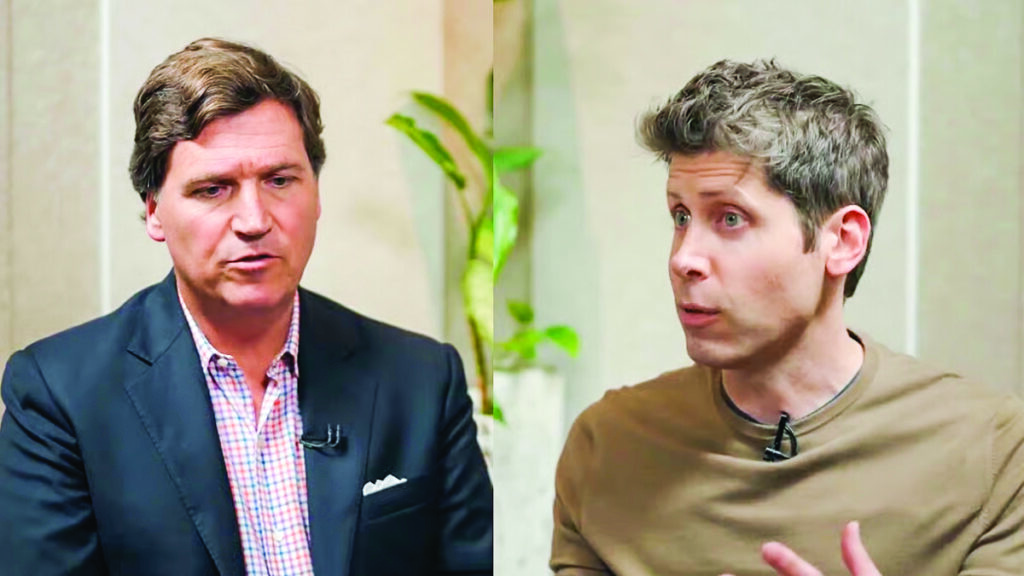
Host Tucker Carlson with Sam Altman, CEO of OpenAI
A Different Kind of Interview
When Sam Altman, CEO of OpenAI, appeared on The Tucker Carlson Show, the encounter was less a Silicon Valley product launch and more a probing philosophical debate. Carlson, one of America’s most influential commentators, pressed Altman on issues of faith, morality, and the societal role of AI—areas far removed from quarterly revenue or model updates. Yet for CEOs, investors, and policymakers worldwide, this exchange mattered. It revealed the new dimensions of corporate leadership in the AI age, where technology is judged not only for what it does but also for what it represents.
AI and the Question of Morality Carlson began with a provocation: “Do you believe artificial intelligence is moral—or even spiritual?” Altman’s answer was firm. “These are very large computers doing mathematics,” he said. AI, in his framing, is not alive, not sentient, not a god. Yet he acknowledged the unavoidable fact: human values are embedded in every system—from what content is filtered to how answers are phrased. For corporate boards, the message is clear. Every algorithm is also a mirror of leadership choices. In industries from banking to healthcare, the perception of ethical alignment will become as important as technological efficiency.
The Musk Question: A Shift in Alliances The interview turned personal when Carlson asked about Altman’s relationship with Elon Musk, OpenAI’s co-founder and now its fiercest critic. Altman acknowledged that he once saw Musk as “a great jewel for humanity.”
“The values encoded in AI systems are unavoidable,” Altman admitted. “Every decision about what’s allowed and what’s restricted reflects judgment.”
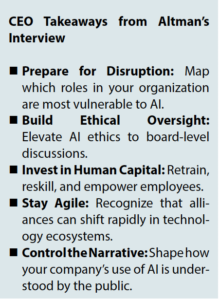
Today, the relationship is more complex, marked by Musk’s lawsuits, rival ventures, and public attacks on OpenAI’s direction. For business leaders, this is a reminder of a harsh truth in the innovation economy: alliances are temporary. Yesterday’s partner may become tomorrow’s competitor, and reputational narratives can shift in months. Agility—in partnerships, joint ventures, and cross-industry alliances—is now a strategic necessity.
AI and the Future of Work
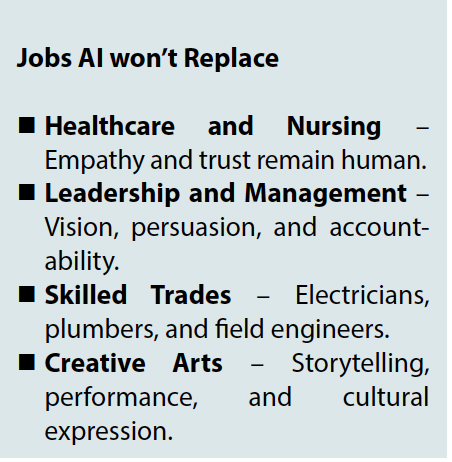
Perhaps the most business-relevant part of the exchange was Altman’s view of employment. He divided jobs into three categories:
High Risk: Roles in customer service, call centers, and repetitive digital tasks are most exposed to automation.
Transitional: Programmers and analysts will not disappear but will see their work transformed—AI will become a collaborator, accelerating output but demanding new oversight skills.
Relatively Safe: Professions requiring empathy, trust, and physical presence—such as nursing, caregiving, and leadership itself—remain beyond the reach of machines.
For CEOs, the challenge is two-fold: to deploy AI for efficiency gains while simultaneously investing in retraining and human capital. Companies that embrace hybrid human-AI models will outpace those that treat AI solely as a cost-cutting device.
Beyond Technology: The Role of Faith and Philosophy Carlson repeatedly pressed Altman on spirituality, suggesting that AI is quietly shaping human morality. If millions of people ask ChatGPT how to live, how to love, or how to work, is it not functioning as a new moral authority? Altman resisted the comparison, but the tension was revealing. AI is not built as a religion, but in practice, it is being treated as one—a trusted source of wisdom, consulted at scale, with its biases shaping behavior. For business leaders, this suggests that corporate communication and governance must acknowledge AI’s cultural role. Trust will not be won by insisting “It’s just math.” It will require radical transparency about training data, biases, and safeguards.
The Bigger Business Picture What does this mean for the global corporate elite? Several themes stand out:
Ethics as Strategy: Ethics has moved from compliance to competitive advantage. Companies that embed transparency, fairness, and accountability into their AI systems will command more trust from regulators, investors, and customers.
Trust as Capital: Reputation is no longer a PR exercise; it is an economic asset. Firms that fail to address ethical concerns may face not only consumer backlash but also capital flight and regulatory intervention.
Workforce Planning: AI is not an instant job destroyer but a job transformer. Firms that invest in retraining programs and hybrid human-AI workflows will emerge stronger. Those that do not risk cultural resistance and long-term talent erosion.
Leadership Narrative: As Altman’s changing relationship with Musk illustrates, technology leadership is also a story. The narrative of who is visionary, who is ethical, and who is reckless will shape markets as much as balance sheets.
AI as a Leadership Test Altman’s appearance on The Tucker Carlson Show was less about technical specifications and more about the soul of technology. He was asked not how ChatGPT works, but what it means—for morality, for jobs, for leadership. For CEOs, the lesson is unmistakable. AI is no longer a back-office efficiency tool. It is a front-page cultural phenomenon, shaping politics, labor markets, and public trust. The question is no longer whether AI works—but whether leaders are prepared to guide it responsibly. In the end, Altman’s interview was not a warning about machines. It was a warning about leadership.
“Technology products are no longer judged only by efficiency or profitability, but also by the values they project.”