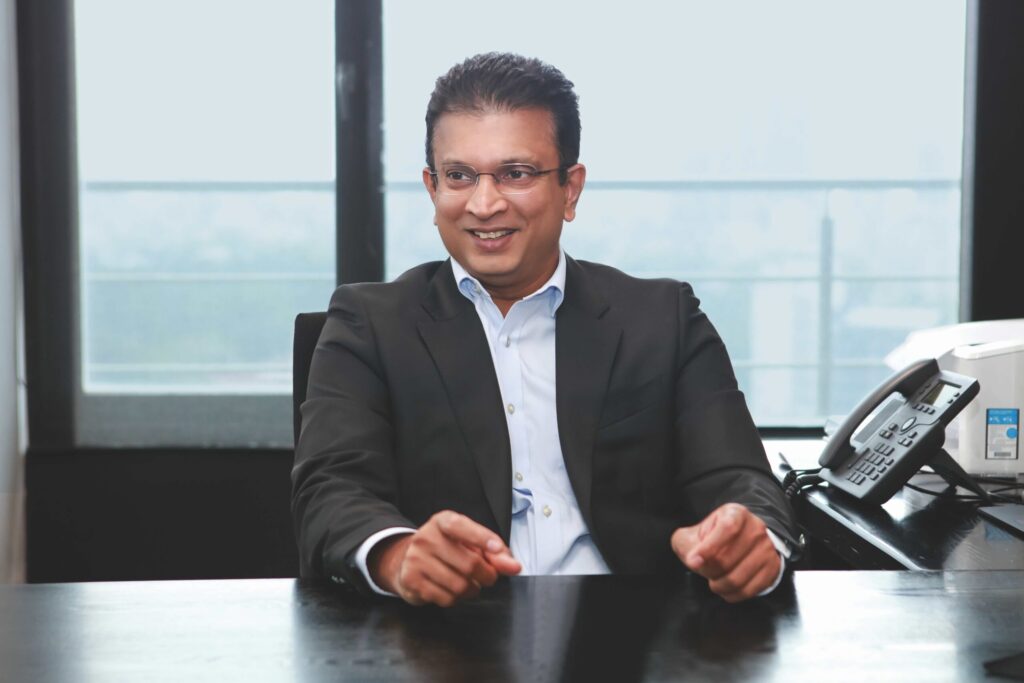

Dialog secured licenses for two spectrums in Sri Lanka’s 5G auction, investing USD 100 million over the next two years to expand 5G nationwide and enable individuals, businesses, and industries to fully participate in a digital Sri Lanka. In an interview with Business Today, GCEO Supun Weerasinghe expressed optimism for 5G’s potential, calling it a milestone for the country’s digital infrastructure and a driver for economic growth through industry efficiency, global competitiveness, and foreign direct investment.
Words Jennifer Paldano Goonewardane.
Photography Sujith Heenatigala and Dinesh Fernando.

Supun Weerasinghe, Group CEO, Dialog.
The commercial launch of 5G is often described as a technological milestone. In your view, what kind of national transformation moment is this for Sri Lanka?
The introduction of fifth-generation mobile networks provides the critical backbone required to transition decisively into Industry 4.0, also known as the Fourth Industrial Revolution.
The Fourth Industrial Revolution is driven by advanced technologies, including artificial intelligence, cloud computing, ultra-low latency communications, and high-speed broadband. These enable automation and operational efficiency, and boost productivity by reducing manual workloads, cutting costs, and accelerating decision-making across industries, ultimately delivering a faster, more personalized digital experience economy-wide.
5G enables Sri Lanka’s digital economy by improving broadband and allowing enterprises to innovate, scale, and compete regionally and globally. A strong 5G ecosystem also attracts investment and prepares Sri Lanka to join the global digital economy.
5G globally is about new use cases rather than just faster data. Which real-world applications do you believe will drive the first wave of commercial value in Sri Lanka?
The initial anchor use case is enhanced mobile broadband. Today, Dialog has approximately 1.5 million subscribers using 5G-capable handsets. As these users migrate onto the 5G network, they will experience significantly higher data throughput and, critically, much lower latency. Latency has a direct impact on real-time applications, such as mobile gaming, financial transactions, and latency-sensitive banking services, where even a single millisecond can be crucial.
From a network perspective, 5G addresses the spectrum inefficiencies observed in 4G. Users with compatible devices benefit from less congestion and improved performance.
The second major use case is fixed wireless access. While fiber remains Sri Lanka’s main broadband for homes and businesses, nearly one million households rely on fixed wireless solutions via 4G routers. Household data consumption has increased significantly due to the rise of more devices, remote work, streaming, and cloud usage. In multi-device homes, 4G-based wireless often cannot support high simultaneous demand.
The alternatives are fiber replacement or next-gen wireless. 5G-based fixed wireless access is a strong alternative beyond cities, providing high-speed, low-latency connectivity with faster deployment, making 5G vital for broadening affordable, scalable broadband.
The third, and most transformative, benefit of 5G lies in enabling industrial automation and higher productivity. Unlike earlier mobile generations, 5G is designed not just for personal use but for massive machine-type communications and supporting the Internet of Things. This enables real-time communication between machines, sensors, and systems, leading to smarter and more automated industrial operations.
5G transforms traditional environments into automated, intelligent systems— such as manufacturing plants, logistics hubs, or ports. In ports, crane operators work from elevated cabins, which can lead to inefficiencies and downtime. With 5G, cranes can be remotely operated from centralized control rooms, improving safety, comfort, and productivity while minimizing job losses. Similar efficiencies extend to logistics, transport, and warehousing via automation and real-time coordination.
These use cases are not mere hypothetical scenarios—they are being realized in advanced markets such as Singapore. For Sri Lanka, adopting these technologies is not optional—it is absolutely vital to boost productivity, remain globally competitive, and streamline costs in core sectors. Dialog is committed to driving this transformation.
Beyond its primary applications, 5G enables advancements such as remote diagnostics and assisted surgery through ultra-low latency and reliable connectivity. A specialist in Colombo could someday support complex medical procedures abroad in real time.

How critical will enterprise, government, and industry partnerships be to effectively monetizing 5G, and which sectors do you expect to lead adoption? In that context, will Dialog move beyond selling connectivity to actively co-create tailored 5G solutions with sectors such as healthcare, education, logistics, and manufacturing?
Dialog has a distinctive capability in convening ecosystems that bring together local enterprises, global technology partners, and academic institutions. Through existing partnerships and by onboarding additional international collaborators, we aim to develop solutions benchmarked against global standards while adapting them to local operational realities.
A critical component of this approach is Dialog’s engagement with universities and research institutions. These partnerships enable the development of locally relevant applications that address Sri Lanka-specific challenges, while ensuring cost efficiency and scalability. Rather than importing fully developed international solutions that may be economically or operationally misaligned with local needs, Dialog is fostering an innovation pipeline that combines global expertise with domestic engineering and research capabilities.
In the public infrastructure domain, ports represent one of the earliest and most impactful areas of adoption, and Dialog has already initiated engagements in this space.
Similarly, we have partnered with Sri Lanka Railways to deliver mission-critical connectivity platforms that aim to improve operational efficiency and safety. These initiatives include enhancing real-time monitoring, reducing accident risks—including human-wildlife collisions—and strengthening overall rail safety through advanced communications and surveillance systems.
National security and defense applications are another important area of adoption, where 5G-enabled networks can support enhanced surveillance, situational awareness, and rapid response capabilities. In such contexts, ultra-reliable, low-latency communications are essential, making 5G a natural fit for mission-critical operations.
Manufacturing is expected to be one of the leading sectors in driving enterprise-level 5G adoption. Productivity improvements are no longer optional if local industries are to remain globally competitive. Through 5G-enabled automation, real-time analytics, and machine-to-machine communications, manufacturers can significantly improve efficiency, reduce downtime, and optimize production processes. Dialog has already begun collaborating with the apparel sector and other manufacturing industries to explore and implement automated manufacturing solutions powered by 5G technology.
How ready are different sectors to embrace 5G technology, and how do you see its adoption reshaping productivity and efficiency across the wider economy?
While Sri Lanka may be five years behind certain leading markets in commercial 5G, we have laid a powerful foundation through years of trials and partnerships. Dialog’s leadership since 2018 has directly enabled key sectors to experience the benefits of next-generation connectivity, giving Sri Lanka a practical edge for rapid adoption.
Sector readiness differs. Some industries must upgrade or reengineer their systems to fully utilize 5G. Ports need to reconfigure cranes for remote and automated operations, while manufacturers must modernize their equipment for machine-to-machine communications. These structural changes require investment and redesign, not just connectivity upgrades.
On the consumer side, adoption has accelerated. Over the past 12 months, approximately 1.8 million subscribers have trialed 5G services, with nearly 1.5 million using fully compatible handsets. Increasingly, upgrades involve models that support both 4G and 5G, demonstrating rising confidence in the technology.
Multiple studies indicate that a 10 percent improvement in broadband penetration and quality can contribute approximately 1.3 percentage points to GDP growth through multiplier effects across various sectors. This is why governments globally now recognize digital infrastructure as a core economic asset, on par with physical infrastructure, in driving long-term growth and competitiveness.
In this context, high-quality broadband is no longer optional—it is foundational. Existing 4G networks are increasingly unable to support the scale, speed, and performance requirements of today’s consumers, enterprises, and digitally connected households. As data consumption intensifies and enterprise use cases become more latency-sensitive and mission-critical, 5G transitions from being a technological upgrade to an economic necessity.
Sri Lanka’s own experience underscores this reality. A decade ago, when the country became the first in South Asia to launch 4G, it ranked in the top quartile globally for broadband speeds. Today, however, Sri Lanka has fallen into the bottom quartile, reflecting the pace at which other markets have advanced while local infrastructure investment lagged due to broader national challenges. This gap has tangible consequences for productivity, investment attractiveness, and industrial competitiveness.
As the nationwide rollout gathers momentum, the focus will shift decisively towards converting readiness into widespread deployment and tangible economic impact.
Will Dialog position 5G as a standalone service—or as a platform that integrates cloud, AI, IoT, and fintech into a broader digital ecosystem?
Given the realities of nationwide rollout and the need to ensure seamless, uninterrupted connectivity, Dialog’s initial deployment strategy is centered on a non-standalone architecture.
Achieving comprehensive national coverage through a purely standalone 5G network cannot be accomplished overnight. Relying exclusively on standalone 5G in the early stages would risk limiting service availability to areas with pockets of coverage, potentially compromising the user experience. By anchoring 5G services on the existing 4G network—which already provides nationwide coverage—Dialog ensures continuity of service while progressively expanding 5G reach. Over the next two years, this non-standalone deployment will be complemented by the systematic development of a standalone 5G layer.
The distinction between standalone and non-standalone 5G becomes most apparent in performance characteristics. Standalone 5G delivers higher data throughput, ultra-low latency, and network slicing capabilities, allowing the full technical potential of 5G to be realized. While both architectures can coexist, standalone 5G is essential for advanced, mission-critical use cases.
Accordingly, Dialog is adopting a targeted deployment model. For specific enterprise and industrial applications— such as ports, manufacturing facilities, and other campus-style environments— dedicated standalone 5G networks will be implemented to enable guaranteed performance levels, ultra-reliable low-latency communications, and consistent quality of service, without dependency on the broader 4G anchor.
Beyond the access network, 5G is being integrated into Dialog’s wider digital infrastructure strategy. The network will be tightly coupled with Dialog’s cloud ecosystem, which includes both hyperscaler partnerships and proprietary cloud platforms. Over time, Dialog also plans to augment its data center infrastructure with artificial intelligence capabilities, including the deployment of GPU-based computing resources to support AI workloads and advanced analytics.
Equally critical is global connectivity. High-speed domestic networks must be seamlessly linked to international digital ecosystems. In anticipation of commercial 5G adoption, Dialog invested in strengthening its international bandwidth resilience. In 2025, the company commissioned its second submarine cable system, connecting Sri Lanka to India and onward to Singapore, with a landing point in Matara. This significantly enhances redundancy and capacity, addressing earlier reliance on a single undersea cable. The next phase will extend connectivity towards Europe, further strengthening Sri Lanka’s global digital integration.

How can 5G lower barriers for SMEs, start-ups, and innovators, enabling them to compete regionally and globally from Sri Lanka?
One of the most important shifts it enables is geographic decoupling— businesses no longer need to be located in major urban centers to access reliable, high-speed broadband. Whether an entrepreneur is operating from Deniyaya or Dambulla, they can connect seamlessly to global markets, deliver BPO services, run digital marketplaces, or manage cloud-based operations without connectivity becoming a limiting factor.
Affordability is critical in this equation. While alternative technologies, such as satellite broadband, play an important role—Dialog has recently announced a partnership with Starlink to offer satellite services to enterprise customers—these solutions are unlikely to be economically viable for all SMEs due to cost considerations. In contrast, 5G offers a highly competitive, scalable, and affordable broadband solution that delivers performance comparable to advanced fixed broadband, making enterprise-grade connectivity accessible to a much broader segment of the economy.
Beyond connectivity, the second key enabler is access to platforms for innovation. Dialog has consistently focused on building digital ecosystems that allow SMEs and start-ups to develop, distribute, and monetize their solutions. Through Dialog’s enterprise marketplace, local innovators can create digital applications—ranging from HR and accounting systems to analytics dashboards or online learning tools—and make them available to other SMEs in a plug-and-play model, similar to consumer app stores such as Google Play or the App Store.
This approach simplifies adoption for SMEs seeking digital tools, while creating a scalable distribution channel for start-ups. Importantly, these platforms are not confined to the domestic market. Dialog is working towards extending marketplace access across regional markets such as Indonesia, Cambodia, and Bangladesh, enabling applications developed in Sri Lanka to be consumed by enterprises across multiple countries. This effectively opens global and regional markets to local innovators without the need for significant upfront expansion costs.
Making broadband widely available, economically accessible, and practically applicable remains our core objective.
Do you think it’s possible to make 5G affordable to these groups in the short term?
Affordability in the short term is achievable, largely because 5G is inherently a far more efficient technology than previous generations. One of its core advantages lies in its ability to deliver significantly higher data throughput within a much shorter time frame. This reduction in transmission time translates directly into lower consumption of network resources.
From a capacity perspective, 5G enables the use of wider, contiguous spectrum blocks compared to the fragmented spectrum allocations in 4G. This can be likened to moving from a congested multi-lane highway to a much wider digital superhighway. The result is significantly higher spectral efficiency, allowing more data to be carried at lower marginal cost.
5G is also more energy-efficient on a per-bit basis. This lowers the cost of network operations, enabling service providers to deliver each megabyte or gigabyte of data at a reduced cost compared to 4G. As data consumption increases, the incremental cost of delivering additional volumes declines, creating a natural pathway for more affordable pricing models.
In practical terms, delivering large data volumes—such as 100GB—over a 5G network can be at least 30 percent more cost-effective than delivering the same volume over a 4G network, purely due to the underlying efficiency gains of the technology. These structural advantages allow 5G services to be priced competitively, making high-capacity broadband more accessible to consumers, SMEs, and start-ups in the near term.
5G requires a heavy investment. How do you balance long-term national ambition with shareholder returns and capital discipline?
For telecommunications operators and infrastructure providers, long-term sustainability and resilience are paramount—particularly in an environment characterized by macroeconomic volatility and external shocks.
In this context, our focus has been on ensuring that we continue to invest in future-ready technologies without deploying scarce capital into platforms that have reached the end of their economic or technological life cycle. Particularly in dollar-constrained markets, it’s essential to focus on technologies that deliver long-term value. This thinking underpinned our decision to fully shut down the 3G network in 2023. By doing so, we freed up spectrum and operating resources, enabling us to build critical mass around 4G and accelerate the transition towards 5G.
Our strategy is to develop a robust 5G layer that progressively offloads high-volume traffic from the 4G network, thereby enhancing overall network performance. This not only improves the economics of 5G utilization but also creates additional capacity on 4G to serve existing users and facilitate the migration of 2G customers to more efficient technologies. The objective is to optimize the entire network stack, rather than over-investing in any single layer.
Industry consolidation has also played a crucial role in strengthening capital efficiency. The consolidation with Bharti last year significantly improved spectrum utilization and overall industry structure. From an operational standpoint, this translated into tangible efficiency gains— most notably a reduction of approximately 25 percent in combined energy consumption following the rationalization and shutdown of nearly 2,000 base stations. These efficiency improvements directly enhance returns on capital while reducing the industry’s environmental footprint.
There is no single lever that delivers capital discipline; rather, it is the result of a coherent, long-term roadmap. This includes prioritizing future-oriented technology investments, consolidating infrastructure where feasible, and making strategic, long-term investments in critical national assets, such as international connectivity. The recently completed submarine cable project, representing an investment of approximately USD 40 million, is a case in point.
Policy and regulatory support have been equally important. The Government has recognized that a sustainable telecommunications sector requires operators to earn meaningful returns on invested capital. This recognition has led to progressive measures, including enabling industry consolidation, encouraging both active and passive infrastructure sharing, and licensing independent infrastructure service providers. Sri Lanka’s move to formally license tower companies and infrastructure providers marks a significant step towards a more efficient and sustainable industry structure.
In parallel, operators themselves have adopted a deeper level of collaboration. The extensive sharing of fiber backhaul, tower infrastructure, and transmission assets reduces duplication, lowers industry-wide costs, and ultimately results in more affordable services for consumers and enterprises. Without such structural efficiencies, neither large-scale 5G investment nor long-term sector sustainability would be viable.
Beyond infrastructure, we empower our teams to explore how emerging technologies such as AI can enrich solutions for critical sectors.

How will you keep your teams aligned, motivated, and confident through this adoption?
At Dialog, we believe Sri Lankan consumers deserve access to the best technology available, and this belief drives both our strategic decisions and day-to-day operations. By investing in cutting-edge technologies and ensuring they are accessible and affordable, we give our teams a meaningful mission that resonates at every level.
The confidence of our teams is reinforced by the market response. Historically, when we have introduced advanced technologies, consumers have consistently embraced them, validating our investments and reinforcing the sense of purpose within the organization, keeping our teams motivated and focused.
Beyond infrastructure, we empower our teams to explore how emerging technologies such as AI can enrich solutions for critical sectors. A prime example is our Govi Mituru platform for agriculture, which has been enhanced with AI capabilities. Farmers, even those without smartphones, can dial 616 on a standard telephone and interact with an AI system that provides context-specific guidance based on their location, crop data, and local weather patterns in Sri Lanka. The system can detect regional crop diseases and provide tailored advice in Sinhala and Tamil. This approach ensures that advanced digital solutions are inclusive, reaching users beyond the urban or smartphone-enabled population.
As sustainability becomes increasingly critical, how is Dialog designing its 5G rollout to be more energy-efficient and environmentally responsible?
Sustainability is a central consideration in Dialog’s 5G rollout. The company has set ambitious targets of achieving carbon neutrality by 2030 and net-zero carbon emissions by 2050. Progress is actively measured, and tangible steps have already been taken. For instance, overall energy consumption has been reduced by approximately 25 percent, reflecting our commitment to environmental responsibility and the business imperative of managing energy costs—one of the largest operational expenses, particularly given that we pay commercial rates rather than industrial tariffs.
5G itself is inherently more energy-efficient than previous generations. It can transmit larger volumes of data in shorter periods, reducing per-unit energy consumption.
Beyond the efficiency of the technology, Dialog has implemented multiple infrastructure innovations. For example, equipment that was previously housed indoors in air-conditioned rooms has now been moved outdoors, where it can operate reliably at temperatures up to 35–40°C. This eliminates the energy-intensive need for air conditioning, resulting in significantly lower power consumption. Another critical advancement is the use of baseband pooling. In traditional 4G networks, each tower contains dedicated radio units at the top and baseband processing units at the bottom. Each site requires its own hardware, much of which remains idle during periods of low traffic. 5G allows multiple sites to share baseband units through a pooled architecture. This means the same baseband pool can dynamically serve high-traffic urban areas during the day and suburban or rural areas at night, optimizing resource utilization. The result is substantial energy savings and reduced capital expenditure, as fewer physical units are needed overall.
What role must regulators, policymakers, and the private sector play together to fully unlock the potential of 5G in Sri Lanka?
Alignment with global best practices is essential. This includes adhering to internationally recognized spectrum roadmaps and allocating spectrum bands appropriately for emerging technologies. Without this alignment, Sri Lanka risks lagging behind in adoption and industrial competitiveness. Regulatory support must also extend to energy, which is a critical enabler for 5G networks and industrial digitalization. Measures such as enabling power wheeling—allowing alternate energy generated in one location to be fed into the grid and consumed elsewhere—can significantly expand the scalability and efficiency of renewable energy deployment for network operations.
Data infrastructure is another cornerstone. Affordable land and energy for the development of data centers, as highlighted by national leadership, are crucial to support AI workloads and other high-capacity computing applications that will leverage 5G.
These facilities underpin not only the telecommunications network but also the broader digital ecosystem’s growth, enabling industries to process, analyze, and act on large volumes of data in real-time.
From the private sector perspective, embracing 5G-enabled technologies is equally critical. Regional competitors, such as China and Vietnam, are rapidly adopting automation and next-generation digital tools to enhance productivity and reduce production costs. For Sri Lanka to remain competitive, industries cannot rely solely on low-cost labor—they must integrate advanced technologies that improve efficiency, automate production lines, and make operations more sustainable. 5G provides the step-change necessary to accelerate this transition, enabling enterprises to participate in the Fourth Industrial Revolution.
What lessons from advanced 5G markets is Dialog applying—and what uniquely Sri Lankan opportunities are shaping your rollout strategy?
We have closely studied deployments in Malaysia, India, and developed markets in Europe and the United States. Insights from these regions—covering network design, spectrum utilization, service models, and consumer behavior—have been instrumental in shaping our approach. Our rollout is supported by network partners from Europe and Asia, allowing us to combine best practices from multiple contexts while adapting to local realities. At the same time, it is crucial to acknowledge that strategies that are successful in developed markets may not be viable or affordable for Sri Lankan consumers. This is where lessons from specialty markets such as India and China become particularly relevant.
Through our partnerships with Bharti and Axiata, we gain practical insights on delivering affordable, high-quality broadband in markets with similar economic and demographic profiles. These experiences inform our pricing strategy and network design, ensuring that 5G deployment is both technologically robust and commercially accessible.
Dialog also leverages collaboration with global technology leaders, including Meta, Google, Amazon, and AWS, to optimize network planning and understand user behavior. For example, these partners can provide insights into consumption patterns, such as the balance between text, video, and other data-intensive applications, which allows us to optimize network capacity and latency. By combining these global insights with local knowledge, we can co-create network strategies that meet real consumer needs, enhance service quality, and anticipate evolving usage patterns.
What message would you give young Sri Lankans, developers, entrepreneurs, and creators about how 5G can expand what is possible for them?
5G has the potential to bring the future to young Sri Lankans today, unlocking virtually limitless possibilities. The only true limitation is one’s imagination.
This technology empowers them to build applications, digital services, and content that serve not only Sri Lanka but the wider world. Sectors such as gaming, content creation, and immersive digital experiences are particularly poised for growth, as the high bandwidth, low latency, and reliability of 5G makes these industries more accessible than ever before.
Crucially, 5G removes geographic constraints. Young innovators no longer need to be concentrated in urban hubs like Colombo to access world-class infrastructure—they can operate from remote towns or rural areas, leveraging cloud connectivity and AI to develop, test, and distribute their products globally.
Ultimately, technology is no longer the barrier; curiosity, imagination, and the drive to create value are. For Sri Lanka’s next generation of creators, 5G presents an opportunity to innovate, transform industries, and make meaningful contributions to the national and global digital economy.
Axiata has stood by Dialog through trying times, even when performance and the bottom lines were low, whereas many other global players have exited when the going was not good.
Axiata has consistently supported us, even during periods of economic uncertainty when many global players chose to exit challenging markets. At the height of the recent crisis, Axiata provided USD 90 million to ensure uninterrupted operations during a severe dollar shortage. Additionally, they backed a guarantee with the IFC, enabling an additional USD 150 million in support. This steadfast backing allowed Dialog to continue investing, serving customers, and preparing for future technological advancements such as 5G.
This belief in the company and the country has been a powerful engine of success. Today, Dialog stands as the single largest foreign direct investor in Sri Lanka. The combination of Axiata’s long-term commitment and Bharti’s operational expertise creates a unique synergy. Bharti, a USD 100 billion powerhouse operating across India and Africa, brings invaluable knowledge on scaling solutions affordably in similar markets, complementing Axiata’s strategic vision and capital support. This partnership has been especially crucial in the twelve months following the crisis.
Dialog’s market performance has reflected this confidence – its share price has reached an all-time high, and the company now ranks fourth in market capitalization on the Colombo Stock Exchange. Investors recognize the potential of the business and the guidance and support provided by its two major shareholders. Their global scale provides insights into technology adoption, pricing of critical equipment, and best practices in network deployment, allowing Dialog to leverage knowledge from Axiata’s regional procurement and Bharti’s operational expertise. Equally important is the faith placed in local talent. Since the appointment of Dr. Hans Wijayasuriya as CEO in 1997, shareholders have trusted Sri Lankan leadership to make strategic decisions, supporting initiatives that have a national impact beyond the business. During the 2022 fuel crisis, Dialog partnered with ICTA to develop and launch the National Fuel Pass, streamlining fuel distribution. During the COVID-19 pandemic, the company supported numerous health and education initiatives. Dialog is also actively contributing to recovery efforts following the Ditwah cyclone.
This long-term, socially conscious approach reflects Axiata’s belief in Sri Lanka’s people and economy. It provides the foundation upon which Dialog can pursue ambitious projects such as 5G, ensuring technological leadership while delivering tangible benefits to the country.
The combination of strategic backing, global expertise, and local talent empowers Dialog to drive innovation, expand connectivity, and support national development, reinforcing the company’s commitment to deliver more than 100 percent in service and impact to Sri Lankans.