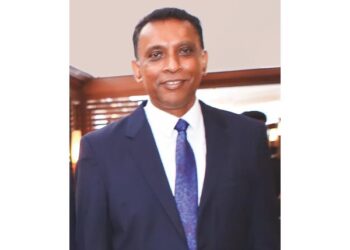

Hatton National Bank rode a remarkable wave of success in the 2024 reporting period, closing the financial year with a profit after tax that was double the previous year’s. Damith Pallewatte, Managing Director and CEO, attributes this success to several key strategic decisions. In an interview with Business Today, Pallewatte reflects on a transformative period for HNB and the Sri Lankan banking sector. Under his leadership, HNB has navigated economic challenges, embraced digital innovation, and strengthened its relationships across corporates, SMEs, and grassroot communities. From leveraging the bank’s subsidiaries to introducing cutting-edge technology and customer-centric solutions, Pallewatte shares the strategic initiatives that have propelled HNB to record profitability and positioned it for sustainable growth.
Words Jennifer Paldano Goonewardane.
Photography Sujith Heenatigala and Dinesh Fernando.
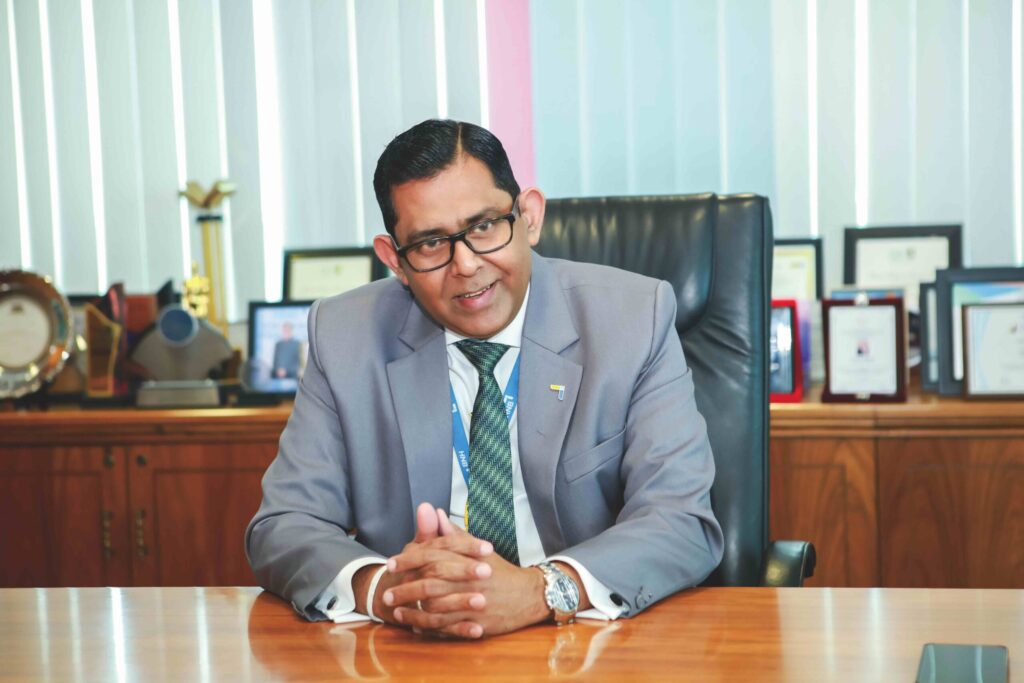
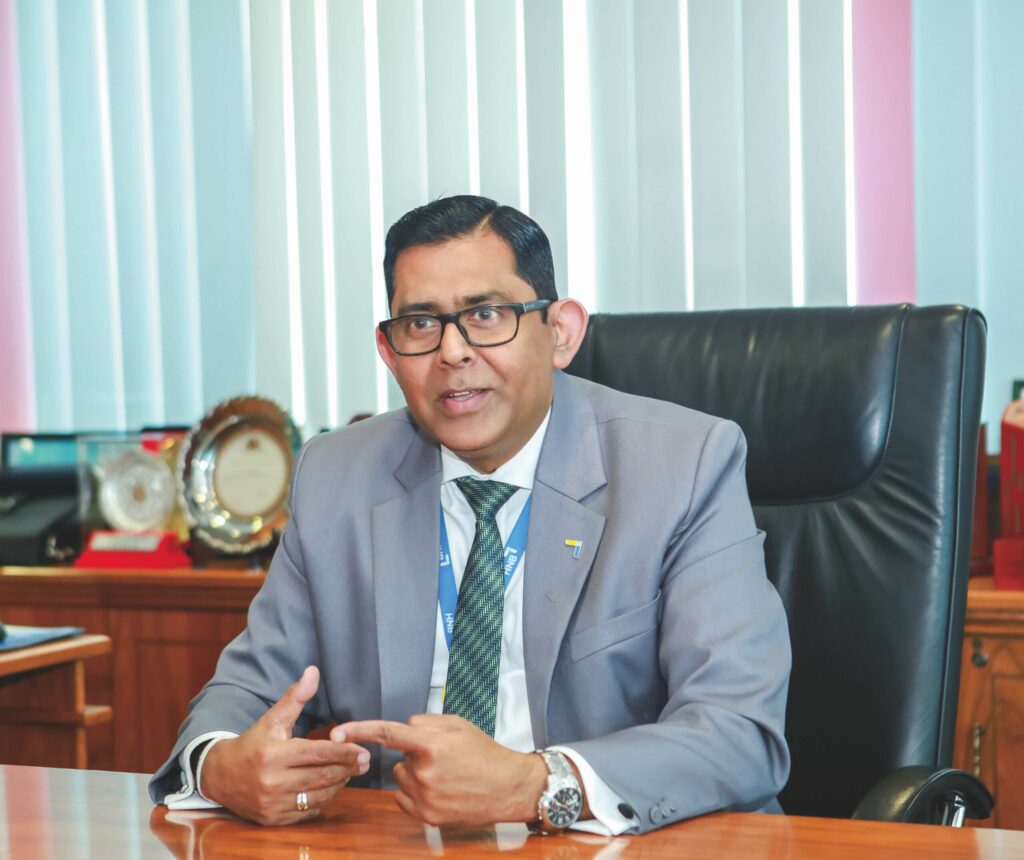
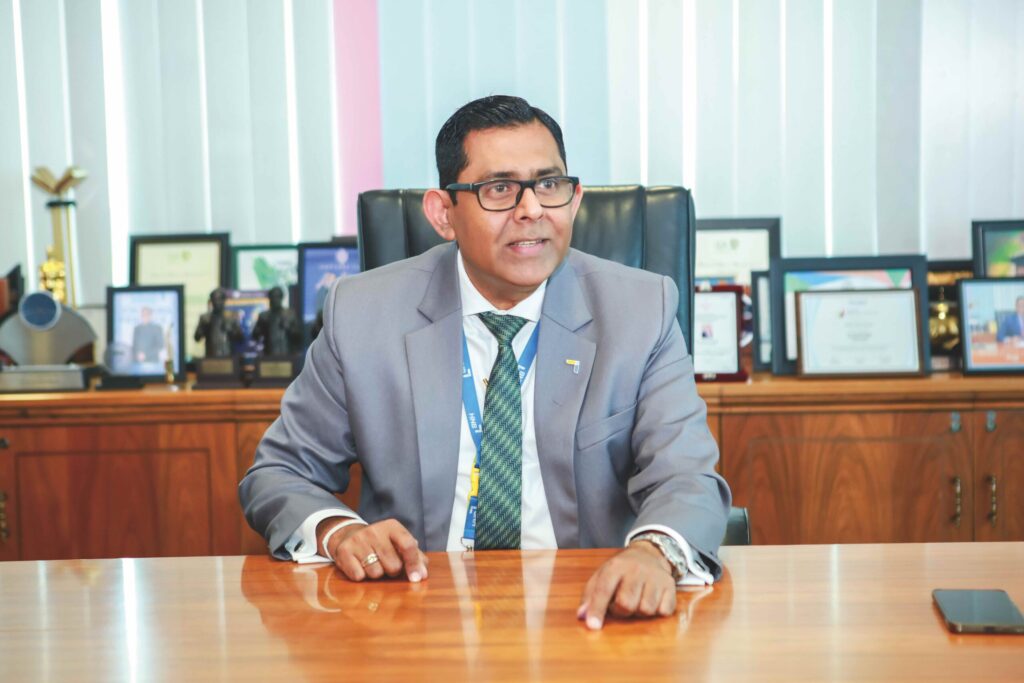
Damith Pallewatte, Managing Director and CEO, HNB.
Twenty-twenty-four was described as a turning point for both Sri Lanka and HNB. Can you pinpoint the key strategic decisions that most significantly contributed to HNB’s sharp rise in profitability in 2024 and its strong start in 2025?
Twenty-twenty-four was indeed a turning point for HNB. We were clear on our role in the economy and the position we wanted to occupy. HNB serves multiple layers of the economy— from corporates and SMEs to retail and microfinance enterprises—and we made a strategic decision to strengthen our presence at the grassroots level. To achieve this, we launched initiatives to rebuild relationships in previously underpenetrated areas. This approach enabled us to integrate supply chain and value chain businesses into our portfolio, significantly increasing connectivity with customers. As a result, we expanded wallet share: clients who previously engaged with the bank in one area now bring multiple business relationships, strengthening both loyalty and incremental profitability.
A second strategic focus was on leveraging the strength of our subsidiaries. HNB is a conglomerate with an insurance arm, an investment bank, and a non-bank financial institution—an advantage no other bank in the country possesses. We capitalized on this by offering holistic solutions. For example, in addition to providing housing loans, we offered home insurance; in addition to lending, we supported clients in raising capital, issuing commercial papers, or bonds. This approach enabled us to offer more comprehensive financial solutions, rather than simply providing standalone loans or overdrafts, which drove profitability and increased client engagement.
We also expanded our services to support customers under pressure. Through our investment banking capabilities, we connected clients looking to sell or dispose of assets with suitable investors, managing the entire process and negotiating deals. This proactive, solution-oriented approach added significant value for our clients while generating business opportunities for the bank—a momentum we expect to continue over the next two to three years.
In January 2025, we acquired the remaining 50 percent stake in Acuity Partners, rebranding it as HNB Investment Bank. With full ownership, we now provide end-to-end investment banking solutions to our customers.
Simultaneously, we have continued to invest in technology to enhance digital banking, offering customers a seamless and fully integrated suite of digitally driven solutions. These strategic decisions—strengthening grassroots engagement, leveraging subsidiaries, supporting customers with tailored solutions, and driving digital transformation—have collectively fueled HNB’s sharp rise in profitability in 2024 and sustained growth into 2025.
In 2024, HNB’s profit after tax nearly doubled compared to the prior year, and early 2025 results show continued strong growth. How much of this performance is driven by macro conditions versus internal operational execution?
While macroeconomic conditions began to recover in 2024 and early 2025, they were not sufficiently supportive
for the banking sector to fully capture the benefits of the improving environment. HNB’s strong performance during this period was therefore driven primarily by focused internal operational execution and strategic initiatives.
One key driver was operational efficiency. Given the scale of our operations, cost management is critical. By investing in digital capabilities, we were able to significantly lower transaction costs, streamline processes, and enhance overall productivity. In parallel, we have been re-engineering processes, centralizing operations, and introducing automation through “bots”—essentially artificial human resources—to handle routine, repetitive tasks. This reduces errors, ensures accuracy, and allows employees to focus on higher-value activities.
We also introduced a “first-time-right” approach, which emphasizes completing customer interactions correctly on the first attempt. Staff are guided on the precise documentation and requirements needed for transactions, and their performance is measured against how effectively they fulfill these requirements. This focus not only enhances operational accuracy but also encourages our teams to become more knowledgeable and customer-or iented, di rec t ly contributing to improved outcomes and efficiency gains.
Additionally, we revamped our organization structure by creating a dedicated innovation vertical, led by a Chief Innovation Officer. This unit focuses on leveraging technology, improving processes, upskilling personnel, and enhancing product features to drive operational efficiency. For example, we launched a facility that allows HNB customers to send money to anyone including non-customers via mobile, which can then be withdrawn at any HNB ATM using an OTP—no account is required. While simple, such innovations enhance customer convenience and engagement, particularly in underserved segments.
By aligning innovation more closely with customer needs, investing in technology, and building a more agile and efficient organization, HNB was able to drive sustainable profitability—well beyond what macroeconomic conditions alone would have facilitated.
Net interest income held up in the first half of 2025 despite pressure on interest margins. What specific pricing and funding strategies did you deploy to achieve this balance?
Net interest margins across the banking sector came under pressure in the first half of 2025, largely due to the shift in balance sheets over the previous two years. During the period of economic stress, many banks— including HNB—increased their exposure to government securities, such as Treasury bills and bonds, which at the time offered very attractive yields. However, from the second half of 2024 into 2025, those yields declined sharply, falling from around 17–18 percent to below eight percent.
At the same time, banks began rotating their asset portfolios back toward loans and advances, which typically generate higher returns. This transition, however, put pressure on net interest margins because deposit costs and overall funding costs did not decline as quickly as lending rates. Market liquidity had increased as banks liquidated government securities, but competition for deposits remained strong, making it difficult to reduce funding costs in line with falling asset yields.
In response, we focused on strengthening our low-cost deposit base, particularly in current and savings accounts, to manage our overall cost of funds. On the asset side, we adopted a cautious and risk-aware deployment strategy.
While SMEs and retail borrowers were beginning to recover, the environment remained fragile in the first half of 2025. We therefore channeled a larger share of funds into corporate lending, which carries lower risk, albeit at a lower yield. As a result, our corporate loan book grew by approximately 15 to 17 percent, well above the normal growth range of around 10 to 11 percent.
This approach allowed us to protect asset quality while continuing to deploy funds productively. As economic activity strengthened toward the end of the second quarter and into the third quarter, we also began increasing our exposure to SMEs, reflecting improved operating conditions in that segment. However, weather-related disruptions later in the year again created challenges for parts of the SME sector, requiring us to remain supportive and cautious.
Overall, in an environment of declining yields and tight margins, our strategy was to balance funding costs, carefully manage risk, and selectively deploy credit. This disciplined approach enabled us to sustain net interest income despite margin pressure during the first half of 2025.
In an environment of declining yields and tight margins, our strategy was to balance funding costs, carefully manage risk, and selectively deploy credit. This disciplined approach enabled us to sustain net interest income despite margin pressure during the first half of 2025.
With capital adequacy ratios significantly above regulatory minimums, how do you plan to deploy excess capital in the near term through lending, dividends, buybacks, or strategic investments?
We view our excess capital in two perspectives. On one hand, it provides a strong cushion and resilience for the Bank; on the other, it represents an opportunity cost, as we currently hold nearly 900 basis points above the regulatory minimum, which underscores the importance of deploying capital in a more productive and growth-oriented way.
Our priority is therefore to use this surplus capital in a disciplined and value-accretive manner. First, it enables us to grow our loan book more quickly than many of our peers. This organic growth is a natural and efficient way to deploy capital, enabling us to support economic activity while enhancing returns.
Second, we are actively exploring strategic investments, particularly with a view to expanding our presence beyond Sri Lanka. We are evaluating opportunities in select regional markets where establishing a footprint would require capital, and our robust capital buffers position us well to pursue such opportunities without compromising stability.
We are therefore highly conscious of our excess capital position and are focused on deploying it in ways that strengthen the Bank’s long-term growth, improve capital efficiency, and create sustainable shareholder value.
Asset quality improvements have been notable. What risk management frameworks or policy changes drove this, and how sustainable are these improvements?
This is a very pertinent question, as the improvement in asset quality reflects the medium to long-term strategies we have implemented since the 2022 economic crisis. When asset quality deteriorated during that period, we undertook a comprehensive strengthening of our end-to-end credit risk management framework.
It begins with our credit underwriting policy, which defines our risk appetite and the types of customers we bring onto the balance sheet. Once a facility is granted, we focus on active monitoring and early identification of stress. We significantly enhanced our processes and procedures to detect early warning signals and intervene before problems escalate.
A key initiative in this regard is the establishment of our Centre of Aspiration, a centralized early-intervention and collections unit. When customers show early signs of stress— such as being a few days or weeks in arrears—the Centre proactively contacts them to understand their situation, engage constructively, and agree on corrective actions. The unit, which currently has around 70 trained staff focusing on the retail segment, has been very effective in helping customers return to regular payment patterns before issues become unmanageable. In parallel, our frontline teams have been trained to identify early warning signs and engage customers promptly, either in person or over the phone.
This is supported by a strong and structured management oversight framework. We have regional recovery heads who report to a central recoveries department at Head Office. They provide monthly updates on recoveries and also participate in dedicated “likely-to-fall” account reviews—accounts that are showing stress but have not yet become non-performing. These accounts receive early and focused at tention to prevent further deterioration.
At the senior management level, I personally review recovery performance twice a month. We segment customers based on the stage of delinquency, which allows us to allocate resources more effectively. Recent defaulters, for instance, have a significantly higher probability of recovery and therefore require different strategies from long-standing defaults, where legal or exit strategies may be more suitable. This segmentation gives us clarity, focus, and efficiency in managing recoveries. Through these measures, we have established a robust and sustainable asset quality framework. We have invested in systems, upskilled our personnel, and implemented robust processes. This positions HNB well to support future credit growth while maintaining strong asset quality over the long term.
HNB has emphasized a digital-first strategy. What are the next major digital initiatives or technology investments we should expect—and how will they enhance customer value and operational efficiency?
Over the past 12 to 15 months, HNB has made significant investments in upgrading its digital infrastructure, particularly in transaction banking and trade finance. We have implemented a best-in-class transaction banking platform for corporate customers, along with an internationally benchmarked trade finance platform that was rolled out in May 2025. These systems enhance efficiency, transparency, and turnaround times for corporate clients, aligning HNB with global standards. On the retail side, we have introduced fully digital onboarding, allowing customers to open accounts remotely through video-based KYC without visiting a branch. Once onboarded, customers can open additional savings accounts and fixed deposits, as well as access a wide range of services directly through the mobile app.
One of our most successful recent innovations is the ability for customers to borrow against their fixed deposits digitally. Customers can access up to 90 percent of the value of their fixed deposit instantly through the app, without any paperwork. The funds are credited immediately and can be repaid at any time. The response has been exceptional—within three weeks of launch, we recorded approximately three billion rupees in disbursements— demonstrating the strong demand for simple, frictionless digital credit. This has laid a very good foundation for our envisaged future digital lending propositions.
Our digital strategy is driven by a deep understanding of customer pain points, and every solution is designed to make banking faster, easier, and more convenient. As these pain points are addressed, customer engagement and loyalty naturally increase.
Our next major digital initiative will be the introduction of a comprehensive wealth management proposition within the HNB mobile app. This will allow high-net-worth and premier customers to manage their entire financial portfolio in one place—from equities, treasury bills, and bonds to venture capital and insurance products. Leveraging the full capabilities of our investment banking, stockbroking, and insurance subsidiaries, customers will be able to move and allocate their wealth seamlessly across multiple asset classes.
This integrated digital wealth platform will be unique in the local market and is the result of extensive customer research. It represents the next phase of our digital-first strategy— one that moves beyond transactions and leading to delivering a complete, end-to-end financial management experience.
How do you balance the pursuit of profitability with affordable financing for businesses and consumers still recovering from economic stress?
Balancing profitability with affordable financing requires a very deliberate and disciplined approach. At HNB, we ensure that funds are allocated to the right segments based on risk, need, and economic impact. A customer seeking support to recover from stress is assessed differently from one pursuing expansion or overseas growth. This is guided by our risk-based pricing framework, which evaluates the risk profile of each customer and determines how credit is priced and deployed.
We recognize that our shareholders expect a reasonable return on the capital they have entrusted to us, and we must therefore maintain a sustainable level of return on equity too.
At the same time, as a domestic systemically important bank, we have a responsibility to support the backbone of the Sri Lankan economy—small and medium enterprises. SMEs contribute more than half of the national GDP, and HNB serves approximately quarter million SME and microfinance customers. Supporting them through periods of stress is not optional; it is central to our role in the economy.
Our strategy, therefore, is to provide relief and flexibility to those who genuinely need it, while also serving customer segments that can bear market-based pricing. This balanced portfolio allows us to continue supporting vulnerable sectors without compromising overall profitability.
In addition, when net interest margins come under pressure, we place greater emphasis on growing non-interest income through fees and commissions. This is one of the key reasons we have invested heavily in digital banking platforms. These platforms improve convenience and efficiency for customers, while also generating sustainable fee-based income. Although the technology itself is costly to build and maintain, the resulting growth in non-interest revenue has helped us preserve profitability even in a low-margin environment.
With global banks exiting retail operations locally, do you see this as an opportunity for HNB to expand market share? How aggressively might you pursue that?
We do see the exit of global banks from local retail operations as a market opportunity. However, our approach is disciplined. While we are keen to grow, we believe that any market share gained must be acquired at the right price and on the right terms. Our strategy is therefore to expand organically and build these relationships at a sustainable cost structure, rather than acquiring business at a premium from exiting multinational banks.
That said, we understand the profile and expectations of the customers served by these institutions. People typically bank with multinational banks for specific reasons—such as service standards, product sophistication, global access, and reliability—and we believe HNB has the product suite, infrastructure, and service capability to meet and, in many cases, exceed those expectations. As these customers seek new banking partners, they will look for institutions they can trust and rely on for consistent and high-quality service. HNB’s strong reputation for trust, stability, and customer service positions us well to attract and retain a meaningful share of this segment.
It is also important to note that many of these customers are multi-banked and highly discerning. They will evaluate and compare options carefully before deciding where to place their trust and confidence. We are confident that our value proposition, combined with our scale, digital capabilities, and customer focus, gives us a strong opportunity to win their confidence and expand our market share in a sustainable manner.
What steps is HNB taking to strengthen corporate culture, attract talent, and build leadership capabilities for the next decade?
HNB has adopted a comprehensive and highly structured approach to strengthening its corporate culture, attracting top talent, and developing leadership capabilities for the next decade.
We have made significant investments in people development, guided by rigorous external benchmarking. Last year, we engaged two leading international human resource consultancies—Cerberus Consultancy and Mercer—to conduct a detailed review of our job architecture, role clarity, grading, compensation structures, career pathways, and progression frameworks. This exercise ensured that our employees clearly understand what is expected of them, how they can grow, and how their performance is rewarded.
A key outcome of this process was our shift from a predominantly fixed-pay culture to a performance-based remuneration framework. Previously, only about 17 percent of our workforce was on performance-linked pay. Today, that figure has increased to 41 percent. This means a much larger proportion of our staff now has a direct incentive to contribute to the Bank’s success, driving greater accountability, engagement, and performance across the organization.
We have also modernized our performance management and career development systems. As a 137-year-old institution, HNB has traditionally benefited from long-term employee loyalty.
While this remains a strength, workforce dynamics have changed, particularly with younger generations who value flexibility and mobility. In response, we have standardized roles below certain levels, allowing people to join for defined periods, contribute productively, and move on without disrupting operations. This has enabled us to manage talent flows more efficiently, price roles more accurately, and remain competitive in attracting younger professionals.
At the same time, we have created clear and transparent career paths for those who wish to build long-term careers with the Bank. Employees now have visibility into how they can progress, the qualifications required, and the competencies needed to advance within the organization. This transparency enables individuals to plan their careers effectively and motivates them to invest in personal development.
Recognizing that automation and digitization are reshaping the global banking industry, we have also focused on upskilling our staff and ensuring that HNB remains an attractive employer of high-quality talent.
We have drawn on international best practices and expertise to ensure that our human resource framework is aligned with the evolving nature of the financial services industry.
In addition, we have modernized our organizational structure and designations, replacing outdated, hierarchical titles with a more agile and contemporary framework, such as Vice President, Senior Vice President, and Executive Vice President. This creates clearer career trajectories and reinforces a more dynamic, performance-oriented culture. These initiatives have positioned HNB with a modern, adaptable, and motivated workforce equipped to support the Bank’s growth and leadership ambitions over the next five to ten years.
HNB measures and manages its contribution to inclusive economic growth through a structured and data-driven approach, with a particular focus on underserved and vulnerable communities. We are the market leader in microfinance, with a portfolio of nearly 50 billion rupees and over 150,000 customers in low-income and underserved segments.
How does HNB measure and report its contribution to inclusive economic growth, especially in underserved communities?
HNB measures and manages its contribution to inclusive economic growth through a structured and data-driven approach, with a particular focus on underserved and vulnerable communities. We are the market leader in microfinance, with a portfolio of nearly 50 billion rupees and over 150,000 customers in low-income and underserved segments. Our “barefoot bankers” work directly in these communities, often travelling by motorbike to remote areas to support agriculture, cottage industries, and small enterprises, ensuring financial services reach even the most inaccessible parts of the country.
Our approach to inclusion and sustainability is overseen by a dedicated sustainability unit that monitors and reports on inclusivity, diversity, corporate social responsibility, and ESG-related activities. These are tracked through structured dashboards that allow us to measure the scale, impact, and sustainability of our interventions.
One of HNB’s most important inclusion initiatives is Gami Pubuduwa, launched in 1989 in the aftermath of the youth unrest to support rural entrepreneurship. In 2024, as we marked 35 years of this program, we introduced HNB Sarusara, a new proposition focused on transforming farmers into Agripreneurs rather than simply improving traditional farming practices. Through this program, farmers are provided with solutions covering both advisory and financial for improved seeds, fertilizers, equipment, and technology, and are also directly connected to markets, eliminating intermediaries and enhancing their income and margins.
Under Sarusara, we have set a clear and measurable target of converting 30,000 farmers into agripreneurs within three years. Since the program began in July 2024, we have already reached approximately 15,000 farmers nationwide and are actively monitoring their progress while providing advisory and technical support.
We also track the broader social impact of these initiatives. Increased and more stable income leads to higher savings, better investment in education, improved housing, and greater financial discipline, which in turn contributes to stronger families and more resilient communities. These outcomes are central to our definition of inclusive growth.
Looking toward the second half of 2025 and beyond, what are your top three strategic priorities for HNB?
Looking ahead, HNB’s strategy is centered on three key priorities.
First, we are focused on significantly strengthening our support for small and medium enterprises. This will be done in two ways. We are actively seeking low-cost funding lines from multilateral and donor agencies to provide SMEs with more affordable financing. In parallel, through our investment banking arm and our venture capital company, Lanka Ventures, we are exploring the establishment of an equity fund to support high-potential SMEs through equity participation rather than debt.
This will allow us to back promising businesses without increasing their leverage, thereby supporting more sustainable growth.
Second, digital transformation remains a major strategic priority. We are committed to bringing technology to SME and microenterprise customers in ways that meaningfully reduce their operating costs and improve efficiency. For many of these businesses, costs currently consume a disproportionate share of earnings. By introducing digital tools and platforms, we aim to help them retain more of what they earn, improve productivity, and strengthen their long-term viability.
Third, we are pursuing strategic expansion, including inorganic growth opportunities beyond Sri Lanka. We believe the timing is right, as we have the capital strength, institutional capacity, and a supportive environment to do so. Geographic diversification is essential to reducing reliance on a single economy. Currently, HNB’s revenue is entirely derived from Sri Lanka, which exposes us to the domestic economic cycles. By expanding into other markets, we can create more stable and resilient earnings through diversified revenue streams.
In your view, what are the greatest risks and opportunities for Sri Lanka’s banking sector over the next 24 months—and how is HNB positioning itself accordingly?
Sri Lanka’s banking sector faces both signif icant oppor tunities and meaningful risks, and HNB is positioning itself to manage both in a disciplined and forward-looking manner.
On the opportunity side, the country is targeting economic growth of over five percent, which implies strong demand for credit. Banks play a critical role in financing this expansion across businesses, consumers, and key growth sectors. In parallel, Sri Lanka’s ambition to build a 15 billion USD digital economy by 2030 presents a major opportunity for the banking sector. Digital commerce and digital services cannot scale without efficient payment systems and digital financial infrastructure. Banks, therefore, must continue to invest in digitizing their platforms, enhancing payment systems, and facilitating seamless financial transactions throughout the economy. HNB sees this as a core growth driver and is investing heavily to support this transition.
At the same time, several risks must be carefully managed. The first is liquidity. In a low-interest-rate environment, funds tend to shift away from bank deposits into alternative asset classes, such as equities or government securities, depending on the relative returns. While liquidity is currently adequate, sustained credit growth requires stable and sufficient funding to support it. Banks must therefore remain vigilant in managing their liquidity positions to ensure they can continue supporting loan growth.
The second major risk is asset quality. As credit demand rises, there is always the temptation to accelerate lending. However, rapid growth without disciplined underwriting can lead to poor credit quality and higher impairments, ultimately undermining both bank profitability and the broader economic recovery. HNB has therefore focused on strengthening its risk management, credit evaluation, and early warning systems to ensure that growth remains sustainable.
A third risk is exchange rate volatility. Since early 2025, the rupee has depreciated by around 15-20 rupees against the US dollar, and further pressure may continue. While exporters benefit from a weaker currency, Sri Lanka is a highly import-dependent economy; therefore, depreciation increases the cost of imports, putting pressure on inflation and external balances.
In this context, HNB strongly supports investment in renewable energy—such as solar, wind, and hydro—as reducing reliance on imported fuel can significantly lower the country’s dollar outflows and help stabilize the exchange rate.
Finally, talent retention is an emerging sector-wide risk. Over the past few years, a significant number of skilled banking professionals have migrated overseas, resulting in gaps in experience and leadership within institutions. This raises operational risk and increases training and recruitment costs.
HNB is addressing this by investing in people, offering career development, implementing performance-based rewards, and adopting modern organizational structures to retain and develop critical skills.
What can you tell us about team- HNB?
HNB is supported by a highly dedicated and professional team that consistently goes beyond the call of duty in serving our customers. They are deeply customer-centric, and despite the inherent challenges of service delivery, their commitment to excellence and responsiveness remains strong. Over the past two years, we have made significant progress in enhancing customer experience by adopting a more structured, data-driven, and scientific approach. We have appointed a Chief Customer Experience Officer who oversees and integrates customer journeys across all channels, ensuring consistency and quality of service.
Supported by a robust digital ecosystem—including mobile and internet banking platforms as well as social media engagement tools—our teams are fully trained to operate these systems and deliver a seamless, high-quality experience. This combination of dedicated people, strong governance, and advanced digital capabilities enables HNB to serve customers efficiently and reliably across every touchpoint.
How do you ensure customers experience a uniform service across all channels?
We are committed to ensure a consistent and uniform customer experience across all channels through a strong focus on people, culture, and continuous learning.
We have a highly experienced workforce supported by a performance-driven and learning-oriented culture. Our teams are continuously trained not only on products and services but also on regulatory requirements, ensuring they can provide accurate, reliable, and consistent guidance whether a customer engages with us in a branch, via call center, or through digital channels.
Employee retention and experience play a critical role in this consistency. While we have observed some generational shifts at junior levels, overall our retention rates remain strong, allowing staff to gain long-term experience and become deeply familiar with HNB’s culture and operational standards. This enables them to perform efficiently and consistently while collaborating across teams.
We also invest in upskilling our people so they fully understand the regulatory and operational frameworks within which we operate. For example, staff must be able to advise correctly on matters such as foreign currency account eligibility. This structured approach to training, combined with a cohesive strategic direction and a collaborative work environment, ensures that HNB delivers a uniform, high-quality service across all customer touchpoints.
In essence, our people, culture, and continuous learning form the backbone of a consistent customer experience, which we consider one of HNB’s greatest strengths.