
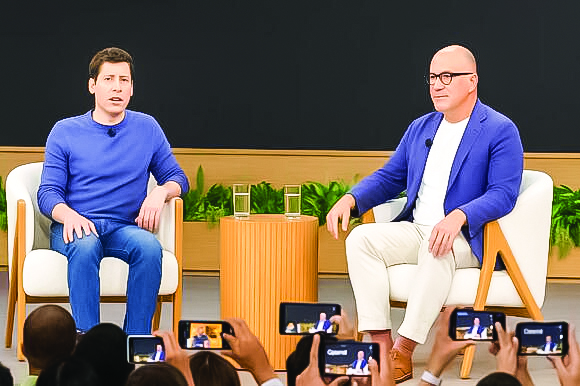
Sam Altman, CEO of OpenAI and Sir Jony Ive, designer.
Where Artificial Intelligence meets Human-Centered Design
On October 6, 2025, in San Francisco, the spotlight at OpenAI DevDay shifted from product announcements to a dialogue that could define the next era of computing. It wasn’t a launch or demo; it was a meeting of minds — Sam Altman, CEO of OpenAI, and Sir Jony Ive, the legendary designer behind the iPhone, Apple Watch, and countless design icons.
The session was titled simply: “A Conversation with Sam and Jony.” Yet what unfolded was far from simple. It was a visionary exchange that explored how artificial intelligence and human design could converge to redefine our relationship with technology itself.
Vision Before Form
Sam began by noting OpenAI’s astonishing scale — millions of developers, hundreds of millions of users, and billions of tokens processed every minute. But numbers, he said, were not the story. “If we can do anything with AI,” he asked, “how do we ensure we do the right things, at the right time — for people?”
Jony’s reply set the tone for the evening. After Apple, he and his team at LoveFrom had been reflecting deeply on humanity’s uneasy bond with its own inventions. “I don’t think we have an easy relationship with our technology at the moment,” he admitted. “That’s the most obscene understatement.”
Technology, he argued, has outpaced our emotional capacity to integrate it meaningfully into our lives. For him, AI represents a second chance — an opportunity to design technology that feels humane again.
“With the launch of ChatGPT, our purpose became clear. Technology had finally caught up to our design ambitions,” said Jony Ive
“They should make us happy and fulfilled, more peaceful and less disconnected.”
Designing for Emotional Well- Being
Unlike typical discussions about AI focused on speed, accuracy, or scale, Sam and Jony turned the conversation toward emotional intelligence. Jony spoke passionately about creating AI companions that help people feel calm, connected, and fulfilled — devices that reduce anxiety rather than amplify it. “They should make us happy and fulfilled, more peaceful and less disconnected,” he said, to quiet applause.
Sam nodded in agreement. “We’ve built systems that are fast and capable,” he said, “but if you can’t live with them day to day, it doesn’t matter.”
For OpenAI, this shift is profound. It signals that the next frontier is not about how much AI can do, but how it makes us feel.
“The next great leap won’t be about performance — it’ll be about peace of mind,” said Sam Altman.
The OpenAI–LoveFrom Alliance
Earlier in 2025, OpenAI formally acquired Jony Ive’s hardware startup, io, in a deal valued at over six billion dollars.
The move was not merely a business transaction; it was a merging of two philosophies — the engineer’s quest for intelligence and the designer’s pursuit of empathy.
Sam described it succinctly: “AI is an incredible technology, but great tools require work at the intersection of technology, design, and understanding people and the world.”
For Jony, this partnership felt like destiny. “Everything I’ve learned over the last 30 years has led me to this moment,” he said. “We want to bring back the sense of delight, wonder, and creative spirit that technology once inspired.”
From Screens to Senses
When asked what form this new class of AI hardware might take, the two became deliberately vague — yet deeply suggestive.
Jony hinted that the future may not center around screens at all. Instead, he described a world of ambient intelligence — where voice, perception, and presence become the interface. Devices, he said, should not demand attention but gracefully dissolve into daily life.
Sam elaborated on the challenge: “Hardware is hard. Getting it right means patience, precision, and deep empathy. We’re not chasing a single gadget. We’re exploring a family of experiences.”
Insiders suggest the team has brainstormed nearly twenty distinct product directions, from AI companions to wearable interfaces. “The challenge now,” Jony smiled, “is to focus.”
“Momentum is extraordinary. We’ve generated twenty compelling ideas — the real test is knowing what not to build,” said Jony Ive.
Beyond Devices: A Philosophy for the Future
Perhaps the most profound moment of the evening came when Jony reflected on the emotional toll of digital life.
“We’ve created machines that compete for our attention,” he said. “What if we created ones that give it back?”
The idea resonated far beyond design. It touched a nerve in a room filled with executives, investors, and innovators — a call to reimagine technology not as a demand, but as a companion.
Sam closed the conversation with quiet conviction: “We’re not building tools for faster work. We’re building tools for better living.”
Leadership Takeaway: Building With Empathy
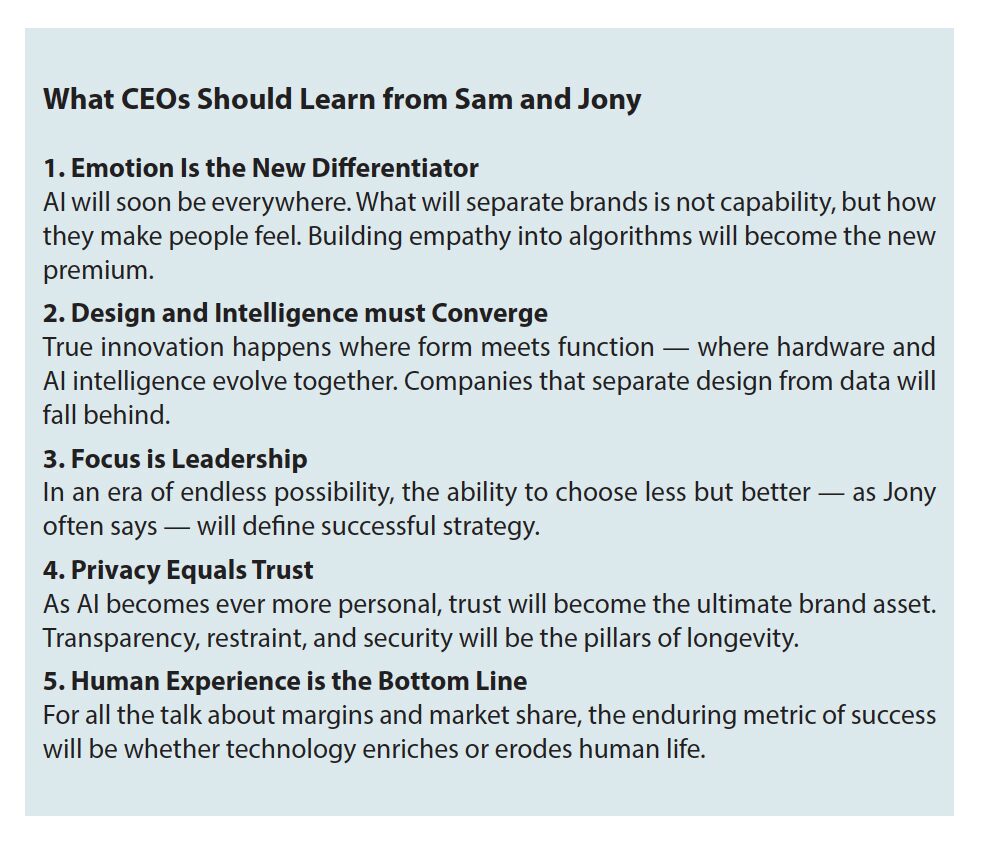
The Sam-and-Jony conversation was less about unveiling a product and more about unveiling a philosophy. It asked every company — whether in AI, finance, or manufacturing — to pause and ask: Are we creating technology that serves people, or the other way around?
If the last decade belonged to the engineers who built intelligence, the next may belong to the designers who give it soul.
“Building with intelligence is necessary. Building with empathy will be indispensable.”