
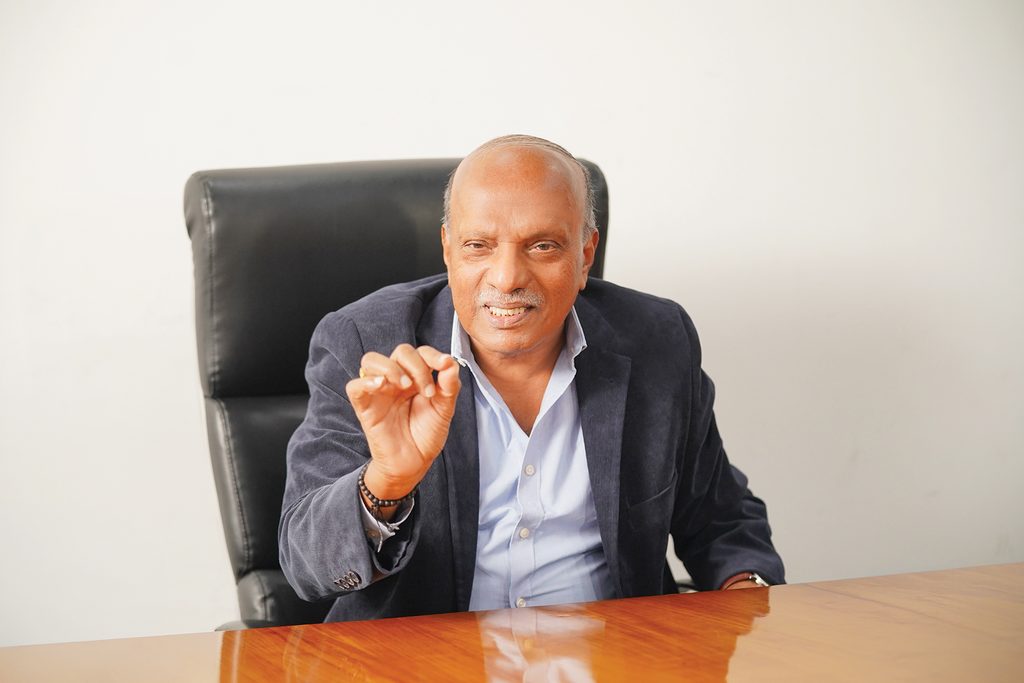
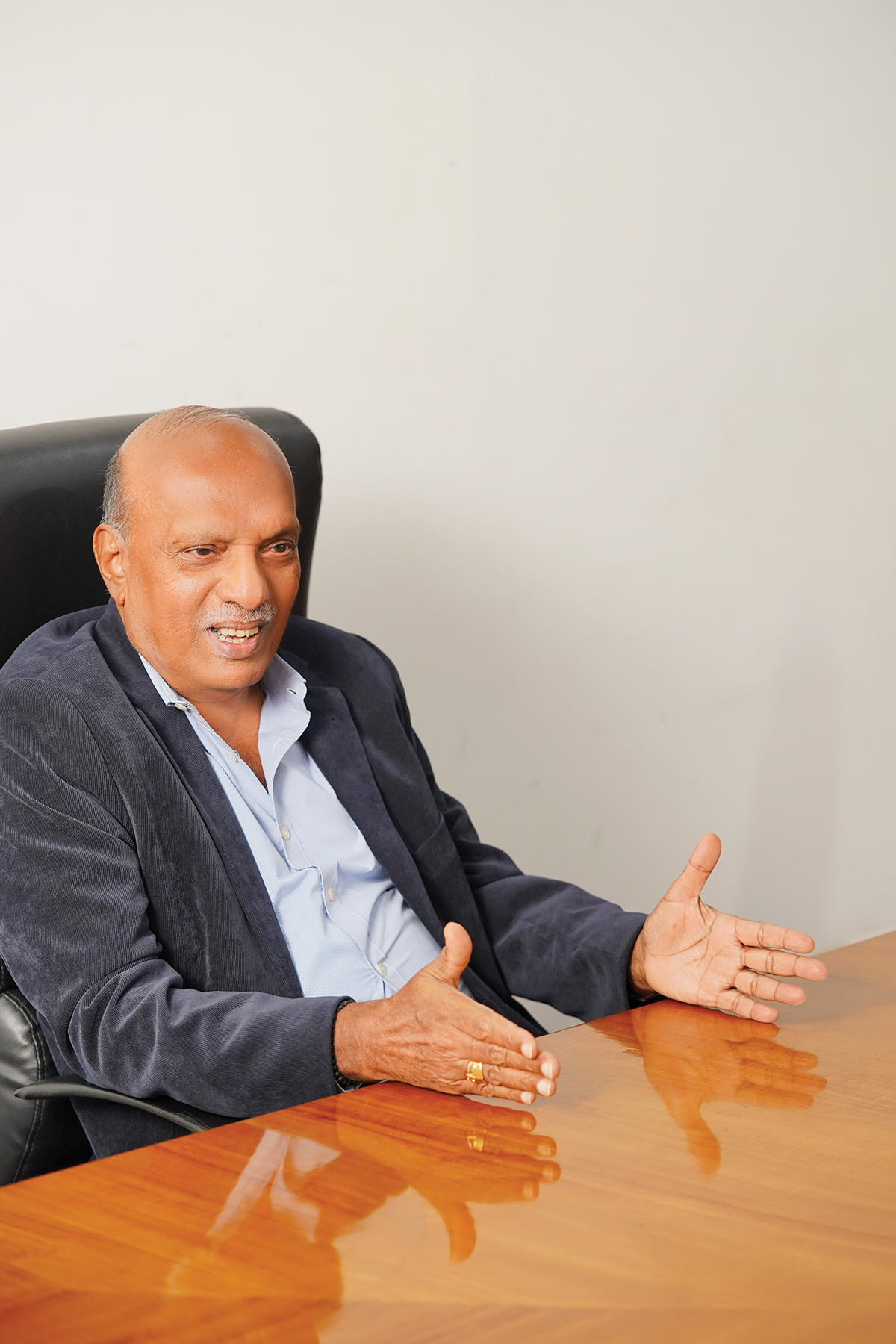
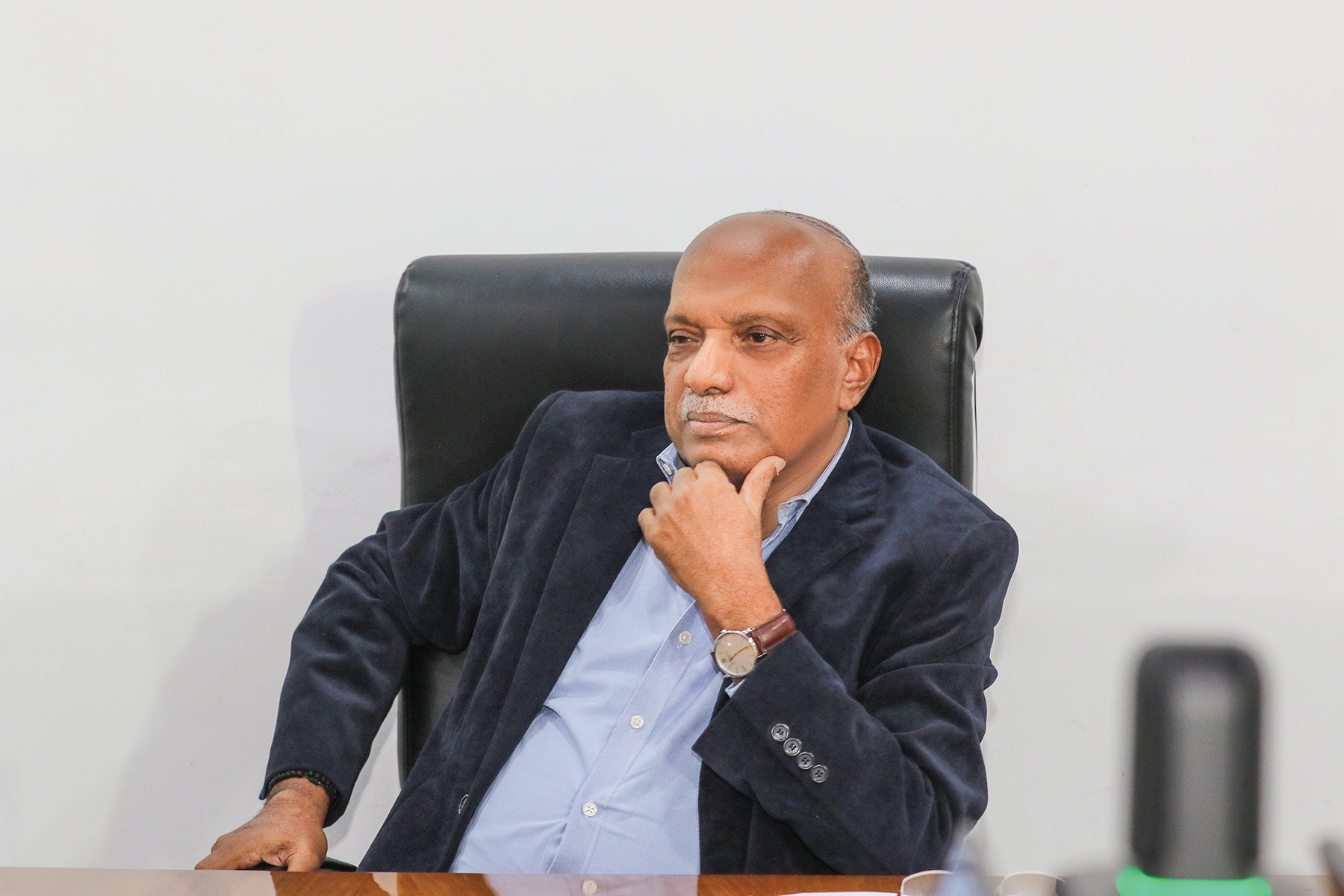
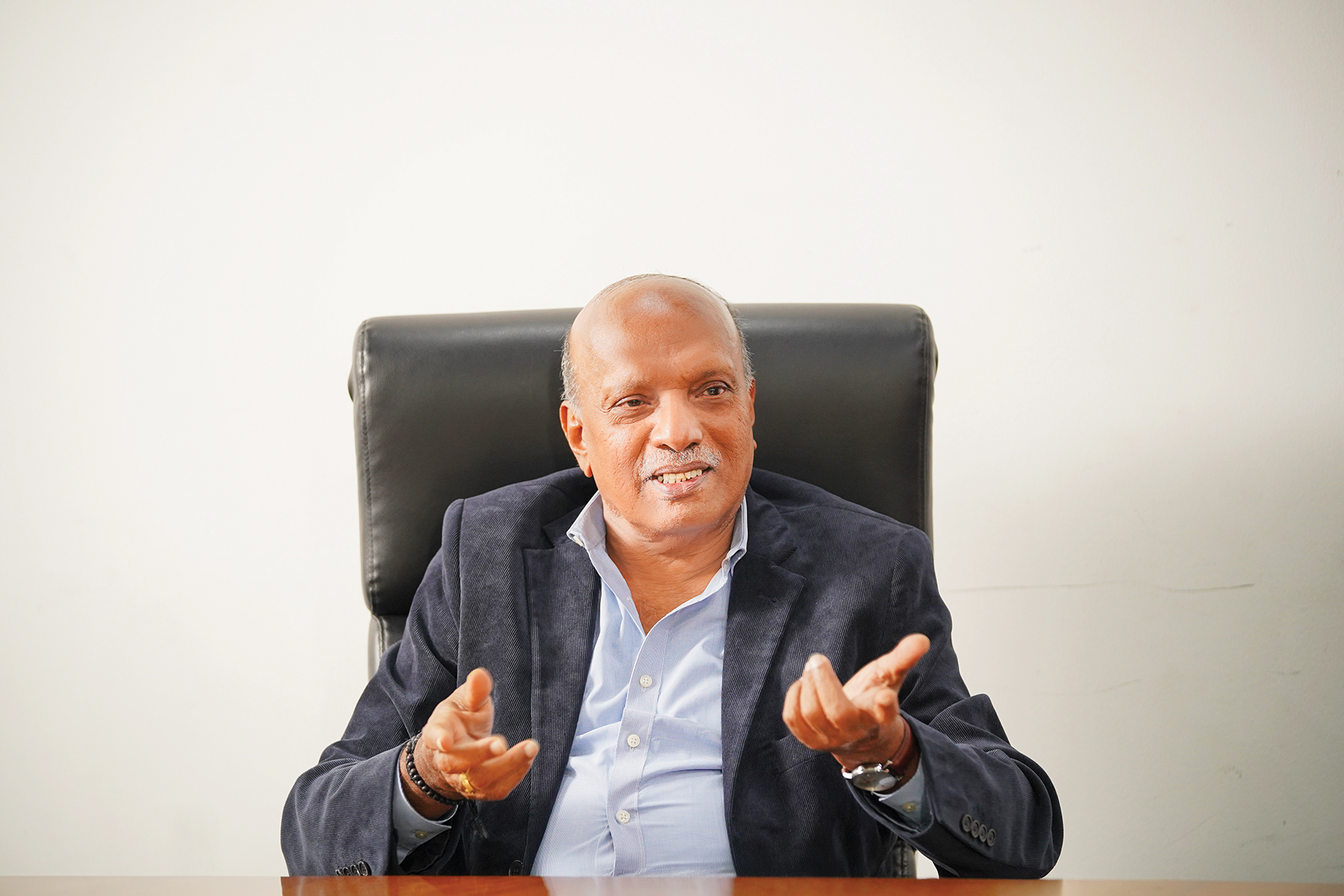
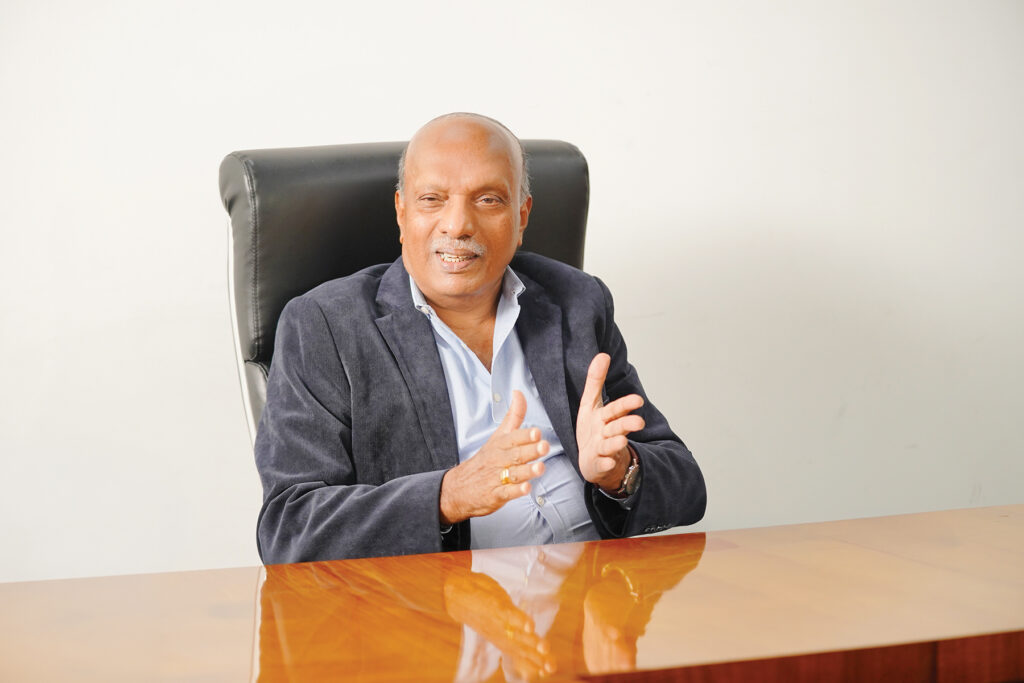
Ranjith Gunatilleke, Chairman, SANKEN GEN.
With nearly five decades of experience in the construction industry, Ranjith Gunatilleke, Chairman of SANKEN GEN, has witnessed the evolution of Sri Lanka’s construction sector. Rooted in the discipline and technical expertise of Japanese construction practices, the Group has evolved into an international enterprise, executing projects across diverse markets.
The establishment of SANKEN GEN as an independent international group marks a new chapter, strengthening overseas operations and empowering the next generation of leadership.
Speaking with Business Today, Ranjith Gunatilleke shares his perspectives on diverse areas connected to the construction industry. A career in the military and working with Japanese management has ingrained in him the importance of discipline, integrity, and sound leadership.
Words: Jennifer Paldano Goonewardane.
Photography: Rasanga Dissanayake and Dinesh Fernando.
SANKEN GEN has evolved from a Sri Lankan operation established under Japan’s Mitsui Construction Company into an international group with a presence across multiple regions. Looking back, what were the defining decisions that shaped this transformation, and which proved most consequential to its long-term success?
Although Japan’s Mitsui Construction commenced operations in Sri Lanka in 1977, my direct involvement began in 1979, when the company was contracted to construct the new Parliament complex. That project marked an important beginning for me and laid the foundation for my subsequent growth.
Over the years, the company underwent several transitions, beginning as Sanken Mitsui Construction Lanka, then Sanken Lanka, and finally Sanken Construction, before evolving into what is now SANKEN GEN.
However, beyond these changes in identity and the expansion of our operations, the foundation of our success has remained unchanged. It is the discipline we inherited from the Japanese, which became deeply embedded in our working culture. That discipline, reflected in everything we do, has been fundamental to our growth and long-term success.
What did the transition to full Sri Lankan ownership and leadership require in terms of institutional capability, management culture, technical expertise, and financial independence? How did you ensure that the standards and discipline associated with the company’s Japanese origins were retained?
I joined Mitsui Construction in 1979 as Chief Engineer. From the beginning, I had the opportunity to work closely with the Japanese management team and experience firsthand their approach to business and engineering.
The Japanese maintained exceptionally high standards, whether in technical matters, commercial dealings, or the overall management of the organization. Beyond contractual obligations and formal agreements, they placed tremendous importance on trust, integrity, and discipline. These were principles that shaped the company from its earliest days and continue to guide us.
When Sanken Lanka was established in 1984, the Japanese remained directly involved in its management. Until 2002, the Managing Director and the Board were led by Japanese representatives, while I served as a Director. I assumed the position of Managing Director in 2002. Even after that transition, we continued to have a Japanese Director on the Board, although not from Mitsui Construction, to preserve the management philosophy and values that had become integral to the organization.
I have enormous respect for the Japanese approach to management. Their commitment to discipline, responsibility, and maintaining high standards is quite remarkable. I believe that retaining these values throughout our transition to Sri Lankan leadership has been one of the most important reasons for our success.
Before joining Mitsui Construction, I served in the Army as a professionally qualified engineer. The discipline I experienced in the Army during the 1970s was very similar to what I encountered in Japanese management. Therefore, adapting to that working culture came naturally to me.
Punctuality, loyalty, commitment, and accountability were not considered additional expectations. They were fundamental responsibilities of the job. That was the culture we established and continued to uphold.
Our Sri Lankan engineers joined the company with strong academic qualifications and technical knowledge acquired through our universities. Working within Sanken gave them the opportunity to combine that knowledge with the discipline and professional standards of the Japanese system. Over time, these principles became part of the organization’s culture, which continues to define how we operate today.
The establishment of SANKEN GEN as an independent international group represents a significant structural change. What prompted this transition, and how will the new structure strengthen the Group’s international operations while creating opportunities for the next generation of leadership?
The fundamental principles of our organization, particularly discipline, commitment, and our approach to business, have not changed. I remain a shareholder of Sanken Construction while serving as Chairman of SANKEN GEN. What has changed is the structure through which we intend to pursue future growth.
As Sanken Construction expanded, we recognized that success depended on financial strength and technical expertise. I have always believed in specialization, whether in infrastructure development, piling, or other construction activities. Specialized work must be undertaken by people with the necessary expertise, rather than by a jack-of-all-trades.
The period from 2019 to 2026 has been particularly challenging for Sri Lanka’s construction industry, with financial difficulties compounded by the pandemic and economic crisis. Although we began expanding overseas in 2003, there was less urgency then because the domestic industry was performing well. The challenges of recent years reinforced the importance of international expansion.
However, operating internationally requires greater independence in decision-making. Those managing overseas projects must have the authority to act promptly because delays can have serious financial and operational consequences.
This was a principal reason for restructuring. We wanted to empower the next generation of leadership, giving my son and his team the independence and responsibility to take the business forward.
My son, Mevan Gunatilleke, is professionally well qualified, perhaps even more so than I am, although experience naturally comes with time. Leadership transitions are inevitable, but succession is not merely about passing responsibility from one generation to another. It is about building confidence among younger professionals and providing them with capable, disciplined leadership. I believe my son is ready to take on that responsibility.
SANKEN GEN’s new structure brings together operating companies within a wider network, allowing them to draw on shared financial resources, technical expertise, and operational capabilities. How will this collaborative model strengthen the Group’s competitiveness and support its international expansion?
In the construction industry, growth can take place both vertically and horizontally. However, expansion in either direction requires substantial financial resources and technical capabilities.
In Sri Lanka, companies generally depend on banks and other financial institutions to support their expansion. At the same time, they must invest in technology, research, and specialized expertise to remain competitive. Developing all these capabilities independently is not always practical, particularly when several companies are operating in different areas of construction.
Consider a group of five companies. They will not necessarily grow at the same pace or achieve the same level of success at any given time. One company may be performing exceptionally well, while another may require additional financial assistance, technical support, or management expertise. The strength of a group structure is that these companies can support one another rather than operate entirely independently. That is the thinking behind our approach. We want the companies within the Group to benefit from each other’s strengths. The company with the greater resources or capabilities at a particular time can provide support to others, enabling the entire network to grow.
As SANKEN GEN expands its international operations, it will also be in a stronger position to provide financial and technical support to other companies within the Group. Sanken Construction, for instance, is primarily engaged in domestic construction, whereas SANKEN GEN is focused on opportunities beyond Sri Lanka.
The scale of international operations can create significant advantages. If our domestic operations can employ 5,000 people, while our international operations create opportunities for 10,000 people with better remuneration and greater exposure, naturally, the international business will become an increasingly important source of strength for the Group.
What additional capabilities must Sri Lankan contractors develop to compete successfully in overseas markets, particularly in managing financial, regulatory, and contractual complexities?
International construction is a complicated business because you must manage challenges both within the organization and in the external environment. There is a Sinhala expression, “Anto Jata, Bahi Jata,” which refers to internal and external complexities. The challenge is knowing how to manage both successfully.
When Sri Lankan companies venture overseas, they must navigate different financial and regulatory environments. We must comply with Sri Lanka’s Central Bank regulations while understanding the laws and financial systems of the countries in which we operate. For instance, companies in financially stronger economies such as Japan may enjoy greater flexibility in transferring funds internationally, whereas Sri Lankan companies face restrictions shaped by our economic circumstances.
Beyond finance, technical specifications, safety standards, and contractual obligations differ across markets. In Sri Lanka, we are familiar with the regulatory framework of the Construction Industry Development Authority (CIDA). Internationally, however, we must understand frameworks such as the FIDIC conditions of contract, including performance bonds, guarantees, warranties, and retention payments. These directly affect a project’s financial viability and successful execution.
We cannot approach international business with a limited understanding of how the industry operates beyond Sri Lanka. We must be familiar with international standards, practices, and expectations.
This also highlights the importance of developing our professionals. A young engineer may graduate with excellent technical knowledge, but a university degree alone cannot provide the practical experience required to manage complex international projects. Overseas, professional credibility depends on knowledge, experience, and the ability to deliver.
Sri Lankan engineering graduates are highly capable, and I believe their technical knowledge compares favorably with international standards. However, technical competence must be complemented by discipline, loyalty, commitment, and professional responsibility. These are qualities we have consistently sought to instill within our organization through training, mentoring, and experience. Our responsibility is to continue developing professionals who can meet the demands of international construction.
Over the past five years, the Group has executed a project portfolio valued at approximately USD 900 million across seven countries. What does this experience reveal about the competitive strengths Sri Lankan construction companies can bring to international markets, and what challenges must they overcome to compete with larger global players?
One of our biggest challenges is access to finance. Sri Lanka’s limited foreign exchange reserves and restrictions on overseas investment place local companies at a disadvantage relative to international competitors with greater financial capacity.
However, the Government has introduced some flexibility, considering certain investments on a case-by-case basis. I believe this is necessary because when a company can demonstrate that an overseas investment will generate returns and bring foreign exchange into the country, it should be encouraged. For instance, investing USD 100 million to generate USD 120 million is a commercially sound proposition. Of course, such flexibility must be accompanied by accountability to prevent misuse.
Despite these financial constraints, Sri Lanka has a significant competitive advantage in its human resources. We have highly qualified engineers, quantity surveyors, lawyers, and other professionals whose expertise is available at competitive costs. This does not mean we undervalue them. Our free education system has produced a technically competent workforce, and that is a national investment whose value we must recognize. I believe our professionals can compete with, and in many instances surpass, their international counterparts.
However, we must understand the realities of different markets. The opportunities, working environments, and acceptance of professionals from our region vary considerably between countries such as India and the United States. We must identify where our capabilities can be most effectively utilized.
Our strength is combining technical expertise with competitive costs, enabling us to undertake international projects and generate foreign exchange. But we need the financial capacity to invest overseas before we can earn those returns.
We must also broaden our understanding of the scale of international business. In Sri Lanka, billions of dollars seem enormous, particularly when discussing our national debt. Yet, in larger economies, such sums are relatively modest. For instance, the value of Saudi Arabia’s daily oil production can exceed one billion dollars.
Sri Lankan companies have the professional capabilities to compete globally. What we need is greater financial flexibility, a broader international outlook, and the confidence to operate on a larger scale. Addressing these limitations will enable our construction industry to expand internationally and contribute more significantly to the country’s foreign exchange earnings.
Sri Lanka’s construction industry has faced considerable volatility in exchange rates, material prices, and operating costs. How have these challenges affected the industry’s competitiveness, and how can greater international exposure help companies such as SANKEN GEN adopt technology and manage costs more effectively?
One of the biggest challenges facing Sri Lanka’s construction industry is currency volatility and the resulting fluctuations in construction costs. These changes are often driven by the country’s broader economic circumstances rather than developments within the industry itself.
We experienced this when the exchange rate moved from approximately 180 to 360 rupees against the US dollar within a relatively short period. The impact was enormous because, apart from locally sourced materials such as sand and aggregates, a substantial proportion of construction materials and equipment is imported. Consequently, currency depreciation can cause costs to increase almost immediately, creating considerable uncertainty for contractors and developers.
Another concern is the efficiency of public sector administration and procurement practices. Weaknesses in these areas have contributed to inefficiencies and price distortions. Consider steel reinforcement bars, which once cost approximately 514,000 per metric ton, compared with around 230,000 rupees today. Yet, despite reductions in certain material prices, the overall cost of constructing a house has increased considerably. This raises questions about how construction costs are determined.
In countries such as Singapore, price movements tend to be more predictable. In Sri Lanka, however, our dependence on imported materials, machinery, fuel, and technology makes us particularly vulnerable to external economic conditions.
We must also be selective in adopting technology. While technological advancements improve convenience and efficiency, we must consider their economic value. In construction, for instance, manual labor using traditional tools has increasingly been replaced by mechanized equipment. This improves productivity, but the machinery, spare parts, and fuel are largely imported, increasing our dependence on foreign exchange.
Therefore, we must strike a balance between technological advancement and economic sustainability. We cannot simply invest in every new technology without assessing its necessity, cost, and long-term benefits.
This is where SANKEN GEN’s international expansion becomes important. Operating in different markets exposes us to advanced construction methods, equipment, and technologies, enabling us to identify what is commercially viable and appropriate for our operations. International projects also generate foreign exchange, strengthening our capacity to invest in the right equipment and expertise.
We cannot remain like a frog in a well, unaware of developments beyond our borders. We must understand how the global construction industry is evolving and adopt the technologies and practices that will improve our efficiency and competitiveness.
Governments across emerging markets continue to invest in infrastructure, urban development, and tourism. However, financial constraints and weaknesses in project implementation can undermine the returns on these investments. In your view, what should determine investment priorities, and how important are sound planning and efficient public sector execution?
Every investment must generate a reasonable return. Otherwise, why would an investor take the risk of entering a business when they could earn a return by placing their money in a fixed deposit? Unfortunately, Sri Lanka has relatively few sectors where investors can confidently expect returns that justify the risks.
Take tourism, for example. Despite substantial investment in hotels and infrastructure, we must examine the returns being generated. Tourist arrivals have improved, but attracting high-spending visitors remains a challenge. A hotel room in Colombo that once commanded around USD 125 per night may now fetch approximately USD 60 per night. Compare that with Singapore or the Maldives, where room rates can be considerably higher. If we invest in facilities of comparable standards, we must be able to generate sufficient revenue to justify the expenditure.
Sri Lanka must therefore identify sectors with genuine growth potential. Education is one such opportunity. We have excellent human resources, and countries such as Australia and Malaysia have demonstrated how education can become a significant industry. Agriculture and healthcare also offer opportunities, including attracting patients from regional markets such as India and the Maldives.
However, identifying opportunities is only part of the challenge. Equally important is the Government’s ability to implement projects efficiently. We have seen substantial budget allocations remain unutilized because institutions lack the capacity to execute planned projects.
Public procurement must function effectively, supported by competent professionals at every level. Unfortunately, the migration of skilled personnel has weakened institutional capacity. Unless we address these inefficiencies, even well-funded projects will struggle to deliver the economic returns the country needs.
You have emphasized the importance of productivity, institutional efficiency, and sound project planning. What fundamental changes does Sri Lanka need to make to create a more competitive construction industry and ensure that major infrastructure investments deliver lasting economic value?
Productivity and efficiency are fundamental to the construction industry. Yet, in Sri Lanka, we continue to follow practices that do not always support productivity.
For instance, I have often questioned whether we could adopt a more flexible approach to working on Poya days. Those who wish to observe religious practices should certainly have the opportunity to do so, but others could continue working. When a Poya day falls towards the end of the week, it can result in several consecutive days of reduced activity, affecting project schedules and productivity. We must find a practical balance between religious observance and economic efficiency.
Economic development does not begin with building expressways or airports. It begins with sound planning, productivity, and accountability. Consider Mattala International Airport. Whatever the original intentions, we must assess its commercial performance and the financial burden it has placed on the country.
In developed economies, major infrastructure investments are generally guided by comprehensive master plans and long-term economic considerations. We must adopt a similar approach. Projects should not proceed simply because funding is available or they are politically attractive. They must have a clear economic purpose, realistic demand, and the potential to deliver sustainable returns. Otherwise, it is ultimately the country and its people who bear the financial burden.
As SANKEN GEN expands across the Indian Ocean region, East Africa, and the Asia-Pacific, what lessons can Sri Lanka draw from the development of these markets, particularly to address labor shortages, improve productivity, and create a more sustainable construction environment?
If you look at countries that have achieved significant economic development, construction has played an essential role in their progress. However, one important factor is often overlooked: many of these countries have depended heavily on foreign labor to develop their infrastructure.
Singapore, for example, developed much of its infrastructure with workers from Malaysia, China, and Indonesia. Thailand has also relied on migrant labor, while countries in the Middle East, particularly the United Arab Emirates, have built their cities with workers from India, Pakistan, Sri Lanka, and elsewhere. Similarly, the Maldives depends considerably on construction workers from Sri Lanka, India, and Bangladesh.
Today, Sri Lanka faces a similar situation. We no longer have sufficient local labor to meet the demands of our construction industry. Major contractors, including Sanken, have had to recruit workers from India to address these shortages.
The challenge is that countries that traditionally supplied labor to international markets are themselves developing rapidly. India, for instance, has been a major source of construction labor worldwide, but as its economy expands, more workers are finding opportunities at home. We have seen a similar transition with China. There was a time when Chinese workers were a common sight at construction sites in Colombo, but that situation has changed considerably.
Sri Lanka is now seeking to accelerate development at a time when construction labor is becoming increasingly difficult to secure, both locally and internationally. In some respects, we have been slow to address these challenges. We must now consider how to develop the industry sustainably, taking into account labor availability, productivity, technology, and financial resources.
Sri Lankan contractors face strong competition from established construction companies in China, India, and other international markets. Where can a Sri Lankan group such as SANKEN GEN establish a lasting advantage?
Our greatest competitive advantage lies in our human resources and management approach. Sri Lanka has highly capable graduates and professionals whom we can develop within a working culture that they understand and value. SANKEN GEN has built a management culture based on mutual trust, understanding, and respect. Our employees know that we recognize both their professional responsibilities and their personal circumstances.
For example, if an employee needs leave because a parent or family member is unwell, we understand and respect that responsibility. Family relationships are deeply rooted in our culture. Management practices differ across countries, and what works in one environment may not necessarily suit another. Our advantage is that we understand our people, and they understand us. This creates loyalty, confidence, and a sense of belonging.
Another important strength is our commitment to honoring contractual obligations. In construction, reputation is everything. When you sign a contract, you make a commitment not only to the client but also to your suppliers, employees, and subcontractors. Failing to honor those obligations can seriously damage a company’s credibility.
We have seen instances where international contractors have withdrawn from projects, creating difficulties for clients and the countries involved. Whatever the circumstances, such situations highlight the importance of contractual reliability.
Sri Lankan contractors have generally demonstrated a strong commitment to fulfilling their obligations overseas. SANKEN GEN places considerable importance on honoring our commitments to clients, suppliers, and employees. That reliability is something we intend to preserve as we expand internationally.
Equally important is the quality of leadership. People perform better when they trust those leading them. A management team that is approachable, fair, and dependable can build stronger relationships and encourage greater commitment.
With a presence spanning ten countries, how does SANKEN GEN evaluate opportunities to enter new markets or expand existing operations? How do regulatory restrictions and financial considerations influence these decisions?
Our international expansion has not always been successful. We entered markets such as Oman and Qatar, but those operations did not work out as expected, partly because of restrictions imposed on foreign businesses. Such regulations can significantly affect the commercial viability of a project.
Even in established markets such as the Maldives, regulatory changes create challenges. For instance, under a recently introduced requirement, businesses receiving foreign currency must convert a specified portion, in certain cases 40 percent, into Maldivian rufiyaa.
The difficulty is that our international operations require foreign currency to meet various obligations. We cannot afford to have substantial funds tied up in a currency that is difficult to convert or utilize internationally, particularly when construction profit margins are relatively narrow.
This is where I believe Sri Lankan authorities, particularly the Central Bank, should play a more supportive role. If Sri Lankan contractors earn foreign exchange through overseas projects, there should be mechanisms to help them manage the associated regulatory requirements. Some countries actively support their contractors in resolving these difficulties through government-to-government arrangements.
As a private company, we cannot always resolve issues arising from another country’s financial regulations. Our authorities and diplomatic missions should be able to intervene where appropriate. These are practical challenges that must be considered when deciding whether a market remains commercially attractive.
Overseas construction projects generate foreign exchange while creating opportunities for Sri Lankan manufacturers and service providers. What regulatory and institutional changes are needed to develop construction and engineering services into a stronger export industry?
I believe the Government must pay greater attention to the practical difficulties faced by Sri Lankan contractors operating overseas. Sometimes, relatively simple regulatory issues can prevent us from supporting other Sri Lankan industries.
For instance, when we undertake construction projects in countries such as the Maldives or Seychelles, we would naturally prefer to use Sri Lankan-made products wherever possible, including locally manufactured PVC water tanks.
Normally, goods exported from Sri Lanka can qualify for VAT relief. If a Sri Lankan manufacturer exports a water tank directly to an overseas buyer, that transaction can receive the applicable export tax treatment. However, when SANKEN GEN purchases the same product for use in one of our overseas construction projects, we encounter difficulties in obtaining that benefit because of how the regulations treat the receiving company. Why should there be a difference? We are exporting construction services while also creating an opportunity for Sri Lankan manufacturers to sell their products internationally. Yet, the regulations can make it more economical for us to purchase materials from another country.
I have raised this matter with the Export Development Board. Ideally, the EDB should coordinate with the Inland Revenue Department and the Treasury to resolve such issues.
What we need is a dedicated mechanism with the authority to address the problems faced by Sri Lankan companies operating internationally. Our diplomatic missions can assist, but they cannot resolve matters that fall under domestic tax or trade regulations. We must create an institutional framework that supports contractors and enables them to promote Sri Lankan products and expertise overseas.
My philosophy has always been to progress slowly and steadily, maintaining discipline, integrity, and consistency. I believe those principles are far more important than short-term gains.
As Sri Lankan engineering professionals increasingly seek opportunities overseas, how is SANKEN GEN adapting its employment and remuneration practices to attract and retain talent within its international operations?
One of the advantages of our overseas operations is that we can remunerate professionals in foreign currency, subject to the applicable regulations. This creates better earning opportunities and encourages skilled Sri Lankans to remain within the Group.
However, remuneration is only one consideration. In my experience, one of the main reasons Sri Lankan professionals migrate to countries such as Australia and Canada is their children’s future, particularly access to quality education.
Parents naturally want their children to have the same educational opportunities as those growing up in more developed countries. We understand that aspiration, and through SANKEN GEN, we are working to provide opportunities for our professionals and their families, including support for their children’s overseas education.
We may not always be able to match the salaries offered in some international markets, but we have improved our remuneration packages and are working towards providing a more attractive overall employment proposition.
Of course, differences in remuneration and benefits between companies within the Group can create expectations among employees. We must manage those fairly while ensuring that our international operations remain competitive.
I also believe the perception of migration is changing. In the past, moving to countries such as Australia or Canada was often seen as a straightforward path towards a better standard of living. Today, the cost of living and the challenges of establishing oneself overseas have become more significant. Simply migrating does not guarantee success. Professional competence, discipline, and the ability to perform remain essential wherever one works.
SANKEN GEN has diversified into real estate, hospitality, and associated services. What is the strategic thinking behind this diversification, and how does it help the Group manage the risks inherent in the construction industry?
As an engineer, I would say that construction is among the highest-risk industries. Unlike most businesses, where customers pay before receiving a product, construction companies undertake substantial work before receiving payment, sometimes waiting months or even years.
For example, if you purchase a vehicle worth 200 million rupees, the transaction can be completed within an hour. But a construction project of the same value may take two years to deliver. During that period, costs and circumstances can change considerably. Even after the work is completed, there is no guarantee the client will meet their financial obligations. If the client becomes insolvent, the contractor can face serious financial difficulties.
We have seen numerous buildings in Colombo abandoned halfway through construction because of financial problems. Such situations demonstrate the risks contractors face. Construction is not always as attractive a business as it may appear, and very few Sri Lankan construction companies have survived for several generations.
That is why we believe a company should not depend entirely on one industry. When construction experiences a downturn, the consequences extend beyond the business to employees and their families.
Our diversification into hospitality and real estate provides greater financial stability. For instance, developing a hotel and leasing it to an operator can generate regular income. Similarly, in a residential development of 200 apartments, we could sell 150 and retain the remaining 50 as assets that can be sold when necessary.
These investments provide alternative income streams and a degree of financial security, reducing our dependence on construction alone. Diversification is about ensuring the Group’s long-term sustainability.
Technologies such as building information modeling, artificial intelligence, automation, and data-driven project management are transforming construction. How should established contractors embrace these developments while preserving the practical expertise essential to the industry?
Every contractor must be prepared to adapt to new technologies, whether it is building information modeling, artificial intelligence, or automation. These developments are becoming increasingly important, and the construction industry cannot afford to ignore them.
However, we must understand both their capabilities and limitations. AI, for instance, offers tremendous possibilities, but using it incorrectly can also have serious consequences.
Construction is different from many other industries because it requires considerable hands-on experience. You cannot depend entirely on data or technology to make decisions. Practical knowledge, professional judgment, and experience remain essential.
I fully support adopting these technologies, but the people using them must understand how they work, what they can achieve, and where their limitations lie. Technology should support human expertise rather than replace it. The balance between technology and practical experience will be essential for the industry’s future.
There is a growing trend in Sri Lanka of real estate developers entering the construction industry. What risks does this pose, particularly in terms of construction quality, regulatory compliance, and accountability?
I believe this is a significant risk because real estate development and construction require different expertise. When a construction company enters real estate development, it already understands the entire building process, from materials and structural requirements to quality control. But when a real estate company enters construction without that experience, it is almost like trying to drive a vehicle in reverse without fully understanding how it operates.
As a contractor undertaking our own developments, we are responsible for everything, from the foundations to the completed condominium. If something goes wrong, we cannot shift the blame elsewhere. However, when developers lack construction expertise, buyers may be exposed to risks they do not fully understand.
Sri Lanka has regulations requiring appropriately registered contractors for certain categories of construction, but the real issue is enforcement. The Urban Development Authority and local authorities impose numerous conditions when granting building approvals, including fire safety requirements. Yet, once construction is completed, unauthorized alterations and additions are sometimes made without adequate oversight.
I have repeatedly emphasized that regulations are meaningless unless they are enforced. Authorities must hold those responsible for unauthorized construction accountable and impose appropriate penalties to discourage future violations.
Professional accountability is equally important. When a building collapses or structural failures occur, the findings of investigations should be made public. Engineers also have a professional responsibility to report unsafe construction and uphold industry standards.
I have raised these concerns with the Institution of Engineers as well. In other countries, serious professional misconduct can result in the loss of the right to practice. We need that level of discipline and accountability in Sri Lanka.
Unlike SANKEN GEN, many other Sri Lankan companies with strong professional capabilities have remained largely domestic. What advice would you offer businesses seeking to establish themselves overseas?
Simply entering an overseas market does not guarantee success. You must have the right team, particularly people who are competent, committed, and loyal to the organization. International operations involve considerable risks, from logistics and insurance to unfamiliar business environments. You cannot expect every venture to succeed. Even a success rate of slightly over 50 percent can be worthwhile if the overall returns justify the risks.
At Sanken, we have always had capable and dedicated professionals. However, a significant change came when my son, Mevan Gunatilleke, assumed the role of CEO. His international exposure and professional networks are different from mine. Through his overseas education, he developed connections with people of his generation working around the world, giving him access to markets and opportunities previously unfamiliar to us.
This demonstrates the importance of choosing the right leadership. International expansion requires more than financial resources. It demands capable people, global exposure, strong professional networks, and the confidence to take calculated risks. Companies must develop these strengths before venturing overseas.
Having been part of Sanken’s evolution for nearly five decades, what guiding principles have shaped your approach to leadership, and what do you believe is essential for building a business that endures beyond its founders?
I have always believed in moving with the times rather than trying to swim against the tide. You must understand the industry, adapt to changing circumstances, and recognize the people you work with.
Above all, I believe in discipline and doing what is right. Whether or not something is specifically addressed by the law, there is always a distinction between right and wrong. As a leader, you must have the judgment and integrity to make the right decision.
I have never believed in pursuing quick money. There may have been opportunities to take shortcuts and achieve faster financial gains, but that is not how I wanted to build this organization.
My philosophy has always been to progress slowly and steadily, maintaining discipline, integrity, and consistency. I believe those principles are far more important than short-term gains. They have guided us throughout our journey and are the values that will enable the organization to endure long after the present leadership has moved on.
What can you tell us about your military background, and how did that experience influence your career in construction?
I joined the Sri Lanka Army as a Second Lieutenant while I was still an undergraduate. I was attracted to the uniform, perhaps influenced by my father, who served in the Police. After graduating, I chose to serve as a volunteer officer rather than pursue a regular Army career.
I continued serving as an engineer officer until my retirement in 2007, contributing my technical expertise to various military projects. I traveled to places such as Palaly and Trincomalee, sometimes flying out in the morning and returning the same evening. My work included designing ammunition storage facilities and the Palaly Hospital, which was constructed in 1982.
I thoroughly enjoyed my military service. The discipline, commitment, and sense of responsibility I developed in the Army proved invaluable throughout my career at Sanken. These qualities were further strengthened by the discipline and management practices I experienced while working with the Japanese.