
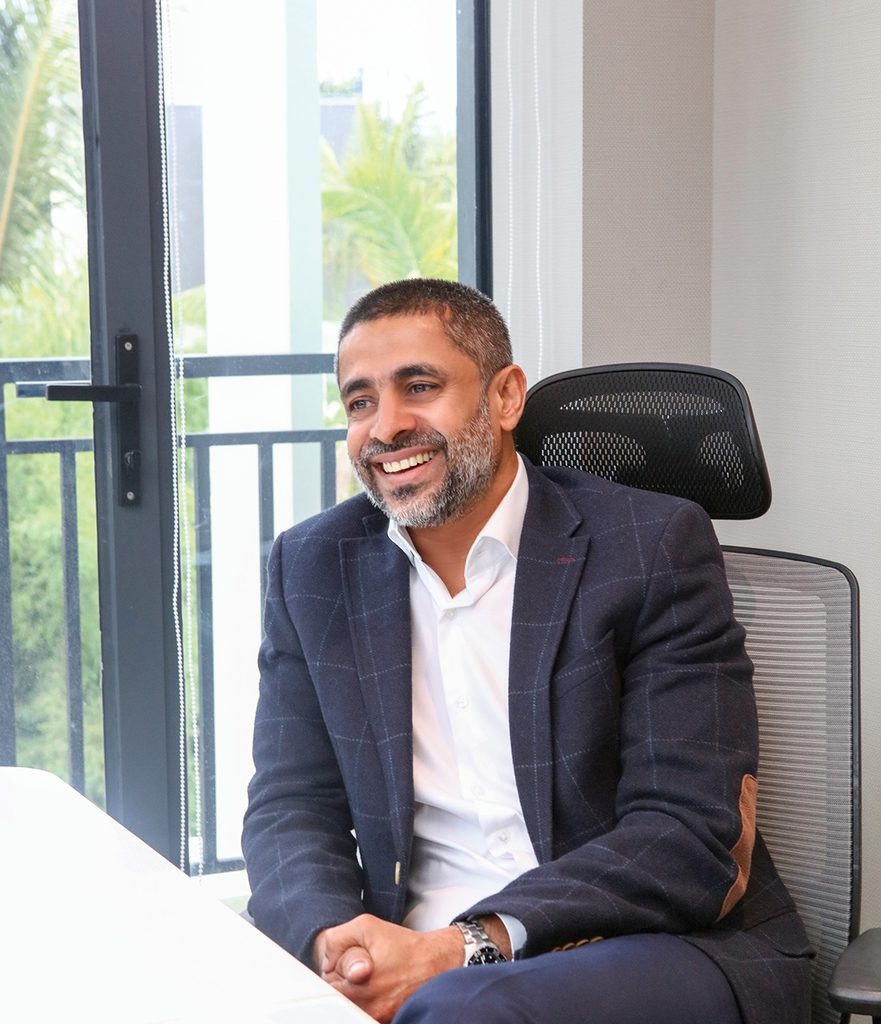
Thulci Aluwihare, Deputy Managing Director, CHEC Port City Colombo.
Thulci Aluwihare, Deputy Managing Director of CHEC Port City Colombo, sees Port City Colombo as far more than a real estate development. He believes it has the potential to transform Sri Lanka’s economic landscape, attract international businesses and talent, and serve as a catalyst for reforms beyond its boundaries.
Having built his career in mergers and acquisitions at PwC Sri Lanka and PwC Australia in Melbourne, Aluwihare returned to head PwC’s M&A practice in Sri Lanka and the Maldives. In 2016, amid considerable negativity surrounding Port City Colombo, he joined the project as Head of Strategy after conducting his due diligence. Nearly a decade later, he remains convinced that Port City Colombo can help reposition Sri Lanka as a regional business hub while setting an example in economic growth, governance, and the creation of an internationally competitive business environment.
Speaking with Business Today, Aluwihare discusses the project’s evolving investment proposition, its potential to connect Sri Lanka to global value chains, and the infrastructure, policy consistency, and institutional reforms needed to realize its ambitions.
Words: Jennifer Paldano Goonewardane.
Photography: Rasanga Dissanayake and Sujith Heenatigala.
Today, Port City Colombo is being positioned as a services-driven economic hub. How did the management make that conceptual shift from Port City Colombo initially being viewed as a reclamation and real estate project to something tangible?
Initially, Port City Colombo was conceived as a real estate development, with its waterfront location offering significant value. The project became viable following the construction of the 5.3-kilometer Colombo Port South Breakwater, funded by the Asian Development Bank in the late 1990s and early 2000s. The breakwater led to sand accumulation, which enabled us to fast-track the reclamation.
Shortly after the reclamation, the government at the time proposed establishing an international financial center in the latter part of 2016. To explore the potential beyond real estate, the Government and CHEC jointly engaged leading international consultants, including experts with experience in International Finance Centres such as Dubai International Finance Centre (DIFC), and Qatar Financial Centre.
By 2017, the study was completed and presented to the government. It outlined the proposed positioning for Port City Colombo, systematically identified the region’s inherent business challenges, and recommended ways to address them through a dedicated legal framework.
The study also identified the potential to develop Port City Colombo into a multi-service special economic zone, addressing regional business challenges and serving as a platform for South Asian businesses seeking global opportunities and for international companies looking to access the South Asian market. This marked the transition from a real estate project to Sri Lanka’s first services export zone.
Services exports are particularly important to Sri Lanka’s economic future. While the country faces a substantial trade deficit in goods, it records a surplus in services. As a small island nation that will continue to import more goods than it exports, developing modern services offers an opportunity to narrow this gap. Port City Colombo can help strengthen Sri Lanka’s position in tech, professional and financial services, as well as maritime services, given its proximity—approximately eight to ten nautical miles—to one of the world’s busiest east-west shipping lanes.
How have Port City Colombo’s objectives and strategic priorities evolved since its inception, particularly in response to Sri Lanka’s economic challenges?
Our aspiration to establish Port City Colombo as a successful business hub in South Asia remains unchanged. The 269-hectare reclamation and master plan have remained consistent. What has changed is the economic context. Since 2019, Sri Lanka has faced significant challenges, culminating in sovereign bankruptcy. Building investor confidence takes time and requires a predictable legal and policy environment, political stability, and sound macroeconomic fundamentals. These factors are essential to attracting substantial long-term investments.
Our proposition has not been diluted. We have attracted established international companies, including IFS, a leading Swedish IT company; Horizon, a US-based educational toy manufacturing company with a 200-year history; GAC Shipping, which relocated its hub operations from Jebel Ali; and Ansell, Australia’s largest listed glove manufacturer, which established its global shared services facility here.
Port City Colombo is still developing its identity and will take time to find the right balance. Technology and IT-enabled services currently lead the way, accounting for approximately 50 percent of the nearly 200 companies operating here. However, maritime services represent a significant opportunity. We are located adjacent to the Port of Colombo, South Asia’s busiest port and the world’s 20th busiest. Port City Colombo can develop an ecosystem that complements the port through shipping, logistics, and related services. This model has helped hubs such as Singapore, Dubai, and Shanghai thrive, while London has also established itself as a maritime services hub, especially maritime related financial services. We already have several shipping and logistics companies operating here and are engaging others to establish a presence.
One of our key advantages is the opportunity to develop an ecosystem from the ground up, with carefully designed regulations suited to specific industries. However, we are not targeting every sector. The priority is to identify Sri Lanka’s strengths and niche opportunities, then build the regulatory and business environment needed to help those industries grow and compete internationally.
Port City Colombo sits at the intersection of Chinese investment, Indian proximity, and Western capital. How do you position the development so that it is seen primarily as an international economic platform rather than through the geopolitical lens of who developed it?
Large-scale developments of this nature require public-private partnerships. While the physical infrastructure was developed by a private company, it is owned by the Government of Sri Lanka. To make the most of this infrastructure, the right regulatory framework is essential. The Special Economic Zone law established that framework, with the Colombo Port City Economic Commission serving as the sole authority and implementing progressive regulations.
Our positioning is that of a multi-ethnic, integrated, and self-sustaining ecosystem. Regardless of who developed or owns the infrastructure, investors will look for a reliable platform with the rule of law, predictable legal and policy environments, and an ecosystem that supports their business objectives.
Port City Colombo’s advantages include its neutral positioning, access to multiple time zones, an educated and professional talent pool, and Sri Lanka’s common-law jurisdiction. Investors looking to establish, relocate, or expand their operations will ultimately assess the quality of the infrastructure and business environment rather than its origins.
Quality of life is also increasingly important, particularly to younger generations. We are developing an environment where people can live, work, learn, and play within a walkable area, with workplaces, gyms, and recreational facilities close at hand. This integrated offering is central to positioning Port City Colombo as an international economic platform rather than through a geopolitical lens.
Port City Colombo can help strengthen Sri Lanka’s position in tech, professional and financial services, as well as maritime services.
You have spoken of signed and binding investments rather than merely expressions of interest. Why does the quality of the investor matter more than the headline value of the investment?
Attracting investment remains challenging, particularly for a country that has experienced sovereign default, although Sri Lanka’s credit ratings have since improved by several notches. My role is to position Sri Lanka internationally, shifting its image from primarily a tourism destination to a vibrant business hub in South Asia.
The first investors are particularly important because they help establish credibility and encourage others to follow. We continue to pursue major, high-quality investors and international brands. One challenge has been that foreign developers often ask why local developers have not invested. Securing the participation of two or three local developers has strengthened our position in discussions with foreign investors, who may also prefer to partner with local developers as they familiarize themselves with the development.
With Sri Lanka’s economic conditions now more supportive of investment, we are optimistic about attracting larger international brands and businesses.
The value of Port City Colombo extends beyond investment figures. It can create opportunities for Sri Lankan professionals to work for international companies without moving overseas. The Sri Lankan rupee is not legal tender within Port City Colombo; 16 foreign currencies are designated for transactions, with the US dollar being the most widely used. Employees working in Port City Colombo are paid in US dollars, creating opportunities to earn foreign currency while building international careers locally.
How much of your investment strategy is driven by where capital is available, and how much by identifying sectors that Sri Lanka genuinely has the capability to build around?
Capital is mobile and will flow towards opportunities offering attractive risk-adjusted returns. The more important question is where Sri Lanka has genuine strengths and which sectors it can develop sustainably. In my view, services are central to that proposition because talent attracts capital.
Sri Lanka has a substantial pool of CIMA-qualified professionals, the largest outside the UK, while its universities produce skilled technology graduates. However, brain drain remains a major challenge. Port City Colombo aims to create opportunities for this talent to remain in Sri Lanka and work for international companies. For investors developing large-scale infrastructure, it is equally important to see which businesses will occupy and utilize that infrastructure.
Our focus is therefore on sectors that build on Sri Lanka’s capabilities, including IT and technology, IT-enabled services, regional headquarters, professional services, trading, and maritime services. Maritime services remain a work in progress, and businesses are still assessing how Port City Colombo could develop into a regional hub comparable to Singapore. I believe we can work towards that ambition by building on Sri Lanka’s strengths and creating the right ecosystem for these industries to grow.
Building investor confidence takes time and requires a predictable legal and policy environment, political stability, and sound macroeconomic fundamentals.
With Port City Colombo moving from planning to active development, could you give us an update on the major investments and development projects currently underway, including those that are under construction, and what these projects signal about the pace and direction of the city’s growth?
Port City Colombo has 74 marketable plots, with a total development investment estimated at USD 15 billion at current costs.
So far, leases have been executed for nine plots, while a further six have secured signed commitments with financial backing, pending execution of the lease agreements.
Together, these 15 plots represent approximately 20 percent of the total and have secured an estimated USD 2.1 billion in investment, covering both land and buildings. This is in addition to the USD 1.4 billion already invested in infrastructure. The USD 2.1 billion in committed development investment will be deployed over time, as construction typically takes three to four years.
Meanwhile, we will continue marketing the remaining plots. Construction has already commenced on four plots where leases have been secured.
We have also identified another 14 plots for development by 2030, representing an estimated further investment of USD 4.1 billion.
By 2030, we expect Port City Colombo to have a visible skyline of completed buildings, with some developments ready for occupation. This will mark a significant transition from infrastructure creation to the emergence of an active, functioning city.
The priority is to identify Sri Lanka’s strengths and niche opportunities, then build the regulatory and business environment needed to help those industries grow and compete internationally.
You have positioned Port City Colombo as an “India-plus-one” location. Could Sri Lanka realistically become a complementary services hub to India? What specific functions do you believe would encourage Indian companies to move?
India is a massive growth market, expected to sustain strong growth over the next two decades. If Sri Lanka fails to connect with that growth, we will miss a significant opportunity.
However, we cannot match India’s scale, particularly in IT talent and its established global capability center (GCC) ecosystem. Instead, we can complement it through what we call a “nano GCC” model, catering to specialized functions within the broader GCC ecosystem.
Sri Lanka remains competitive in terms of talent, while international companies are increasingly looking to diversify their operational risks rather than concentrate all their activities in one country.
Port City Colombo can offer a nearshore location that supports business continuity while benefiting from proximity to India.
As a 100 percent export-oriented zone, Port City Colombo offers access to the Indian market, with South India just an hour away and approximately 180 flights per week connecting Sri Lanka and India.
It can also serve as a neutral jurisdiction for Indian companies seeking to expand internationally, including into markets such as Bangladesh and Pakistan. The opportunity is not to compete with India, but to complement its growth through specialized services, talent, and strategic connectivity.
Investors looking to establish, relocate, or expand their operations will ultimately assess the quality of the infrastructure and business environment rather than its origins.
The single-window system is one of Port City Colombo’s strongest selling points. What have you learned about the difference between having good regulations on paper and delivering genuinely frictionless execution?
The term ‘single window’ can be a cliché, but the Colombo Port City Economic Commission is demonstrating how it can work in practice. The law gives the Commission the necessary regulatory authority and autonomy to make decisions and facilitate investment, coordinating with relevant government agencies where required. This eliminates the need for investors to navigate the dozen or so agencies they would otherwise have to approach.
As Port City Colombo is a planned city, its development control regulations are already gazetted. Requirements relating to building height, footprint, and landscaping are clearly defined. Provided a proposed design complies with these parameters, approvals can be obtained in as little as three months, allowing construction to begin sooner than would generally be possible elsewhere.
The same principle applies to attracting talent. Port City Colombo offers a green-channel visa for employees for up to five years, depending on their employment contracts. Directors, investors, landowners, and apartment buyers can obtain visas for up to ten years. There are still teething problems, but the mechanism is working. Every month, the Secretary to the Treasury and the Chairman of the Colombo Port City Economic Commission meet businesses operating under authorized person licenses to discuss practical challenges, including visa delays, opening bank accounts, and international transactions. The Secretary to the Treasury sets aside time for these direct discussions, demonstrating a commitment to resolving investor concerns.
Port City Colombo is still a developing city, and we acknowledge that challenges remain. Within Sri Lanka’s democratic system, we are working to address them efficiently and make the investment process increasingly seamless.
A successful business district needs more than offices. What will make someone choose to live, work, socialize, and eventually build a long-term life in Port City Colombo rather than simply use it as a place to conduct business?
Port City Colombo’s master plan, developed by Sweco, one of Sweden’s leading architecture and engineering consultancies, carefully considered how the 74 plots would be used and integrated.
The plan brings together offices, residences, retail outlets, a marina, an integrated resort with a casino, schools, a hospital, and a university, as well as Colombo’s first beach front.
The objective is to create a self-sustaining city where people can live, work, and socialize within walking distance of one another.
Open spaces are equally important. Of Port City Colombo’s 269 hectares, 91 hectares are dedicated to open spaces, including parks, beaches, waterways, and jogging tracks. The green areas outside the plots, including the central park and park connectors, cover more than 25 hectares. These features are intended to create a green lung for Colombo while providing the lifestyle amenities that make the city attractive to residents and visitors.
We are building an international city, not simply a business district. Combining employment opportunities with recreation, green spaces, and an integrated living environment will be essential to attracting both Sri Lankans and foreigners to live and work here.
The first investors are particularly important because they help establish credibility and encourage others to follow.
Sri Lanka has traditionally viewed foreign investment as capital entering the country. Could Port City Colombo help change that mindset towards viewing FDI as a means of integrating Sri Lanka into global value chains?
With a population of around 22 million, Sri Lanka has a relatively small domestic market and cannot rely on it alone to drive growth. We need to access new export markets and identify our comparative advantages to integrate into global value chains.
Foreign direct investment (FDI) is essential for attracting the capital needed to develop tradable goods and services, particularly as the Government’s fiscal capacity to fund infrastructure remains limited. Growth must therefore be largely private-sector driven.
In the past, some FDI has focused primarily on infrastructure, including debt-driven investments. Port City Colombo offers an opportunity to attract capital into higher-value, modern services, supported by the infrastructure needed to develop these industries. It can also help retain and attract skilled talent by creating opportunities for Sri Lankans to work locally in internationally connected businesses.
However, we must be pragmatic. Port City Colombo is an ambitious, long-term undertaking, and Sri Lanka still faces considerable economic challenges. Maintaining fiscal discipline and rebuilding investor confidence are essential, and both take time. If we stay the course, I believe we can attract the capital and talent needed to support sustained economic growth of seven percent or more.
From your international investor engagements, what are the main challenges in positioning Port City Colombo as an investment destination, and how has the response evolved?
Attracting investment requires sustained effort; investors are not simply lining up to come to Sri Lanka. We use a multi-pronged approach, from large-scale events to build awareness to one-on-one engagements facilitated by our relationships and channel partners in key markets.
For many investors, Sri Lanka’s risk profile is their first concern. We must demonstrate how those risks can be mitigated and why the risk-adjusted returns could be more attractive than those available elsewhere. It is a long process that requires continued engagement and guidance.
We have a dedicated team available 24/7 to assist prospective investors throughout the process, from initial inquiries and applications to securing approval from the Colombo Port City Economic Commission. The conversations have become more encouraging as the country’s economic conditions have improved. During the more difficult period, it was challenging to aggressively promote a USD 15 billion development. Since the second half of last year, however, we have seen positive momentum, which we need to sustain.
Investor decisions also follow their own timelines. A company that was not ready to invest last year may reconsider in a year or two. We therefore maintain contact, track their interests and concerns, and continue demonstrating the value proposition. As more established international brands commit to Port City Colombo, it will become easier to attract others.
Given the improving investment climate, which sectors are showing the strongest potential to attract major international brands to Port City Colombo?
I believe we will attract significant international brands, particularly in technology and maritime services. In addition to GAC Shipping, we are in discussions with a major shipping and logistics operator that recently acquired a Singapore-based business specializing in semiconductor logistics. The company already has a presence in Sri Lanka and is considering establishing its headquarters here.
One of the biggest concerns for investors is uncertainty about the time and processes involved in setting up operations. Delays have a direct financial cost. Providing clarity on procedures, timelines, fees, laws, and regulations makes the proposition more compelling and gives investors the confidence to make informed decisions.
How competitive is Port City Colombo in terms of business setup and real estate costs compared with regional hubs?
Cost is a significant advantage. Our benchmarking indicates that the cost of doing business in Colombo is approximately one-quarter of that in Singapore and Dubai. This includes real estate and other operating costs, creating a substantial cost advantage for businesses considering Colombo as a base for their operations.
Has the geopolitical uncertainty in the Middle East created new opportunities for Port City Colombo, particularly as businesses seek to diversify risk and strengthen business continuity?
In an increasingly multipolar world, businesses are reassessing their geographic exposure and seeking alternative locations to reduce risk and ensure business continuity. This is not unique to the Middle East; geopolitical disruptions can prompt companies across regions to diversify their operations. Every jurisdiction has an opportunity to benefit from this shift.
We are seeing interest from Middle Eastern companies looking to establish operations in Port City Colombo.
However, our positioning is not to replicate Dubai, but to offer a complementary jurisdiction where businesses can establish business continuity or disaster recovery offices.
The Colombo Port City Economic Commission has also indicated its willingness to fast-track visas to facilitate this. Of the approximately 200 companies established in Port City Colombo, around 20 percent are from the UAE. Given the UAE’s familiarity with master-planned developments of this nature, we are engaging with major developers, investors, and funds to encourage them to consider Sri Lanka as an investment destination beyond tourism.
The value of Port City Colombo extends beyond investment figures. It can create opportunities for Sri Lankan professionals to work for international companies without moving overseas.
There is often a tension between building a globally competitive enclave and ensuring that the wider economy benefits. How do you intend to make the economic spillovers from Port City Colombo meaningful for businesses outside its boundaries?
The benefits to the wider economy were built into Port City Colombo’s legal framework from the outset. It is an export-oriented special economic zone designed to attract foreign capital and businesses whose markets are outside Sri Lanka. Its differentiated regulatory and fiscal framework is intended to address the limitations of previous policies in attracting FDI, rather than provide an unfair advantage to businesses that do not meet these requirements.
The greatest spillover will come through supply chains. Developing a city that requires an estimated USD 15 billion in investment creates opportunities for Sri Lankan businesses, SMEs, and individuals to supply goods and services.
Once fully developed, Port City Colombo is expected to accommodate around 80,000 residents and a total population of approximately 250,000, including transient population through the city. As businesses operate and earn in foreign currency, employees and local suppliers will also have opportunities to receive payments in foreign currency.
Although developers receive certain tax benefits, their suppliers, contractors, and subcontractors remain subject to taxation, allowing economic activity to generate revenue for the country as well. The wider impact will therefore extend beyond Port City Colombo through employment, business opportunities, and tax contributions.
An independent assessment by PwC estimated that, once fully developed, Port City Colombo could contribute more than USD 13 billion annually to Sri Lanka’s GDP. This reflects the scale of the potential economic impact beyond its boundaries.
Could Port City Colombo become a catalyst for Colombo as a whole, lifting the competitiveness of the existing Central Business District?
Port City Colombo is an extension of the existing central business district, not a substitute for it. The two should complement one another. Port City Colombo will introduce modern, planned infrastructure, while the existing city offers a rich architectural and heritage landscape, including the Dutch Hospital and Fort. This contrast could encourage Colombo as a whole to enhance its real estate offerings, architecture, and overall competitiveness.
Connectivity will strengthen this relationship. The final stage of the airport highway is expected to connect to Port City Colombo’s northern entrance, while the outer circular highway links it to the wider national road network. This will improve access to destinations across the country from Colombo.
We also want to expand Colombo’s appeal as a destination so that visitors stay longer than the current average of about 1.5 days, benefiting existing hotels and businesses. A 70,000-square-foot event dome, scheduled for completion before the end of this year, will accommodate large-scale events, including musical performances. An amusement park is also planned.
In addition, Port City Colombo has introduced South Asia’s first downtown duty-free shopping destination outside an airport. Sri Lanka attracts a significant number of Indian visitors but is not yet established as a shopping destination. We aim to change that.
A second phase is planned to include a check-in lounge, allowing travelers to shop, check in for flights, and take a shuttle directly to the airport via the highway network. These developments are intended to generate more activity across Colombo, strengthen its appeal to visitors, and create opportunities for businesses throughout the city.
What capabilities—skills, infrastructure, institutions, or policy—does Sri Lanka need to develop outside Port City Colombo for the project to achieve its full potential?
For Port City Colombo to achieve its full potential, Sri Lanka must continue investing in national infrastructure, strengthening institutions, and developing its talent base.
Connectivity is particularly important. As the country pursues ambitious tourism targets, airport capacity must expand. The planned extension of Bandaranaike International Airport is important, and Sri Lanka may eventually need to consider having more than one international airport.
Despite its strategic location, the country must improve air connectivity. Expanding port capacity is equally vital to strengthening Sri Lanka’s overall proposition. Continued public investment in roads, bridges, and other essential infrastructure is also necessary.
Institutional capacity and governance are just as important. Sri Lanka has undertaken significant reforms, and foreign investors increasingly recognize the country’s recovery from its economic crisis and efforts to strengthen governance. These reforms must continue to build confidence.
Talent is another critical factor. With services accounting for around 58 percent of GDP, Sri Lanka’s greatest asset is its people.
Universities must offer relevant curricula that produce employable graduates, supported by greater investment in education at primary, secondary, and tertiary levels. This is essential not only to meet domestic demand but also to prepare graduates for opportunities overseas.
Policy consistency and predictability are crucial. Labor reforms aimed at consolidating provisions currently spread across numerous statutes are particularly important.
With continued progress in infrastructure, governance, education, and regulatory reform, Sri Lanka can strengthen its position as a destination for international businesses seeking access to South Asia and make a greater mark in the Indian Ocean region.
And if Sri Lanka gets Port City Colombo right, what could this country realistically become in the Indian Ocean economy?
Sri Lanka has yet to fully capitalize on its strategic location in the Indian Ocean.
We have long aspired to become a maritime, logistics, and aviation hub, and Port City Colombo is a real test of whether we can establish ourselves as a business hub for South Asia. Its special economic zone (SEZ) framework also provides a controlled environment to test regulatory and policy reforms that could eventually be extended to the wider economy.
Despite significant challenges, our objective has remained unchanged: to position Sri Lanka as a sought-after, vibrant business destination and expand its identity beyond tourism.
Colombo is already a major transshipment hub, but we have an opportunity to create greater value by developing the maritime, logistics, and professional services that support this trade.
The fundamentals are in place. Sri Lanka has a strategic location, an English-speaking population, and a common-law jurisdiction.
Within Port City Colombo, businesses benefit from multi-currency banking, liberalized capital flows, the freedom to employ foreign talent without numerical restrictions relative to local employees, and a dedicated center for resolving commercial disputes. These features, together with modern infrastructure, can help create a competitive international business environment.
Realizing this potential will depend on consistent regulations, predictable policies, and political stability.
If we get these right, I believe Port City Colombo can help redefine Sri Lanka’s position in the Indian Ocean economy. We have the foundations, and there is no reason why we cannot achieve that ambition.