
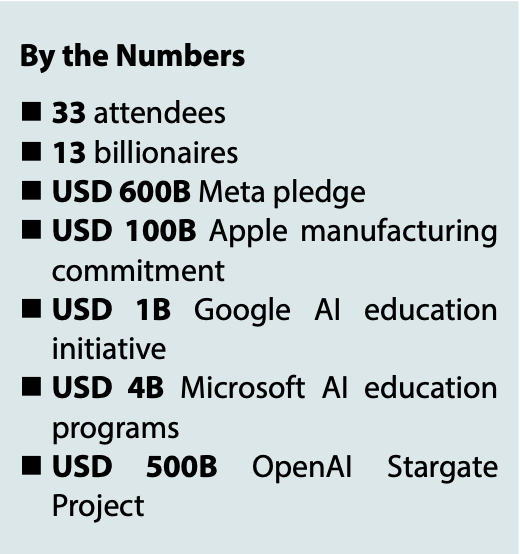
From Apple’s USD 100 billion bet to Meta’s USD 600 billion gamble — how one dinner redrew the map of power.
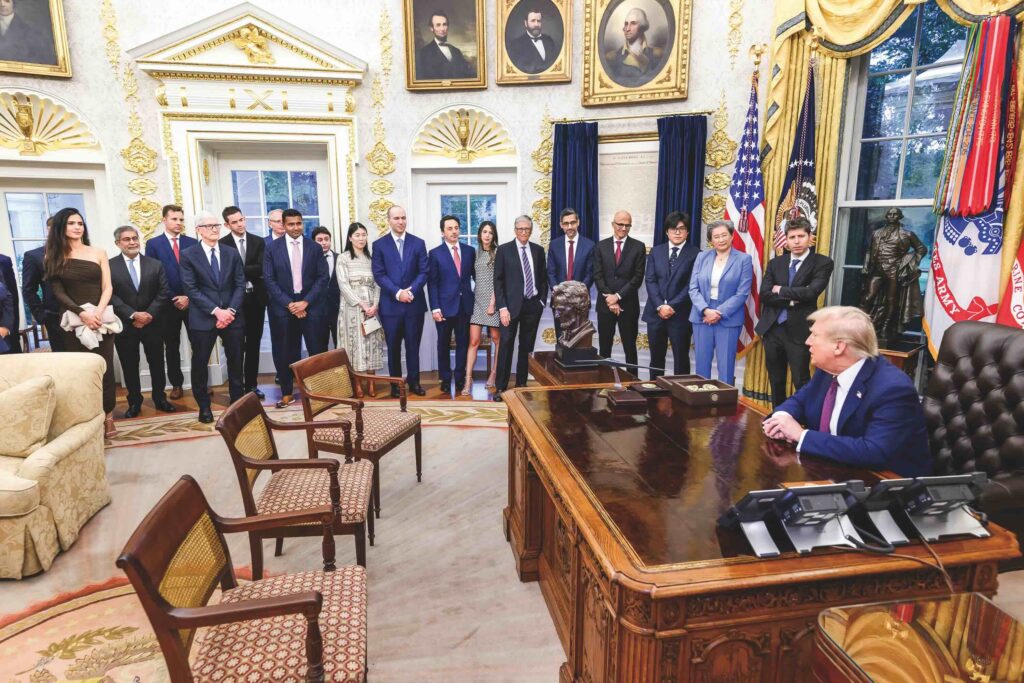
U.S. President Donald Trump with 33 leaders of Silicon Valley and global technology.
The White House hosted an extraordinary gathering on a rain-soaked evening in Washington.
Around a single table sat 33 of Silicon Valley’s most powerful figures — CEOs, innovators, investors, and political operatives — joined by the President and First Lady. Collectively, they represented trillions of dollars in market value and the engines of America’s technological destiny.
The dinner was more than a ceremony; it was a declaration. For decades, Washington and Silicon Valley often eyed one another with suspicion. Yet on this night, their interests aligned in a common mission: securing American supremacy in artificial intelligence. From billion-dollar pledges by Apple, Meta, and Microsoft, to bold declarations from OpenAI and Google, this was when politics and code fused into strategy.
A Rain-Soaked Washington, A Historic Dinner
The Rose Garden was ready. White linen tables and golden cutlery shimmered under floodlights. However, as heavy rain swept through Washington, the event moved indoors to the State Dining Room. Beneath its chandeliers, history unfolded. President Donald J. Trump and First Lady Melania Trump welcomed 33 leaders of technology and politics. With 13 billionaires present, this was one of the wealthiest gatherings in White House history. Trump opened the evening with a simple declaration: “America will lead in AI. With your talent, money, and innovation, this country will not only compete — it will win.” The applause was thunderous. The former adversaries — Silicon Valley and Washington — were now partners.
Melania Trump: Education as Destiny
First Lady Melania Trump introduced the AI Education Task Force, which she chairs. Her mission is to bring AI literacy into schools nationwide. “The future belongs to children who not only use AI but build it,” she said with quiet determination. Beside her was Susie Wiles, Trump’s White House Chief of Staff, the strategist credited with running his disciplined 2024 campaign. Together, they set the stage: AI leadership would be built with capital, education, and political strategy.
Sam Altman and the OpenAI Vision
Sam Altman, CEO of OpenAI. Calm and composed, Altman thanked the administration for supporting the USD 500 billion Stargate Project, OpenAI’s massive infrastructure plan with Oracle and SoftBank. “This investment in America’s future is only possible because your administration has chosen optimism and partnership. It sets us up for long-term success.”
Altman, once the President of Y Combinator, has become the face of America’s AI push. His partner in building OpenAI, Greg Brockman, sat nearby. Brockman, who left MIT to become Stripe’s first CTO before co-founding OpenAI, is the engineering mind behind GPT breakthroughs. His wife, Anna Brockman, a symbolic figure during OpenAI’s 2023 leadership crisis, completed the tableau — a reminder that even in Silicon Valley, technology is human drama.
Sergey Brin Returns to the Spotlight
Sergey Brin, co-founder of Google, rose next. Born in Moscow, raised in Maryland, Brin embodies the immigrant dream. After years of relative quiet, he has reemerged to lead Alphabet’s AI resurgence.
“It’s an incredible inflection point. AI will define nations. The fact that this administration supports us instead of fighting us changes everything.” At his side was Gerelyn Gilbert-Soto, founder of GG Health Coach, who looked visibly moved as Brin spoke. For Brin, now worth nearly USD 200 billion, the moment symbolized a reunion of Silicon Valley and Washington.
“America will lead in AI. With your talent, your money, and your innovation, this country will not only compete — it will win” — President Trump.
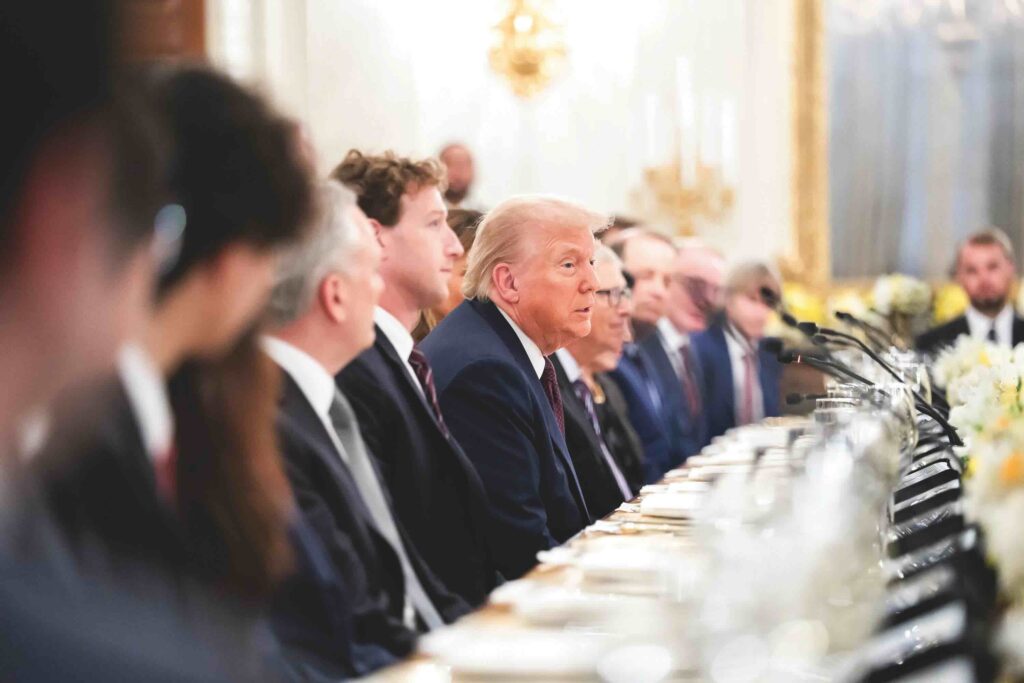
President Donald Trump convened some of Silicon Valley’s most influential figures at the White House.
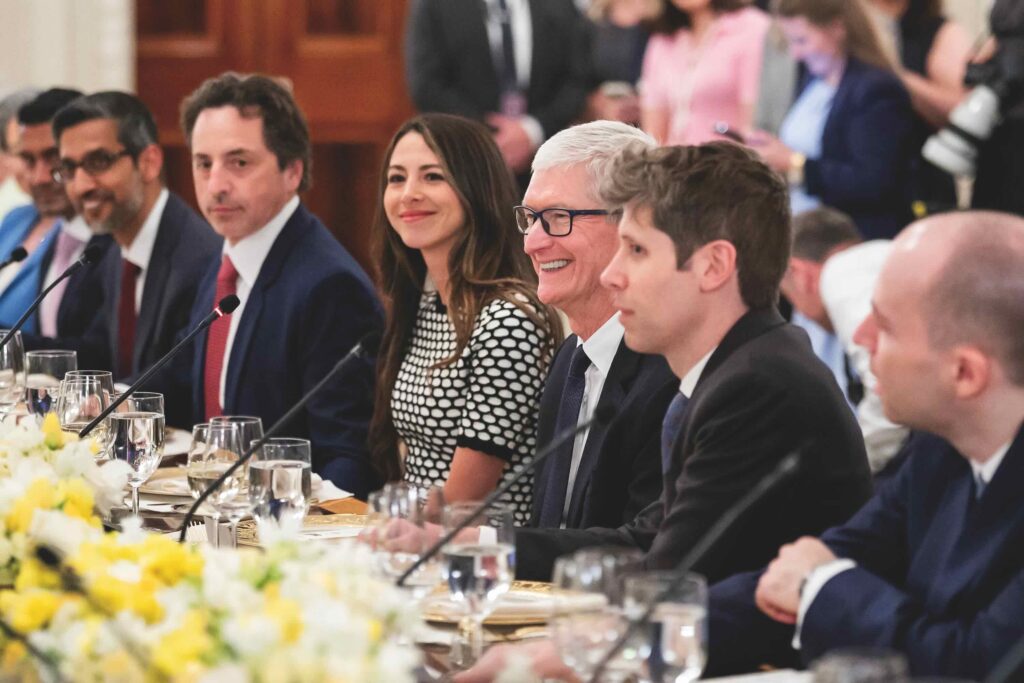
L–R: Shyam Sankar, CTO, Palantir; Sundar Pichai, CEO, Alphabet and Google; Sergey Brin, Co-Founder, Google and Gerelyn Gilbert-Soto, Founder, GG Health Coach; Tim Cook, CEO, Apple; Sam Altman, CEO, OpenAI; and Greg Brockman, President and Co-Founder, OpenAI.
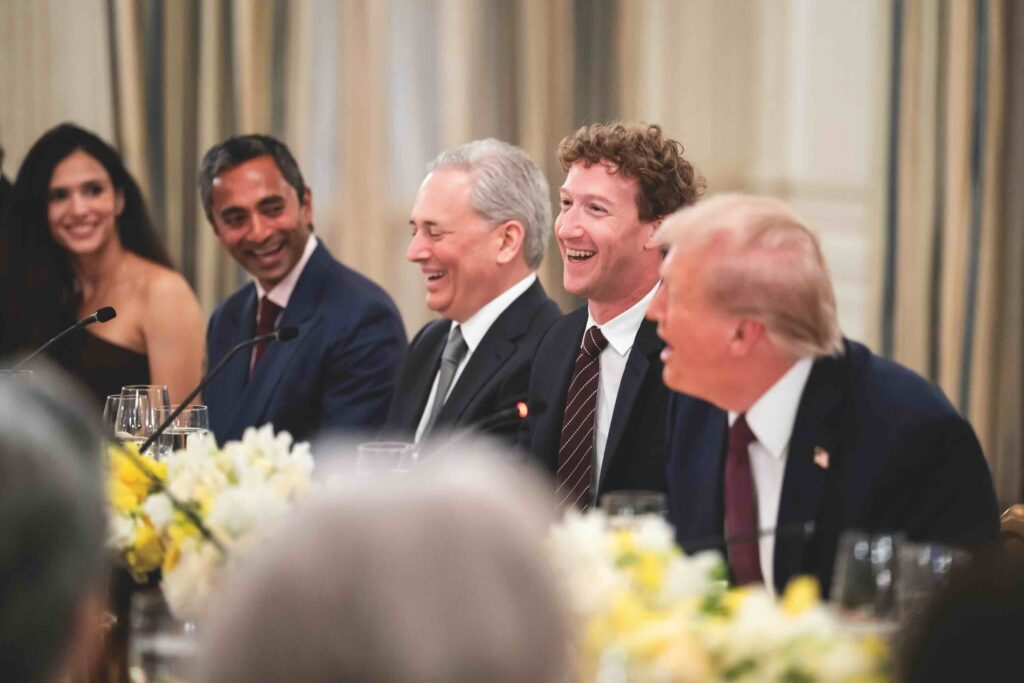
President Trump with Chamath Palihapitiya, CEO, Social Capital and wife Nathalie Dompé, Co-CEO, Dompé Farmaceutici; David Sacks, White House AI and Crypto Czar; and Mark Zuckerberg, CEO, Meta.
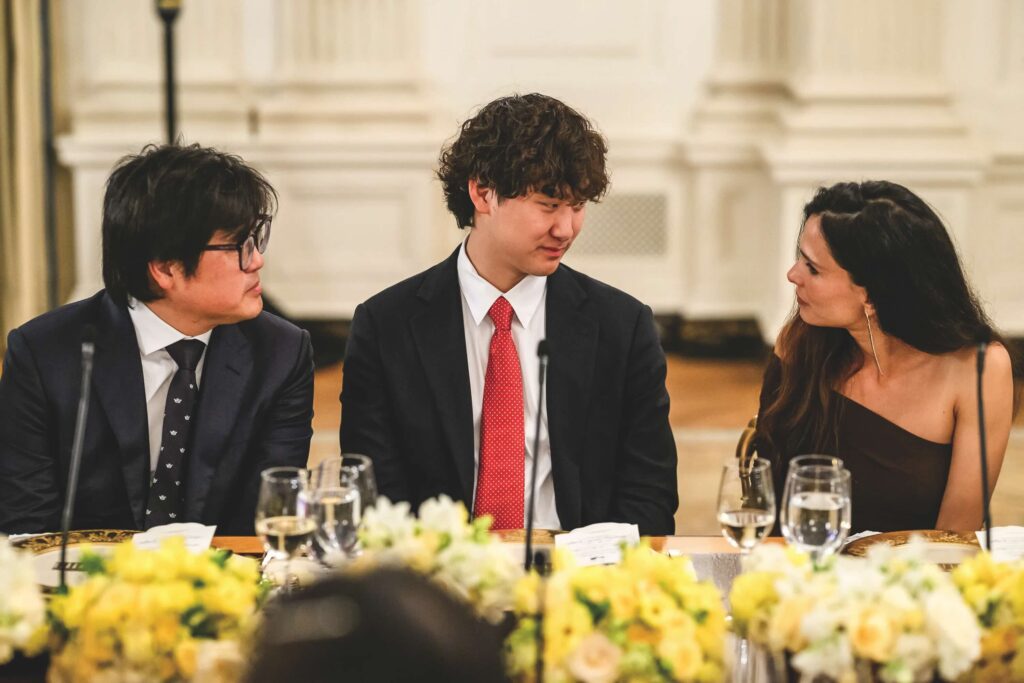
Jason Chang, CEO, CSBio; Alexandr Wang, Chief AI officer, Meta and Nathalie Dompé, Co-CEO, Dompé Farmaceutici.
Apple’s USD 100 Billion Bet
Tim Cook, Apple’s steady and meticulous CEO, followed. Reserved yet powerful, Cook announced a USD 100 billion U.S. manufacturing investment, part of Apple’s USD 600 billion technology pledge. “This commitment says something profound about America’s capacity to innovate when government and industry work together.” Under Cook, Apple became the world’s most valuable company. That night, he became one of Trump’s most important allies.
Satya Nadella and Microsoft’s Trust Dividend
Satya Nadella, Microsoft’s calm and professorial CEO, spoke about the global trust in American technology. “It is not only innovation but trust that makes this industry unique. Your policies ensure that trust endures.” Nadella has transformed Microsoft into an AI superpower, with its OpenAI partnership and billions pledged for AI education. His leadership reflects Microsoft’s position as a corporate giant and a public partner.
Sundar Pichai’s Global Perspective
Sundar Pichai, CEO of Alphabet and Google, pledged USD one billion for U.S. education and job training, with USD 150 million dedicated to AI learning. “The AI moment is the most transformative of our lifetimes. Under your leadership, America can remain at the forefront.” Pichai’s rise from Chennai to Silicon Valley symbolizes the immigrant path to power. His presence underscored Google’s central role in shaping AI globally.
Safra Catz and Oracle’s Pragmatism
Safra Catz, CEO of Oracle, spoke with trademark sharpness. “AI will change everything. And you, President, recognized this first. You unleashed American innovation.” Born in Israel, raised in the U.S., Catz is one of America’s highest-paid executives. She has overseen Oracle’s pivot into AI cloud infrastructure. Her husband, Gal Tirosh, a quiet figure, represents her close ties to Israel’s technology sector.
Lisa Su: The Chip Queen
Lisa Su, CEO of AMD, brought focus to semiconductors: “The acceleration of this industry has been incredible. These are the brains of AI, and America must lead.” Su, one of the most respected engineers of her generation, revived AMD and positioned the U.S. at the heart of the global chip race.
Mark Zuckerberg’s USD 600 Billion Gamble
Mark Zuckerberg, founder and CEO of Meta, stood confidently. “All of us here are making huge investments in America. At Meta, we are committing at least USD 600 billion through 2028.” Once defined by social media controversy, Zuckerberg has rebranded Meta as an AI powerhouse. His gamble — on AI superintelligence and U.S. alignment — is one of the largest private investments in American history.
Bill Gates: The Philanthropic Statesman
Bill Gates, Microsoft co-founder and philanthropist, spoke about AI’s potential in healthcare. “We must take American innovation to the next level. AI can cure diseases, end suffering, and unlock opportunity.” Though retired from corporate leadership, Gates’ philanthropy in vaccines and medicine keeps him at the forefront of innovation. His presence lent moral weight to the evening.
The Wider Cast of Innovators
Not all guests were household names, but each played a role in the AI ecosystem
Chamath Palihapitiya, Social Capital founder and outspoken Trump ally, symbolized venture capital’s new political power. His wife, Nathalie Dompé, biotech heiress and co-CEO of Dompé Farmaceutici, highlighted transatlantic ties.
Jared Isaacman, billionaire fintech founder and private astronaut, embodied America’s entrepreneurial daring.
Alexandr Wang, prodigy founder, Scale AI and now Meta’s Chief AI Officer, represented youth and technical genius.
Sanjay Mehrotra, CEO, Micron, reminded the room of memory and storage as AI’s unsung backbone.
Dylan Field, Figma co-founder, showed how design itself is being reshaped by AI.
John Hering, cybersecurity investor, underscored the need for digital defense.
Sunny Madra, COO, Groq, represented the race to build AI-specific chips.
Mark Pincus, Zynga founder, brought the DNA of consumer innovation.
Vivek Ranadivé, NBA team owner and TIBCO founder, linked data science with culture.
David Sacks, Trump’s AI and Crypto Czar, bridged Silicon Valley money with Washington power.
Shyam Sankar, Palantir’s CTO, kept the focus on defense technology.
Jamie Siminoff, Ring founder, illustrated AI’s consumer reach.
Jason Chang, CEO of CSBio, brought biotech into the mix.
Meredith O’Rourke, Trump’s finance director, and Tony Fabrizio, his pollster, showed the political machinery behind the evening.
David Limp, CEO of Blue Origin and former Amazon executive, linked AI with space exploration.
Each represented a piece of America’s AI ecosystem — chips, biotech, defense, consumer tech, and politics.
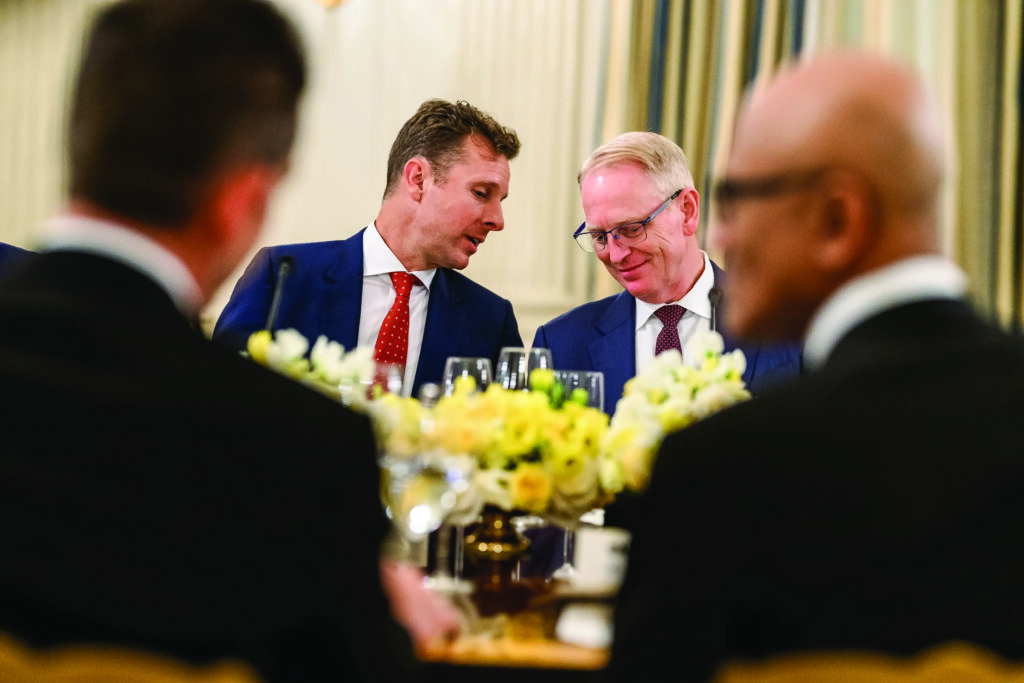
Jamie Siminoff, Founder, Ring with David Limp, CEO, Blue Origin.
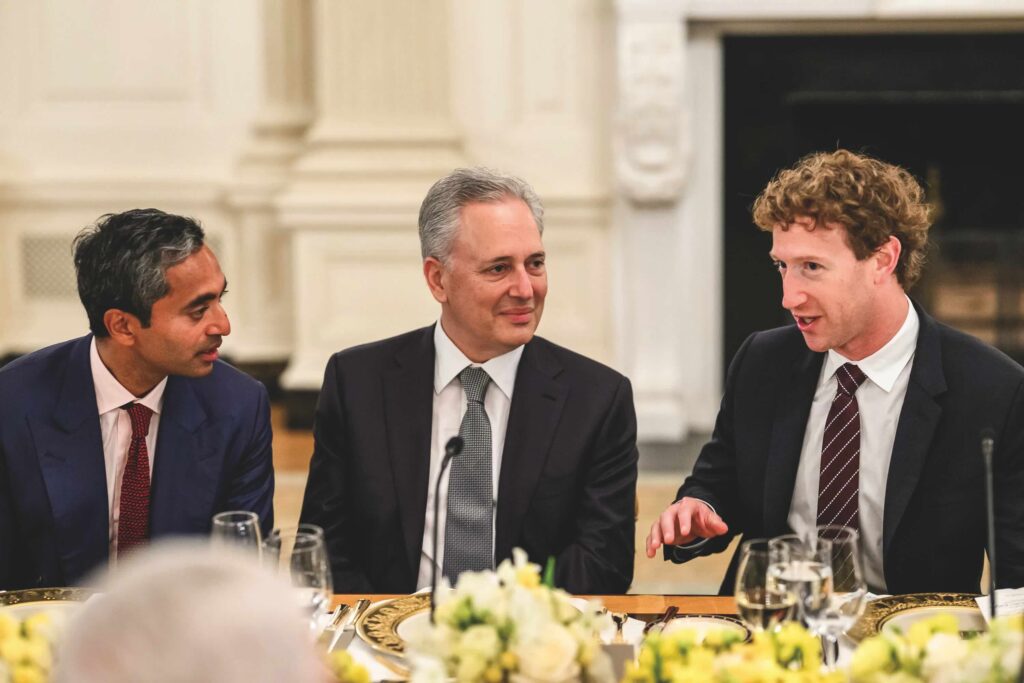
Chamath Palihapitiya, CEO, Social Capital; David Sacks, White House AI and Crypto Czar; and Mark Zuckerberg, CEO, Meta.
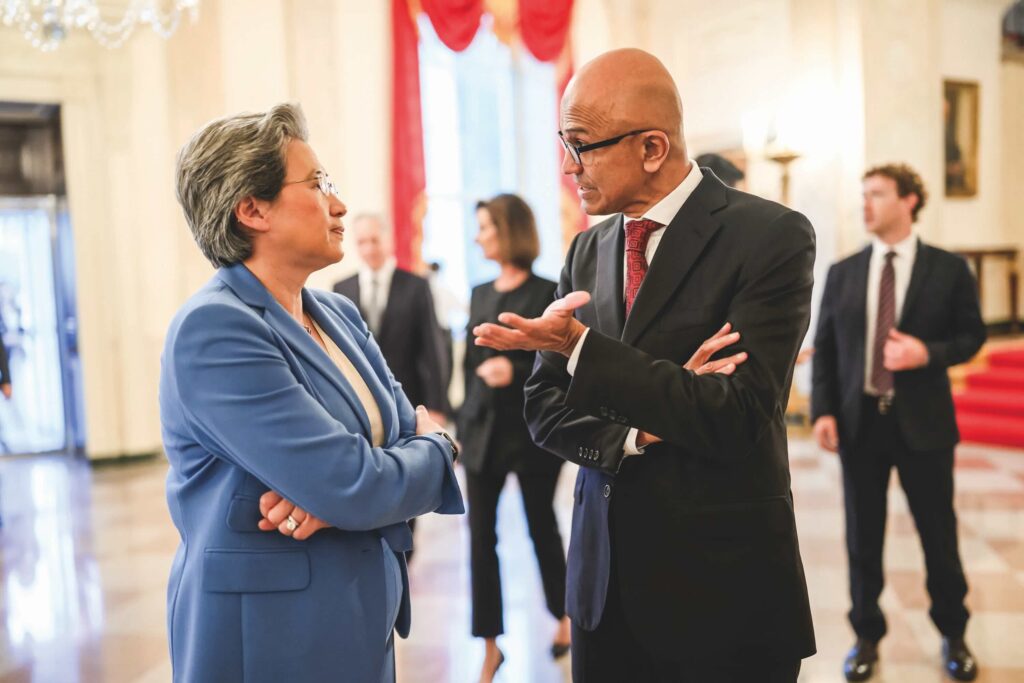
Lisa Su, CEO, Advanced Micro Devices (AMD) with Satya Nadella, CEO, Microsoft.
The Absent Icons
Two names were whispered but absent: Elon Musk of Tesla and SpaceX, and Jensen Huang of NVIDIA. Musk cited scheduling conflicts; Huang declined, preferring private meetings. Their absence underscored the event’s political complexity — even among AI titans, not all align with Trump.
The Closing Toast
As dessert was cleared, Trump raised his glass: “We are building something extraordinary here. America will not fall behind. Together, we will lead the world in AI.” The room — 33 leaders worth trillions — rose in unison.
Closing Analysis: This was not a dinner. It was a contract, unspoken but binding. For Silicon Valley, the price of access was pledges: USD 600 billion from Meta, USD 100 billion from Apple, USD 1 billion from Google, USD 4 billion from Microsoft, and USD 500 billion from OpenAI. For Washington, the prize was supremacy: energy for data centers, jobs for the next generation, and global leadership in AI.
The implications are profound:
Washington is no longer a regulator of Silicon Valley — it is now its partner.
AI is no longer a technology; it is a national strategy.
For China and Europe, the message is blunt: America intends to lead the AI century.
History will remember September 4, 2025, as the night America redrew the map of power — political and technological.
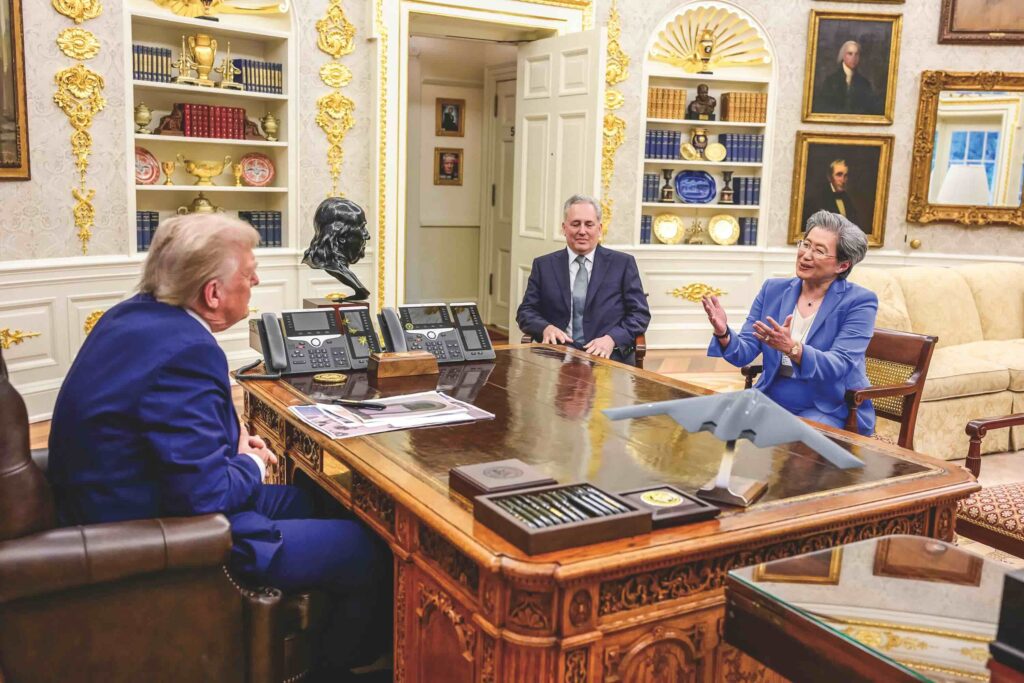
President Trump in a discussion with Lisa Su, CEO, AMD and David Sacks, White House AI and Crypto Czar.