

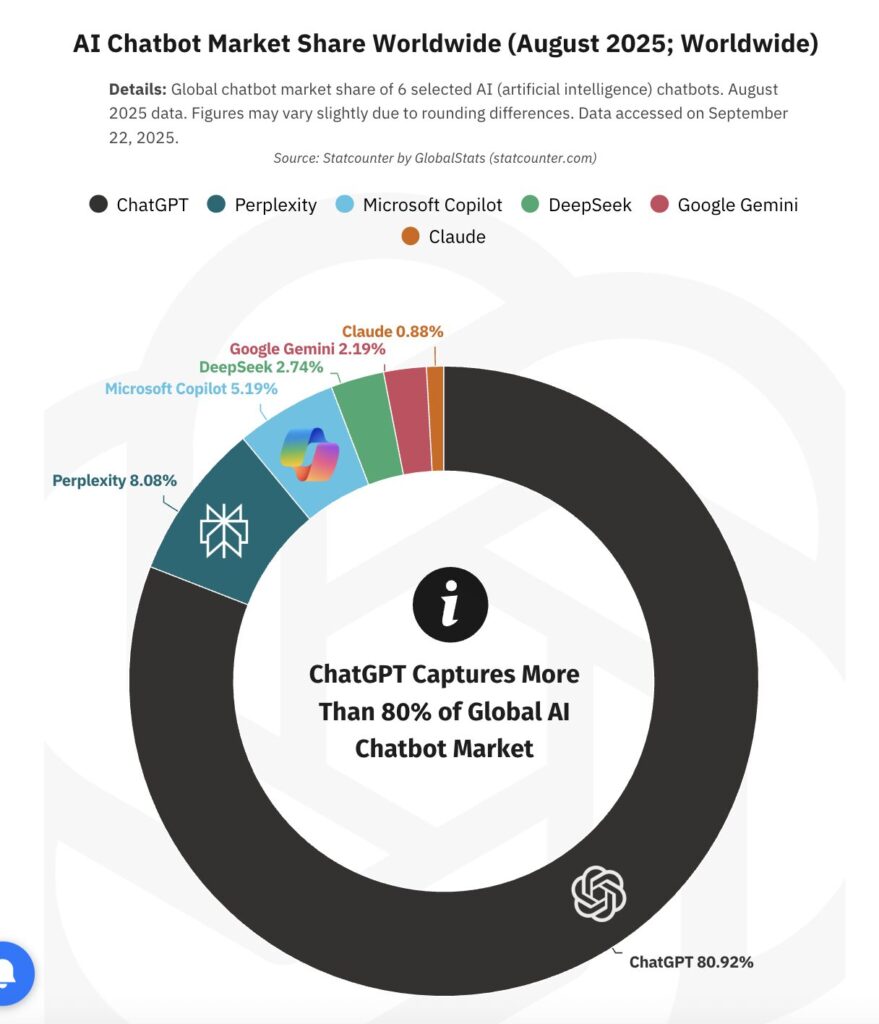
Artificial intelligence (AI) is no longer just a rising trend. It has become part of daily life, and one platform has taken a commanding lead. According to TechGaged findings, ChatGPT accounted for 80.92 percent of global AI chatbot traffic in August 2025. This overwhelming dominance makes it the primary gateway through which most of the world now engages with AI.
September 22, 2025. Rokas B.
The figures underscore how quickly ChatGPT has become the default interface for users worldwide.
In just a few years, it has transformed from an experimental tool into the central hub of everyday digital interaction. Asking a question, drafting text, or generating ideas has, for many people, become synonymous with opening ChatGPT. Its sheer market share mirrors earlier eras when Google defined internet search and when YouTube became the standard for online video.
Rivals struggle to gain ground
Despite ChatGPT’s overwhelming presence, competitors are not absent from the landscape. Techgaged.com’s August 2025 data shows Perplexity with 8.08 percent of the global market, positioning it firmly in second place. Perplexity’s strategy has been to blend AI conversation with live internet search, appealing to users who want real-time answers rather than pre-trained knowledge alone.
Microsoft Copilot ranks third with 5.19 percent. Its adoption reflects a different approach, relying on integration within Microsoft 365 applications. For many users, Copilot is less a standalone chatbot and more an embedded assistant in familiar productivity tools like Word, Excel, and Outlook. This positioning makes its global share notable even if it trails far behind ChatGPT.
Among newer challengers, DeepSeek captured 2.74 percent, demonstrating that innovation and differentiation still create openings in a concentrated market. Google Gemini accounted for 2.19 percent, leveraging Google’s ecosystem to gain traction in the AI race. Claude, developed by Anthropic, registered a modest but noteworthy 0.88 percent, reflecting its emphasis on safer, more aligned conversational AI. Together, these numbers highlight how difficult it is for smaller providers to break through against a platform that has already consolidated dominance.
The scale of ChatGPT’s lead has far-reaching implications. For consumers, it means a unified experience: most people rely on the same platform, reducing friction in learning and usage. For businesses, it suggests that integrations, workflows, and customer-facing AI strategies increasingly orbit around ChatGPT. For policymakers, the concentration raises questions about dependency and competition in a field expected to shape the future of work, education, and information.
At the same time, the presence of challengers shows that there is room for alternatives. Perplexity’s growth demonstrates demand for AI that stays connected to the web. Microsoft Copilot’s share indicates that embedding AI within existing ecosystems can secure adoption. DeepSeek’s rise shows how quickly new entrants can gain traction when they offer something distinct, Google Gemini highlights the value of ecosystem-driven adoption, and Claude illustrates the importance of safety and trust as differentiators in the market.
The next phase of the AI chatbot race will depend on whether competitors can convert their footholds into meaningful alternatives or whether ChatGPT’s lead will continue to expand, making it not just the leader but the lasting standard for how the world interacts with artificial intelligence.
The future of the chatbot race
The data reveals an industry that has already consolidated around one leader, but history shows that markets can evolve. Just as Facebook once faced challenges from newer social platforms, ChatGPT’s dominance does not guarantee permanent control. Rivals are innovating in ways that target specific user needs, whether through integration, safety, or connectivity. Still, the numbers are decisive. More than four out of every five AI chatbot interactions globally happen on ChatGPT. The next phase of the AI chatbot race will depend on whether competitors can convert their footholds into meaningful alternatives or whether ChatGPT’s lead will continue to expand, making it not just the leader but the lasting standard for how the world interacts with artificial intelligence.
Rokas is a technology news journalist, studying Creative Industries at VILNIUS TECH University. He specializes in insightful articles on the latest technology trends and their social impact.