Changing Judicial Attitudes
What is Tax Avoidance?
Tax avoidance is a way of removing, reducing or postponing the tax liability of a tax payer other than by means of tax saving and tax evasion. Tax saving is the reduction of the tax liability by means which the statute has expressly permitted or by means that the statute did not intend to cover. Thus an individual may refrain from the consumption of a certain product and avoid payment of a purchase tax or turnover tax, or he/she may deliberately slow down his/her work or production in order to avoid having a larger income which would be eroded by taxes. Or a tax payer may by prudent planning and utilization of tax incentives offered by the legislature remove and/or reduce his/her tax liabilities. The tax saving and the tax planning described above which is also a type of tax avoidance, is wholly legitimate.
Tax evasion indicates the case where the taxpayer avoids the payment of tax, without avoiding the tax liability, which is unquestionably due according to the tax law. Evasion is therefore the direct violation of tax law. For example, if the taxpayer fails to file returns of income and wealth, or fails to pay over to the revenue taxes deducted from the salaries of employees or falsifies accounts, claims false deductions or commits any fraudulent act with the intention of escaping the payment of taxes legally due, he/she indulges in evasion of tax (see Section 151 and 153 of Inland act No. 28 of 1979 which contain the precise ingredients of the acts of omission and commotion which constitutes tax evasion). A tax evader intentionally breaks the law and therefore the taxpayers’ state of mind or the dishonest and wilful intake to break the law is relevant, and a sine qua non for establishing the guilt of the of fender. For instance, any one of the above acts of omission or commission which prima facie appear to be wilful evasion, may on closer examination, have been reliance on the misguided advice of others, the incompetence of book-keepers or an honest but mistaken interpretation of the law.
Judicial Interpretations of Avoidance
The above definition of tax avoidance has been stated in negative terms i.e. in contradistinction to tax saving and tax evasion. In more positive terms, the concept of tax avoidance is based on the right of a taxpayer to organize himself and his business and economic activities in a lawful manner which removes, reduces or postpones his tax liabilities. This kind of avoidance has also been judicially recognized as wholly legitimate.
‘No man in this country is under the smallest obligation, moral or other, so to arrange his legal relations to his business or to property as to enable the inland revenue to put the largest possible shovel into his stores. The Inland Revenue is not slow and quite rightly to take every advantage which is open to it under the taxing statutes for the purpose of depleting the taxpayers pocket. And the taxpayer, is in like manner, entitled to be astute to prevent so far as he honestly can, the depletion of his means by the Inland Revenue.
Per Lord Clyde in Ayrshire Pullman Motor services and Ritchie Inland Revenue Commissioners, (1920 14 Tax Cases 754 at pages 763-4). The right to exploit the civil law without infringing the tax law was asserted by Lord Tomlin in even stronger terms in his classic dictum in the landmark decision of the House of the Lords in Duke of Westminister v Commissioner of Inland Revenue (1936) AC 1 on page 7; 19 Tax Cases 490,
“Every man is entitled if he can to order his affairs so that the tax attaching under the appropriate Acts is less than it otherwise would be. If he succeeds in ordering them so as to secure this result, then however unappreciative the Commissioners of Inland Revenue or his fellow taxpayers may be of his ingenuity, he cannot be compelled to pay an increased tax.”
Thus it has long been recognized that a taxpayer is legally entitled to remove, reduce or postpone his tax liabilities by entering into civil law transactions, exploiting the formalism of the law, or the loopholes in the taxing statute itself, to frustrate the spirit and in- tent of the tax law. There are numerous examples of partnerships, trusts, companies, deeds of gifts and annuities which have been widely exploited to avoid or reduce the tax liabilities of individual tax- payers. The Duke of Westminister v Commissioner of Inland Revenue is a classic example where a taxpayer was able to reduce his tax liabilities by entering into the respective civil law transactions.
In the case of Duke of Westminister v Commissioner of Inland Revenue (Supra), the Duke entered into covenants with his domestic staff in terms of which they were paid annuities which were equal to the remuneration payable to them for services rendered in the courses of the Duke’s employment. Annuity payments were deductible from income, while salary payments to domestic staff were not deductible. By thus diverting his income, the Duke succeeded by means of legally enforceable covenants to minimize his tax liability. The Revenue contended that though in legal form the annuities created legally binding obligations, in substance they were designed to avoid and had the effect of reducing the actual tax payable by the Duke. The Court, it was argued by the Revenue, should therefore reject the annuities as being invalid for tax purposes. The House of Lords saw no reason to displace the legal effeet of the annuity covenants in favor of the alleged ‘substance’ of the transactions.
Judicial approval of valid civil law transactions even if such transactions have such effects of reducing actual tax payable and therefore of frustrating the tax law in its spirit though not in his letter, is also seen in a decision of the Supreme Court of Sri Lanka in Dawoodbhoy v Commissioner General of Inland Revenue (Sri Lanka Law Reports, Volume 1, Supreme Court (1978-79). The facts of this case were as follows:-
Davoodbhoy, one of the five partners of a partnership business, was entitled to 1/5th share of its profits. In order to provide for his children, he entered into an agreement with them, in terms of which, the five children agreed to be partners in regard to the 1/5th share of the profits and losses of Davoodbhoy. The share of the capital and goodwill in the partnership business which was the property of Davoodbhoy, was to remain his separate estate. The only asset of the transaction between. Davoodbhoy and his five children, therefore, was the 1/5 share of the profits received by Davoodbhoy from the partnership business. Davoodbhoy claimed that the whole of the 1/5th share of the profits was not assessable on him but on his children as their income from the agreement entered into with their father. The revenue contended the agreement was an artificial device which had the effect of reducing and was intended to reduce the tax payable by Davoodbhoy. It was held by Samarakoon CJ (with Samarawickrama J and Wanasundara J agreeing) that an agreement to share profits only, can constitute in law a partnership between the parties to the agreement. The agreement between Davoodbhoy and his children created a sub-partnership which is dependent on another partnership and that this agreement is perfectly valid in civil law, and must therefore attract the provisions of the Inland Revenue Act relating to the taxation of partner ships, in terms of which the children of Davoodbhoy were taxable on their share of income from the agreement between them and Davoodbhoy. The income from the main partnership was not the income of Davoodbhoy alone, and he could not deal with it as he liked, without incurring legal liability in terms of the agreement. The learned Chief Justice rejecting the contention of the Revenue that the sub-partnership was an artificial device to avoid tax observed as follows:-
This is a perfectly legal document. It incorporates a family arrangement by which a father is seeking to provide for his children a most natural desire, and if so minded, the children could even enforce it in law. This kind of family arrangement is not only genuine but very common in our society. To brand it as artificial or fictitious is unwarranted and unjust.’
The Supreme Court was well aware that this sub-partnership was a tax avoidance scheme. But the court refused to reject the legal validity of the transaction merely because it had the effect of frustrating the tax law and removing the tax liability of Davoodbhoy. As Samarakoon CJ observed:
“The commissioner general referred that, if this appeal is upheld, tax payers will resort to this advice to reduce their tax. I am alive to this problem. Indeed, it could be resorted to in such away as to avoid payment altogether. But this is a matter for the legislature to remedy, and not a matter for us to consider as interpreters of the law as it exists today.”
The Westminister principle as propounded in the dicta of Lord Tomlin and Lord Atkin has also been followed by the Indian Su- preme Court. Thus in C.I.T v Ra man and Co. (1968) 67 1.T.R.11 (S.C.) Shah J. observed as follows:
‘Avoiding of tax liability by so arranging commercial affairs that the charge to tax is distributed, is not prohibited. A tax payer may resort to a device to divert the income before it occurs or arises to him. The effectiveness of the device depends not upon considerations of morality, but upon the operation of the Income Tax Act. Legislative injunction in taxing status, may not, except on peril of penalty be violated, but it may be lawfully circumvented.’ Subsequent decisions of the Indian Courts in the following cases have made it clear that the substance of a transaction could not be taken to override the form of a transaction in revenue matters:
i. C.I.T. v Kharwar (1969) 72 I.T.R. 603 (S.C)
ii.Devidas Vithaldas & Co. v C.I.T (1972) 84 I.T.R. (S.C.0
iii. C.I.T. v Pinpat Woollen and General Mills Ltd. (1976) 103 I.T.R. 66 (S.C.)
Even as lately as 1979, the House of Lords held in I.R.C. v. Plummer (1980) A.C. 896 that the legal effect of the transaction entered into by the taxpayer was the effect which the documents purported to achieve.
The departure from the Westminister principle
Thus in most common jurisdictions the Courts have consistently adopted an approach which gives full legal effect for tax purposes to transactions or a series of transactions which may have been carried out or arranged for the purpose of avoiding tax, although from time to time English judges have indicated. their personal dislike of tax avoidance schemes without striking down the legal validity of tax avoidance techniques. A caution- ary note was sounded by Viscount Simon in Latilla v. I.R.C. (1943) A.C. 377 (H.L.) at p.381.
However, in 1978 there ap peared in the dissenting judgment of Eveleigh LJ. in Floor v Davis (1978) Ch. 295 (C.A.), a break with the consistency of the English Courts in rejecting the doctrine of substance over form in tax matters.
The real point of departure from the traditional approach of English Courts to the avoidance of tax, occurred in W T Ramsay Ltd.
iv. L.R.C (1981) 1 All E.R. 865. In this case, the House of Lords followed the approach of the United States Supreme Court in Knetsch
v. U.S. 364 U.S. 361 (1960), which adopted the proposition that transactions designed solely to avoid tax and lacking otherwise any other economical or social reality are to be denied their efficacy for tax purposes. The principles emerging from the Ramsay decision can be broadly stated as follows:-
(i) When a taxing status has to be construed, the Courts are not confined to literal interpretation of the law. The contents and scheme of the act as a whole and its policy or purpose should also be considered.
(ii) Any tax payer is entitled to organize his affairs to reduce his tax liability. The legal effect of thetransaction is paramount.
(iii) But in analyzing the legal effect of the transaction, the scheme of avoidance of tax should not be ignored. Once the existence of such a scheme is recognized and it is apparent that the scheme is designed to produce tax consequences without producing other significant economic consequences, the legal effect of various steps involved in the scheme is to be analyzed accordingly.
(iv) Documents and transactions are either genuine or sham. Genuine documents and transactions are in law what they purport to be. Sham documents and transactions profess to be one thing, but in fact are something different. It is a question of fact whether a document or transaction is a sham.
(v) If a document or transaction is genuine the Court cannot normally go behind it to some supposed underlying substance. But if it can be seen that a document or transaction was intended to have effect as part of a nexus or a series of transactions or as an ingredient of a wider transaction intended as a whole, so to regard the transaction is not to prefer substance to form.
(vi) If therefore in a preordained series of transactions into which there are inserted steps that have no commercial purpose apart from the avoidance of a liability to tax, which in the absence of these particular steps would have been payable, the documents which give effect to the preordained series of transactions in such circumstances are a ‘fiscal nullity’, and have to be disregarded for tax purposes.
In enunciating these principles Lord Wilberforce observed as follows:-
“While the techniques of tax avoidance progress and are technically improved, the Courts are not obliged to stand still. Such immobility must either result in loss of tax to the prejudice of other tax- payers or to parliamentary congestion or (most likely) both.”
It will be seen that this approach reflects a sharp contrast to the observation of Samarakoon C J in the Davoodbhoy case cited above.
The Ramsay decision was largely influenced by the business purpose’ test adopted by American Courts in deciding avoidance cases, although Lord Wilberforce did state:
‘It is probable that the United States Courts do not draw the line precisely where we with our different systems, allowing less legislative power to the Courts than they claim to exercise would draw it, but the decisions do at least confirm one in the belief that it would be an excess of judicial abstinence to withdraw from the field before
The importance of the Ramsay case was emphasized in the follow ing subsequent decisions;
I.R.C. v Burmah Oil Co. HL (1981) 54 T.C. 200 Furniss v Dawson (1984) 1All E.R. 530.
In India too the Supreme Court followed the Ramsay decision in the case of McDowell Co. Ltd. v Commercial Tax Officer (1985) 154 I.T.R 148 (S.C.) Chinnappa Reddy, J in a separate judgment said:-
‘We think the time has come for us to depart from the Westminister principles emphatically as the British Courts have done.”
The limitations of the Ramsay Principle
It is submitted however that in the Ramsay decision the House of Lords did not altogether jettison the Westminister principle. The Ramsay principle and the ratios of the subsequent decisions of Burmah Oil Co. and Furniss v Dawson were applied only to a series of transactions for the purpose of totally cancelling the series or of treating one or more of the steps in the series to be ineffective for tax purposes. The limitations of the Ramsay principle have been explained in Lord Brightman’s speech in Furniss v Dawson (supra).
‘My Lords, in my opinion the rationale of the new approach is this. In a preplanned tax-saving scheme, no distinction is to be drawn for fiscal purposes, because none exists in reality, between
(i) a series of steps which are followed through by virtue of an arrangement which falls short of a binding contract, and
(ii) a like series of steps which are followed through because the participants are contractually bound to take each step seriatim. In a contractual case the fiscal consequences will naturally fall to be assessed in the light of the contractually agreed results. For example equitable interests may pass when the contract for sale is signed. In many cases equity will regard that as done which is contracted to be done.”
Applicability of the Ramsay principle in Sri Lanka Tax Law
The dicta of Lord Brightman indicate that if the Ramsay principle is applied indiscriminately, even legally binding contracts such as partnerships, trusts, and even gifts can be struck down as ‘fiscal nullities’, since by entering into these transactions, the incidence of tax can be legitimately reduced, even though taxing statutes contain special provisions and schemes for the taxation of these legal relationships. It is therefore, a matter of speculation whether the Ramsay doctrine will be expanded, and in due course, be applied to single transactions and single structures to provide a tax benefit. For instance, would the following ‘preordained series of transactions’ attract the application of the Ramsay principle and result in their being treated as ‘fiscal nullities’ under the Tax Laws of Sri Lanka?
(1) A acquired a property in 1985 by way of gift from his mother. The value placed on the Deed of Gift was Rs 300,000 since it had been acquired by the donor before 01.04.77, although the market value of the property as on the date of gift was Rs 1,000,000. Gift Tax was duly paid on a taxable gift of Rs 300,000, since as on the date of the gift, the Gift Tax was still in force.
(ii) In 1986 A received an offer of Rs 1,000,000 for the sale of the property. The sale would attract capital gains tax in terms of section 7(3)(1) of Act No 28 of 1979 on the difference between the sale price of Rs 1,000,000 and the 1977 value of Rs 300,000 plus cost of improvements additions or alterations to the property less the deductions for expenditure incurred in the transaction which led to the sale.
(iii) Gift Tax was abolished with effect from 14.11.85. A therefore gifts the property to his wife at the market value of Rs 1,000,000 and, of course pays only the stamp duty on a gift of Rs 1,000,000.
(iv) A few months later, A’s wife sells the property at Rs 1,000,000 the prevailing market value of the property without realizing any gain.
(v) A’s wife then gifts the Rs 1,000,000 in cash back to A, who has by this series of transactions successfully avoided capital gains tax arising on the change of ownership from the sale.
It is significant that this ‘tax loop-hole’ has since been closed by Section 2 of Inland Revenue (Amendment) Law No. 8 of 1988 which reads as follows:
‘Value’ with reference to any property or consideration in the context of the definition of Capi- tal gain, and in relation to any person to whom the capital gain arises shall be as follows:-
Where the property is immovable property and that property was acquired by way of gift or inheritance on or after April 1, 1977, by the person to whom such gain arises from any person who had acquired such property on or after April 1, 1997, the value of such property at the time when it was acquired by the first mentioned person shall:-
(i) if the second mentioned person had acquired that property by purchase, be an amount equal to the cost of such purchase; and
(ii) if the second mentioned person had acquired that property otherwise than by purchase, be an amount equal to the market value of the property at the time of such acquisition.
(iii) be increased by the cost of any improvements, additions or alterations to that property made by the second mentioned person after it was acquired by him.’
It is submitted that neither the doctrine of Form and Substance nor the business purpose test adopted in the Ramsay case will be applicable in Sri Lankan tax law, since the Inland Revenue contains entrenched anti-avoidance provisions, the most significant, being section 91 of the Inland Revenue Act No 28 of 1979.
‘Where an assessor is of opinion that any transaction which reduces or would have the effect of reducing the amount of tax payable by any person is artificial or fictitious or that any disposition is not infect given to, he may disregard any such transaction or disposition and the parties to the transaction or disposition shall be assessable accordingly.” In this Section ‘disposition includes any trust, grant, covenant, agreement or arrangement.” Thus in Sri Lanka it will be necessary for the Revenue to bring any transaction or disposition within the ambit of Section 91 of the Act for such a transaction to be struck down as an avoidance scheme. The Supreme Court in the Davoodbhoy case, has in the strongest terms deprecated and rejected the contention that an agreement, contract or arrangement which is valid in civil law cannot be branded as artificial or a sham. In the Privy Council case of Seramco Ltd., Superannuation Fund v Commissioner of Income Tax (Jamaica), Lord Diplock analyzing Section 10(1) of Income Tax Law (1954) of Jamaica which substantially contains the same provisions as section 91 of Inland Revenue Act No 28 of 1979 observed as follows:-
“Artificial” is an adjective which is in general use in the English language. It is not a term of Legal Art; it is capable of baring a variety of meanings according to the context in which it is used. Their Lordships reject the Appellant’s contention that its use by the draftsman is pleonastic that it is a synonym for “fictitious”. A “fictitious” transaction is one which those who are ostensibly the parties never intended should be carried out. “Artificial” as disruptive of a transaction, is in their Lordships’ view, a word of wider import.’
It is perhaps because of the difficulty of successfully invoking Section 91 of the Act to attack tax avoidance schemes and practice in the courts, that the Inland Revenue of Sri Lanka prefers to plug tax loop-holes, which can be exploited for tax avoidance, by amending legislation. Witness the amending legislation cited above, and the repeal of 1984 of the tax law which restored the reducibility of Duke of Westminister type annuities by covenants and agreements in 1979 after its previous abolition in 1974. In this connection, the following observations of Northcote Parkinson in his book The Law’ are apposite. “The man who has found a loop-hole in the law, one through which he can derive his gold plated Cadillac will certainly keep the secret to himself. For an individual to use the method in question maybe unremarked or unopposed, but the spectacle of a whole herd converging on the same gap in the fence will invite remedial legislation, passed with a speed observable in no other kind of parliamentary activity.” It is submitted that although it maybe possible by evidence to establish that a transaction is fictitious or that any disposition has not in fact been given effect to, it maybe difficult for the revenue to prove that a contract, agreement or disposition which is valid and legally effective between parties is an ‘artificial transaction’. The Revenue may however resort to the criteria laid down in the Ramsay and subsequent decisions to ascertain whether any transaction is ‘artificial’ and argue that in the absence of a clear business purpose in the transaction, such transactions should be struck down as an artificial device and a fiscal nullity. In this connection it is important to note that in Canada, (Stubart Investments Ltd.
v The Queen (1984) C.T.294, 84 D.T.C 6305), New Zealand (Challenge Corporation Ltd. v C.I.R. (1984) 6 N.Z.T.C. 61,807) and Australia (Oakey Abbatoir v. Federal Commissioner of Taxation (84 A.T.C 4718), the courts have rejected the application of the ‘business purpose’ and ‘fiscal nullity’ principles, since the taxing statutes of these countries contain entrenched anti avoidance provisions which are not in force in England and the United States.
The observations of Estey, J. Supreme Court of Canada in Stubart Investments Ltd. v The Queen (supra) are particularly relevant to Sri Lanka today. ‘
I would therefore reject the proposition that a transaction maybe disregarded for tax purposes solely on the basis that it was entered into by a tax payer without an independent or bona fide business purpose. A strict business purpose test in certain circumstances would run counter to the apparent legislative intent, which in the modern taxing statutes, may have dual aspect. Income tax legislation is no longer a simple device to raise revenue to meet the cost of governing the community. Income taxation is also employed by government to attain selected economic policy objectives. Thus the statute is a mix of fiscal and economic policy. The economic policy element of the Act sometimes takes the form of an inducement to a taxpayer to undertake or redirect a specific activity. Without the inducement offered by the statute, the activity may not be undertaken by the taxpayer for whom the induced action would otherwise have no bona fide business purpose. Thus by imposing a positive requirement that there be such a bona fide business purpose, the taxpayer might be barred from undertaking the very activity which Parliament wishes to encourage. At minimum, a business purpose requirement might inhibit the taxpayer from undertaking a specified activity which Parliament has invited in order to attain economic and perhaps social policy goals. Indeed, where taxpayer is induced to act in a certain manner by virtue of incentives prescribed by the legislation, it is at least arguable that the taxpayer was attracted to those incentives for the valid business purpose of reducing his cash outlay for taxes to conserve his resources for other business activities.” In the example of the avoidance of capital gains tax cited above, it is clear that the taxpayer has been legislatively placed in the position of being able to avoid the capital gains tax as a result of the abolition of Gift Tax in Sri Lanka. Parliament could not have been unmindful (for whatever reason gift tax was abolished) of the ex- tensive vistas the abolition of Gift Tax opened up for tax avoidance. Indeed, it could be said that the abolition of Gift Tax is as much an ‘incentive’ for tax avoidance, as Certificates of Deposit of black money (with even the interest income going untaxed) are an ‘incentive’ for tax evasion. It would not be an exaggeration to think that in view of the blessings given by the legislature to tax evasion through the Certificate of deposit, tax avoidance in Sri Lanka need not attract as much judicial censure as it has in England.
Section 91 Act of No 28 of 1979 appears to be an application of the doctrine of abuse of rights’ adopted in several civil law jurisdictions such as France, Switzerland and Germany. The essence of this doctrine is that transactions are not recognized for tax purposes if they form a part of an arrangement to circumvent tax rules. A transaction is not so recognized if:
(a) the transaction, alone or combined with another transac- tion, (the income of which wholly or partly taxed on the taxpayer), is a part of a course of action that provides an important benefit to the taxpayer who has entered into such a transaction.
(b) considering all the circumstances, obtaining the benefit can be assumed to be the main reason for carrying out the transaction; and
(c) an assessment of tax based solely on the arrangement would be contrary to the fundamental intent of the tax legislation. It is submitted that if the parties to a transaction, as in the sub- partnership agreement in the Davoodbhoy case (Supra) and in the gift transaction in the illustration given above, entered into valid legal transactions without violating any legal obligation and created relationships all consequences of which they have accepted, even if the forms which they have adopted are not the most normal, they have only exercised their freedom given to them by the civil law and the constitution under which they can do anything which is not forbidden, and enter into legal transactions to avoid situations under which tax is eligible. The desire to escape taxation is normal. It is conceivable that a taxpayer would enter into a trans- action wondering what he should do to pay the highest amount of tax. It is more natural that his plans are structured to pay the lowest tax, or to avoid it altogether as Northcote Parkinson has observed,
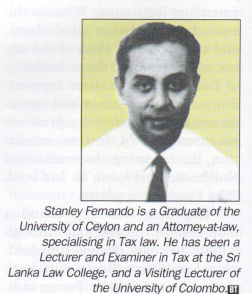
Those who speak sardonically about ‘tax dodgers’ reveal only their ignorance of the entire subject. Taxes cannot be dodged. They can be either avoided or evaded, depending upon whether the method used is legal or other- wise. Both methods are old as taxation itself.” Stanley Femando is a Graduate of the University of Ceylon and an Attomey-at-law, specialising in Tax law. He has been a Lecturer and Examiner in Tax at the Sri Lanka Law College, and a Visiting Lecturer of the University of Colombo