
Words Imara De Chickera.
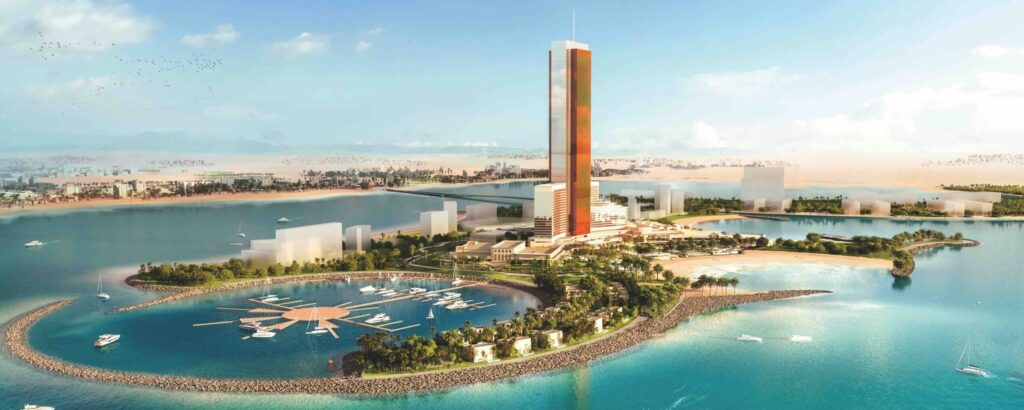
A panoramic aerial view of Wynn Al Marjan Island with its landmark tower, turquoise waters, luxury marina, and surrounding desert landscape.

A serene landscaped walkway with vibrant gardens beside the modern tower.

Craig Billings, CEO, Wynn Resorts.
When global executives evaluate transformative bets, Wynn Resorts’ move into the UAE stands out as one of the boldest strategic plays of the decade. Long associated with Las Vegas grandeur and the high-stakes energy of Macau, Wynn is now reshaping the Gulf’s tourism landscape with a USD 5.1 billion integrated resort on Al Marjan Island in Ras Al Khaimah, the UAE’s first venture into commercial gaming. At the center of this ambitious undertaking is Craig Billings, CEO of Wynn Resorts, whose confident leadership reflects a commitment to scale, global reach, and market-defining strategy.
Billings effectively captures the company’s philosophy. Wynn does not pursue modest or incremental opportunities. It builds destinations that redefine markets. Al Marjan Island, a man-made archipelago developed over more than a decade, offers exactly the type of blank canvas the company seeks. It is positioned outside the overexposed zones of Dubai and Abu Dhabi, yet close enough to benefit from their infrastructure, international airlift, and regional connectivity. For Wynn, the value of this location extends beyond its geography. Billings notes that when the resort opens, 95 per cent of the world’s population will be within an eight-hour flight of a Wynn property. This level of global access is unmatched by any other integrated resort operator.
The resort now rising on the island aims to reset expectations for luxury and experiential hospitality in the Middle East. Scheduled to open in 2027, the development will feature approximately 1,500 rooms, a private beach, a theatre, 22 restaurants, extensive retail offerings, multiple swimming pools, landscaped promenades, and a spa that blends coastal calm with upscale sophistication.
Although the gaming floor has captured the most attention, Wynn reiterates that gaming is only one element of its operating model. It is an important source of revenue, but the company’s core identity is built on immersive experiences that attract diverse global travelers and generate strong non-gaming returns.
For Ras Al Khaimah, this development marks a significant shift in trajectory. Often described as the UAE’s quieter northern emirate, Ras al-Khaimah offers a unique combination of natural landscapes, long coastlines, and a relaxed charm that sets it apart from its neighbors. The partnership between Wynn Resorts, Marjan LLC, and RAK Hospitality Holding reflects a long-term vision that aligns international expertise with local ambition, positioning the emirate to attract a new category of visitor and investor. The economic implications are substantial. Ras Al Khaimah has been working to diversify its economy, and a project of this magnitude can act as a catalyst across multiple sectors. Job creation is expected to be considerable. Wynn reports receiving more than 100,000 applications for roles related to the project. This surge highlights the demand for high-quality employment opportunities. However, it also reflects the reality that many of these roles require specialised skills that may need to be sourced internationally. The cultural dimension cannot be ignored. The introduction of gaming in a conservative emirate will require careful management of social sensitivities.
Beyond employment, revenues generated from the resort could enhance public services, including housing, healthcare, and education. Critics caution that the distribution of these benefits may not be as broad as anticipated. Infrastructure remains a key challenge. Roads, healthcare systems, and public amenities will need rapid advancement to support the influx of tourists and residents who will be drawn to the area. Economic projections suggest that Ras Al Khaimah’s GDP per capita could reach around USD 32,800 by 2027, signalling an upward trajectory for the emirate’s financial profile.
The establishment of the General Commercial Gaming Regulatory Authority by the UAE marks a historic shift in national policy. For the first time, the country has established a structured framework to regulate commercial gaming, signaling an openness to new economic models. Wynn has secured a 15-year exclusive gaming license in Ras Al Khaimah. However, this exclusivity represents a strategic window rather than a long-term certainty. Other emirates, including Abu Dhabi, are evaluating the feasibility of gaming licenses. Wynn is preparing for the possibility of competition. Billings points to the company’s success in the competitive markets of Las Vegas and Macau as evidence of its ability to perform effectively in both monopoly and open-market environments.
Billings notes that when the resort opens, 95 per cent of the world’s population will be within an eight-hour flight of a Wynn property. This level of global access is unmatched by any other integrated resort operator.
Wynn Al Marjan Island is also part of a broader corporate strategy. As expansion opportunities in the United States become increasingly limited, the company is looking more toward global markets to drive growth. Japan and Thailand are among the countries being considered for future developments, where integrated resorts could stimulate tourism and contribute significantly to their national GDP. The UAE project, therefore, acts as both a flagship development and a strategic foothold for Wynn’s next phase of international expansion.
There is an inherent tension in this undertaking. Wynn is introducing a Las Vegas-born gaming culture into one of the most culturally conservative regions in the Middle East. Ras Al Khaimah takes pride in its traditions and social continuity. The success of this project will depend on the company’s ability to balance global luxury hospitality with respect for local identity. Billings consistently frames the resort as an economic, architectural, and cultural landmark designed to elevate the emirate’s international profile while preserving its character.
Wynn’s Al Marjan Island investment is a calculated, transformative bet. It reflects the UAE’s ambition to diversify via high-value tourism and lifestyle experiences. If successful, it will reshape Wynn’s global footprint and Gulf tourism.
Wynn’s decision is already changing Ras Al Khaimah’s trajectory. It shows how a global brand and emerging destination can redefine a market, demonstrating leadership, risk-taking, and long-term value creation.

Elegant entrance to a luxurious bar adorned with grand drapery and crystal peacock sculptures.

A grand hotel lobby at dusk, glowing with warm lighting, ornate columns, and elegant seating overlooking the sunset.

A luxurious indoor promenade lined with elegant boutiques and manicured garden-style greenery beneath grand arched ceilings.
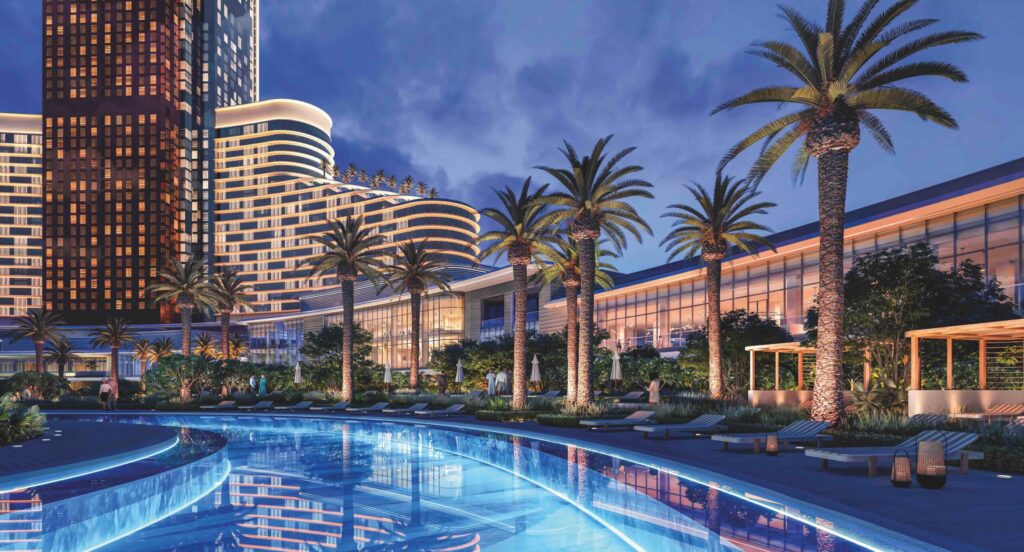
A glowing pool deck at dusk, framed by palm trees and the illuminated curves of the resort’s tower.