
Clara Mendelson.
The CEO’s New Reality
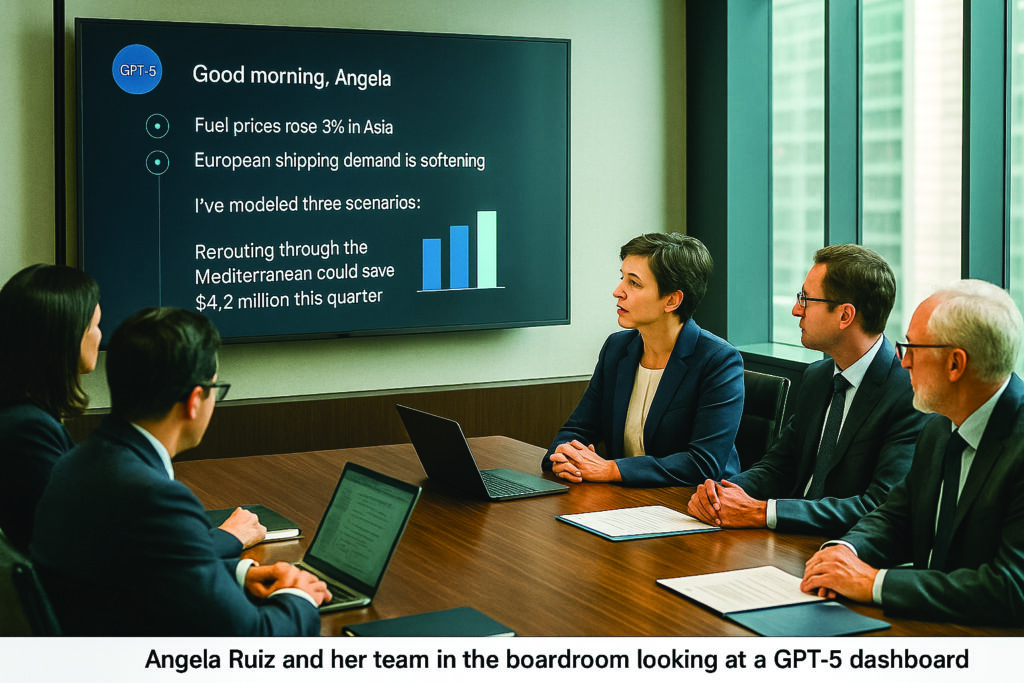
At 7.58am, Angela Ruiz, CEO of a multinational logistics company, sat down in her boardroom. On the large display wasn’t her usual dashboard of KPIs. Instead, GPT-5—the latest generative AI model from OpenAI—was waiting with a morning briefing.
“Good morning, Angela,” the system began. “Here’s what’s new: fuel prices rose three percent in Asia, but European shipping demand is softening. I’ve modeled three scenarios. Rerouting through the Mediterranean could save USD 4.2 million this quarter and protect margins through Q4.”
Ruiz looked around the table. Analysts, VPs, even her CFO nodded. The kind of insight that once required a week of cross-functional coordination had just landed in less than three minutes. For the first time, AI wasn’t just a back-office productivity tool. It was a strategic actor.
GPT-5, the latest generation of OpenAI’s conversational model, marks a turning point. Where earlier versions impressed with language fluency, GPT-5 demonstrates decision-grade reasoning, contextual memory, and enterprise integration that elevate it from assistant to advisor. For CEOs, it raises a defining question: Are you ready to let AI sit at the executive table?
From Tool to Strategic Partner
Until recently, executives treated generative AI as tactical. Draft a press release, summarize customer feedback, outline a proposal—helpful, yes, but not transformative. GPT-5 crosses a threshold.
Three innovations distinguish it from predecessors:
- Strategic Memory: GPT-5 retains organizational context. It knows your quarterly objectives, your industry’s regulatory landscape, your leadership team’s communication style. Each interaction compounds, creating continuity across weeks and months.
- Decision-Grade Reasoning: Rather than generating plausible responses, GPT-5 evaluates trade-offs. It can frame multiple outcomes, flag assumptions, and highlight risks—bringing a consultative lens that leaders recognize from their best human advisors.
- Enterprise Integration: Through APIs, GPT-5 connects seamlessly to ERP, CRM, and financial systems. Instead of static prompts, executives can query live business data in natural language: “What is the five-year ROI on our Southeast Asia expansion compared to scaling in Africa?”
The result is not an intern-level tool but a colleague-level presence. One early adopter described GPT-5 as “the partner who always has the numbers, always knows the playbook, and never needs a weekend.”
Case Studies: GPT-5 in Action
Banking: Compressing Compliance Timelines
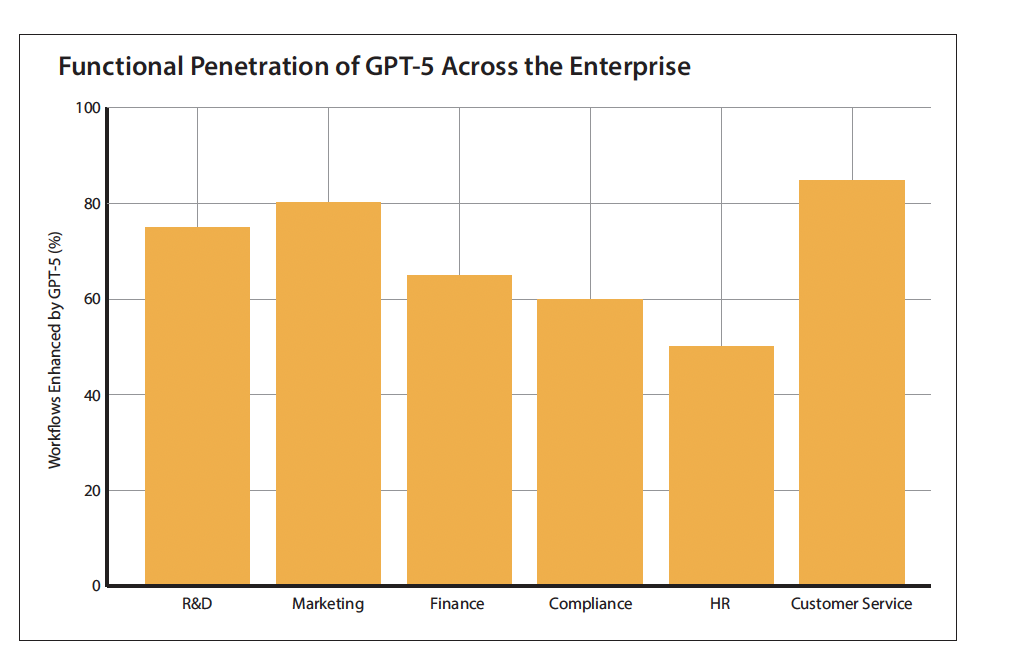
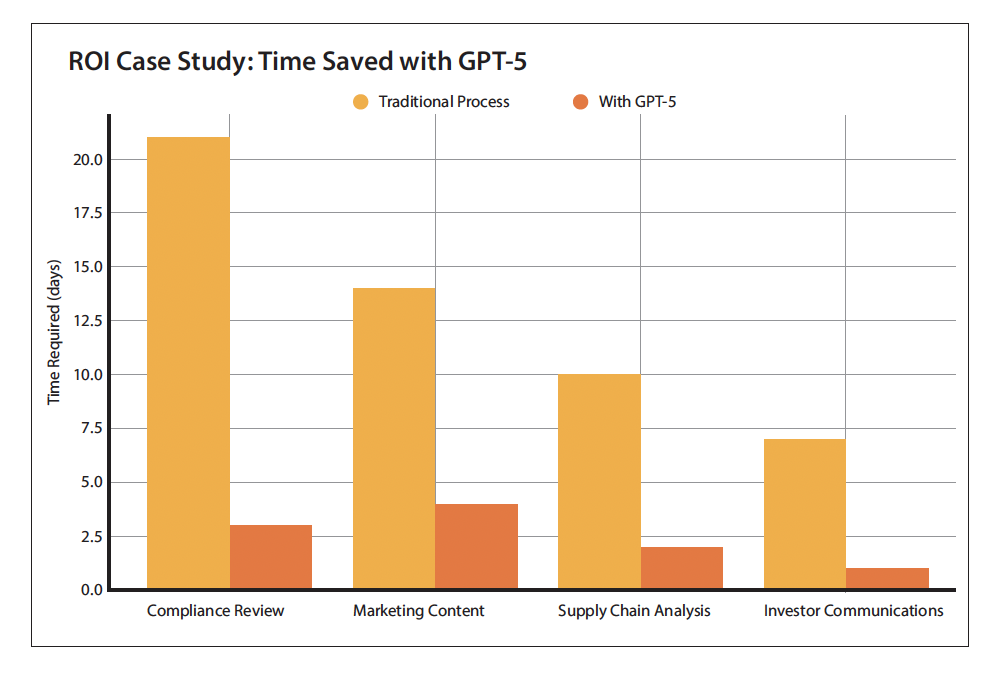
A Japanese bank faced mounting pressure to accelerate compliance reviews under new anti–money laundering regulations. Traditionally, the process required three weeks of legal review and manual cross-checking. With GPT-5 integrated into their compliance system, the cycle dropped to three days. The AI flagged high-risk anomalies, generated plain-language summaries for executives, and even drafted regulator-ready documentation. Human oversight remained essential, but throughput improved by 85 percent.
Consumer Goods: Reinventing Marketing at Scale
A European CPG company needed to launch campaigns across 12 markets, each with strict brand guidelines. GPT-5 became their content engine, generating local-language campaigns that preserved tone, compliance, and brand equity. Marketing costs fell 70 percent. But more critically, speed doubled, allowing launches in parallel across multiple geographies. The CMO observed: “GPT-5 wasn’t just cheaper— it made us faster than competitors.”
Logistics: Smarter Supply Chains
Angela Ruiz’s firm isn’t fictional. Her global logistics company now runs daily scenario analyses through GPT-5, modeling shipping delays, fuel price fluctuations, and geopolitical shifts. Instead of waiting for monthly risk reviews, the CEO receives near real-time “executive briefs.” She calls it “the early warning radar my industry never had.”
The Strategic Payoff
The business impact is measurable across four vectors:
- Speed: What once took weeks now takes hours. GPT-5 collapses the time between data availability and executive action.
- Cost Efficiency: From content creation to compliance, pilot programs report savings between 30 percent and 70 percent.
- Risk Management: Early detection of compliance issues or market shifts reduces exposure to regulatory fines and supply chain shocks.
- Leadership Leverage: GPT-5 amplifies executive bandwidth. Instead of drowning in prep work, leaders focus on judgment and vision.
A Fortune 500 CTO summarized it succinctly: “GPT-5 doesn’t just automate tasks. It accelerates decisions.”
The Risks and Tensions
Yet GPT-5’s arrival is not without friction. CEOs face three categories of risk:
- Trust in AI Judgment: GPT-5 speaks with authority. But like any AI, it can be wrong—sometimes subtly, sometimes spectacularly. Over-reliance without validation could lead to billion-dollar mistakes.
- Data Governance: Feeding sensitive strategy documents or customer data into GPT-5 requires robust guardrails. Wi thout enterpr ise-grade deployment, companies risk leaks or regulatory breaches.
- Cultural Resistance: Executives and managers vary in their comfort with AI. Some see it as empowerment; others fear replacement. Without intentional change management, adoption will stall.
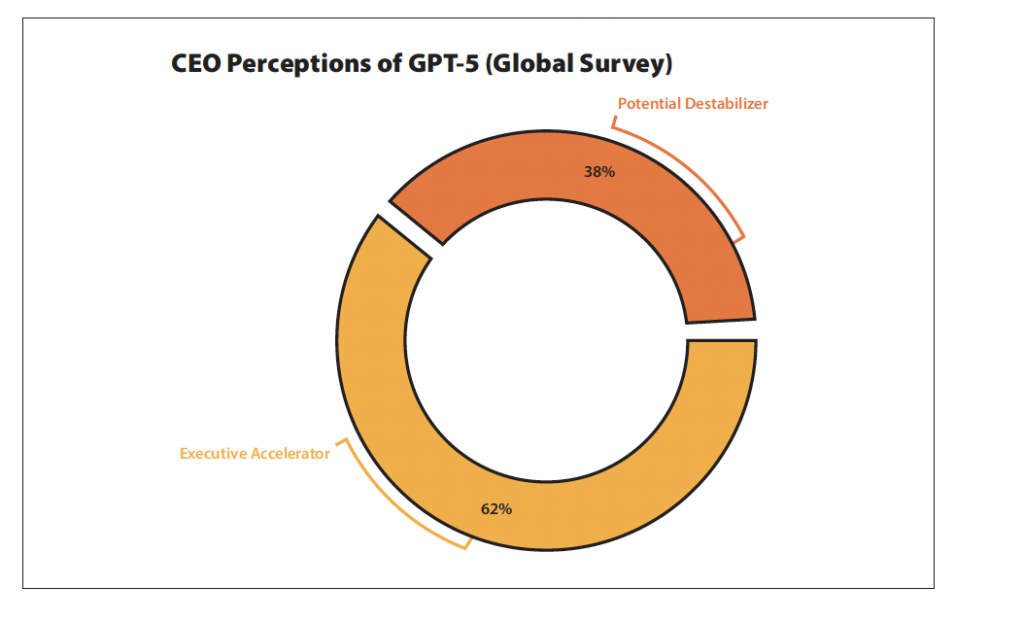
A recent survey of 300 global CEOs showed a divide: 62 percent saw GPT-5 as “an executive accelerator,” while 38 percent labeled it “a potential destabilizer.” The difference? Governance maturity and willingness to redesign workflows.
A Framework for CEOs: The AI Boardroom Agenda
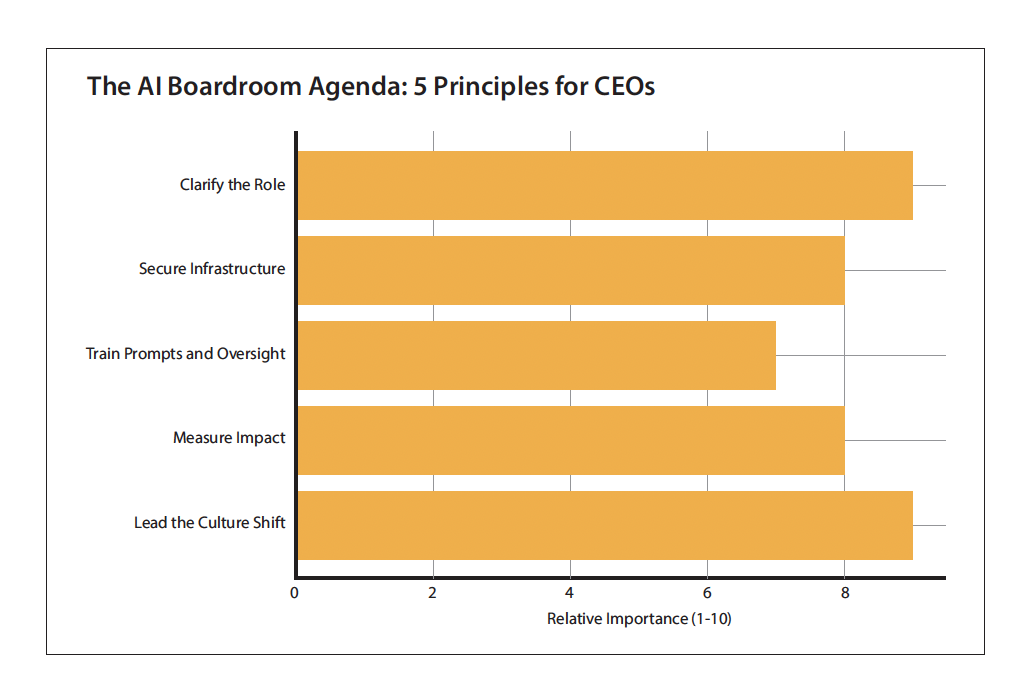
Based on early deployments, five principles define successful GPT-5 adoption:
Clarify the Role: Treat GPT-5 as an advisor, not a decision-maker. Final accountability must remain with humans.
Secure the Infrastructure: Insist on private, enterprise-grade deployments with strict data retention policies.
Train for Prompts and Oversight: Executives need to learn how to ask questions and how to audit responses. Prompt literacy is a leadership skill.
Measure Impact: Track time saved, errors avoided, and decisions accelerated. Translate outputs into ROI.
Lead the Culture Shift: Reframe AI as augmentation, not automation. Highlight stories of leaders who became more effective by using GPT-5.
The Future of Leadership in the GPT-5 Era
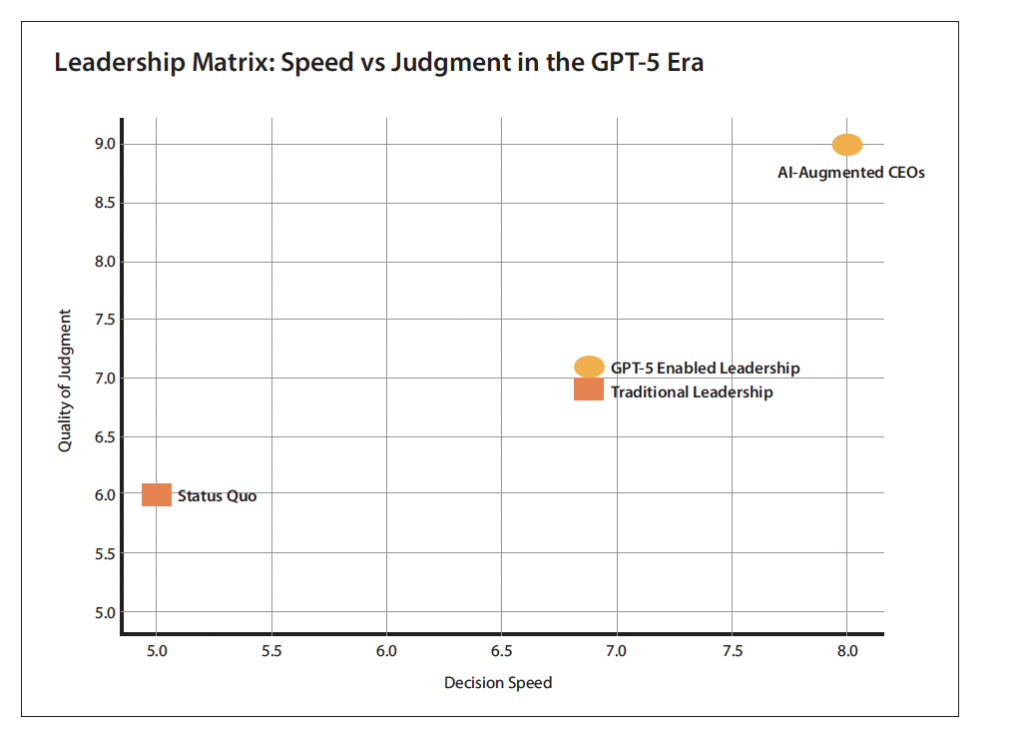
Leadership itself is evolving. Traditional advantages—access to information, ability to process complexity, speed of analysis—are being democratized. What distinguishes leaders in the GPT-5 era will not be information access but judgment, vision, and humanity.
As Ruiz puts it: “GPT-5 gave me the data and scenarios. But it couldn’t tell me what kind of company I want to build. That’s my job.”
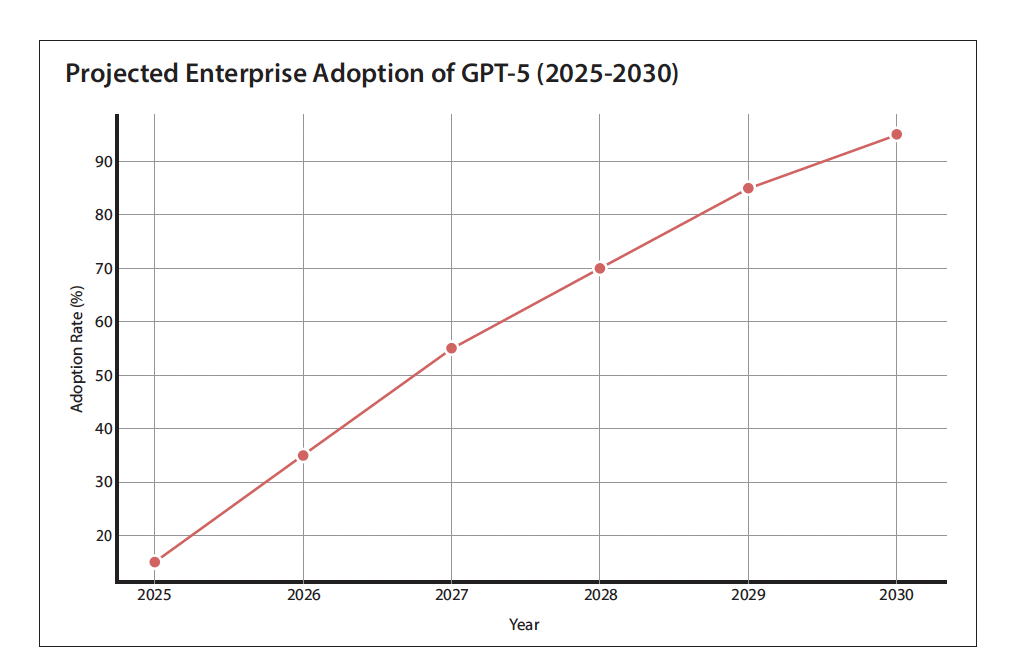
By 2030, business historians may write that GPT-5 marked the moment when AI moved from tactical assistant to strategic partner. Not because it was the smartest model ever built, but because it was the first to speak fluently in the language of leadership.
The CEO’s Checklist
- Pilot Now. Identify one high-stakes use case—investor communications, compliance, or supply chain forecasting.
- Secure Deployment. Ensure enterprise-grade data protection.
- Build Capability. Train executives in prompt strategy and oversight.
- Measure ROI. Quantify both efficiency gains and decision acceleration.
- Scale Thoughtfully. Roll out across functions only once governance and cultural adoption are solid.
The Bottom Line
GPT-5 is no longer just software. It is a strategic capability. CEOs who embrace it thoughtfully will find themselves leading faster, sharper, more resilient organizations. Those who hesitate risk being written out of the next chapter of business history.
In the words of one global CEO: “My competitors and I both have GPT-5. The difference is, I trained my team to use it as an ally. That’s our edge.”
Clara Mendelson is a senior analyst and writer specializing in technology strategy, organizational transformation, and the future of work. With over 15 years advising Fortune 500 executives and emerging-market leaders, she brings a boardroom-level perspective to the intersection of artificial intelligence and leadership. Clara’s work has been featured in leading business publications, and she has presented at the World Economic Forum on digital transformation and executive decision-making. She writes frequently on how CEOs can harness emerging technologies to unlock growth, resilience, and competitive advantage.