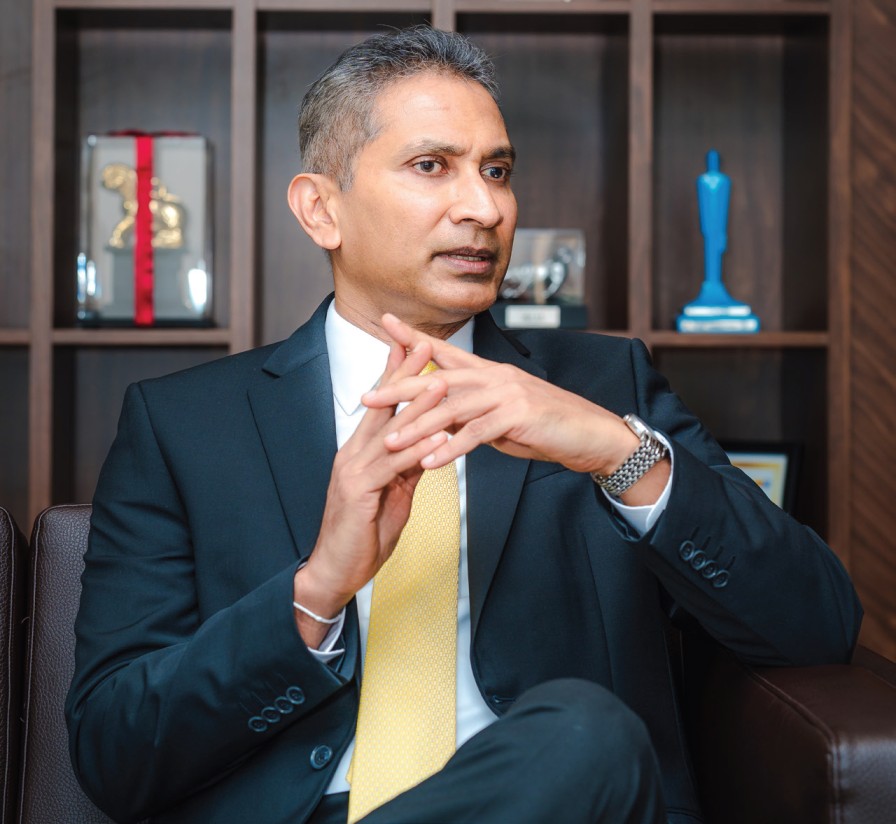

Sampath Bank has emerged as one of Sri Lanka’s strongest performers in the post-crisis recovery, delivering record profitability in 2024 and sustaining strong momentum into the first half of 2025. Speaking with Business Today, Chief Executive Officer Sanjaya Gunawardane outlines how disciplined balance-sheet management, diversified income streams, digital transformation, and proactive risk governance enabled the Bank to navigate a period of severe macroeconomic stress while positioning itself for sustainable growth. He also shares his outlook on credit expansion, the role of banks in supporting national development, and how Sampath Bank is leveraging technology, data, and strategic focus to build a resilient, future-ready financial institution.
Words Jennifer Paldano Goonewardane.
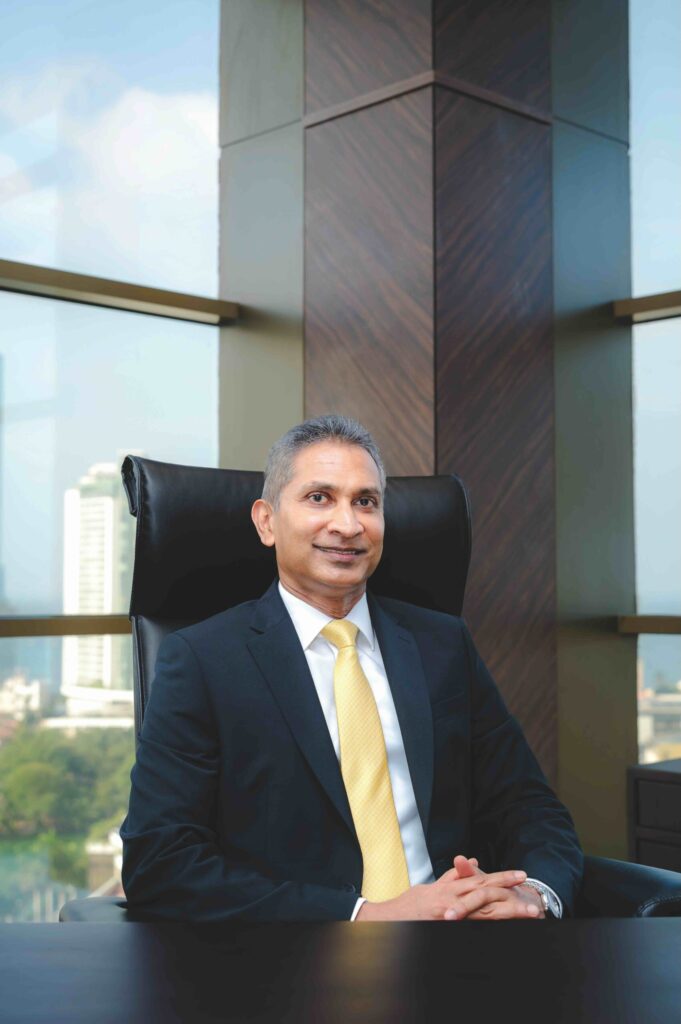
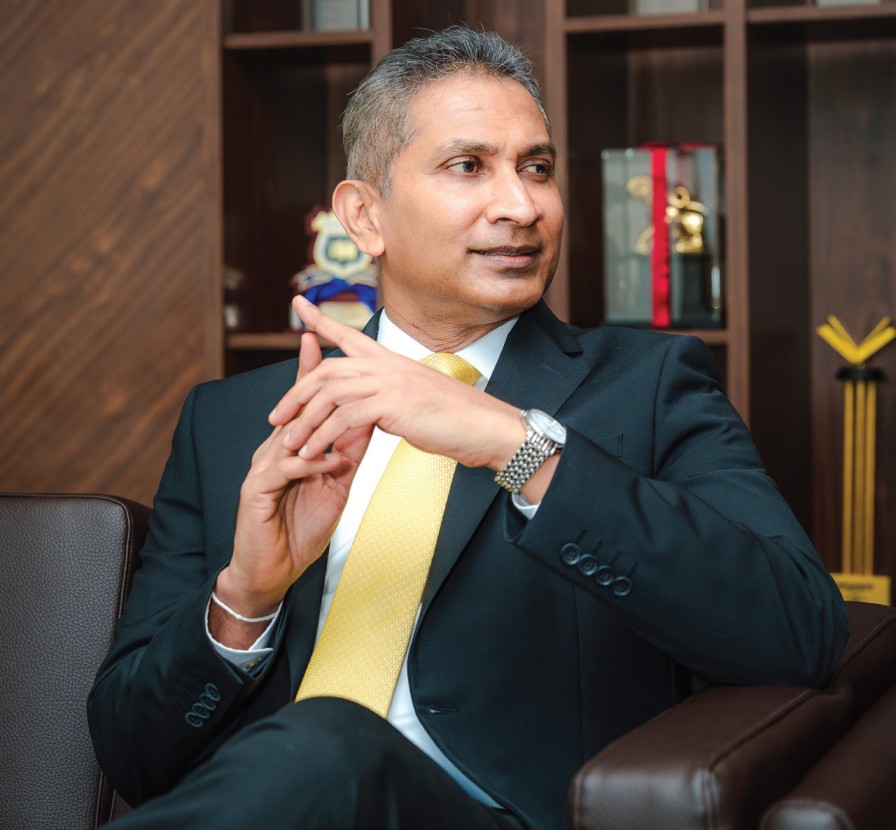
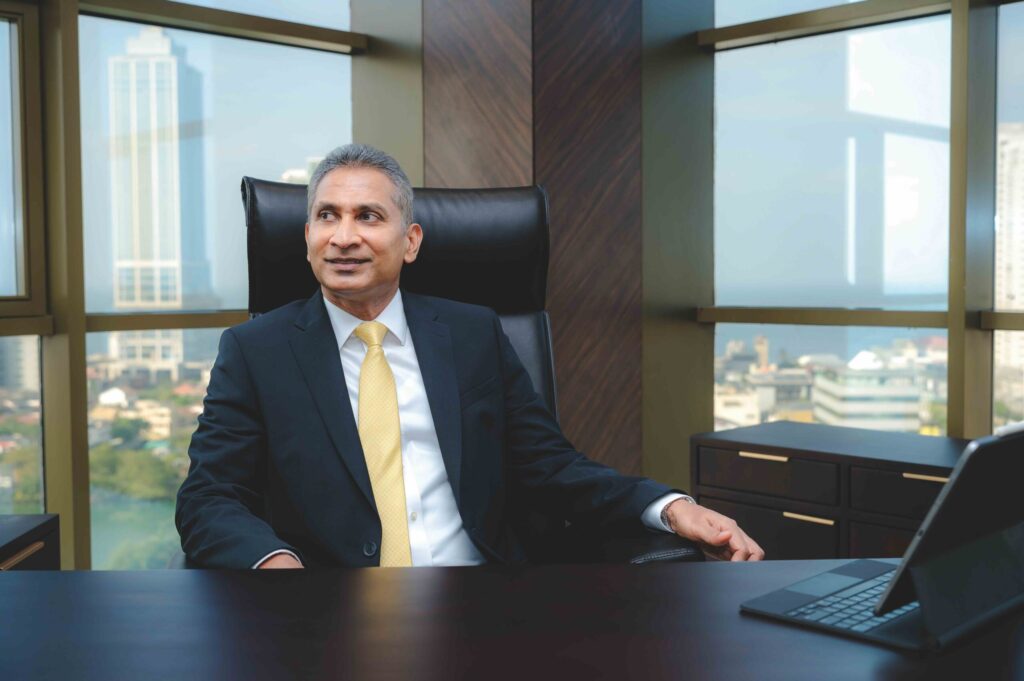
Sanjaya Gunawardane, Chief Executive Officer, Sampath Bank.
Sampath Bank delivered its highest PAT in history in 2024, with around a 59 percent increase year-on-year. What were the key strategic decisions that drove such impressive profitability, and how are you sustaining that momentum into 2025?
Sampath Bank’s record profitability in 2024 was not the result of a single factor, but rather the outcome of a series of deliberate strategic choices taken over several years, particularly during a period of macroeconomic stress.
First, balance sheet discipline was a key driver. We consciously focused on asset repricing, liability optimization, improving portfolio mix, and maintaining sufficient liquidity as interest rates peaked, enabling us to expand margins while upholding prudent risk standards and maintaining customer confidence.
Second, our strategy to diversify income was essential. Growth in non-fund-based income—from trade finance, cards, digital payments, and treasury—reduced dependence on interest income and stabilized earnings.
Third, asset quality management was a central focus. We adopted a proactive approach to credit monitoring, early warning signals, and restructuring viable borrowers during the downturn. We ensured uninterrupted support for customer requirements, which helped us preserve our customer base during challenging times — a foundation for future growth. This resulted in lower impairments and reversals as economic conditions stabilized.
Sustaining this momentum into 2025 is not about repeating a one-of f performance but about institutionalizing these disciplines. As interest rates normalize, our focus has shifted toward sustainable credit growth, deepening customer relationships, and scaling fee-based businesses. We are also prioritizing data-driven decision-making to sharpen pricing, risk assessment, and customer segmentation.
Our results demonstrate a resilient and long-term growth strategy. We focus on delivering consistent value by striking a balance between growth, risk, and returns.
For the first half of 2025, the bank posted robust double-digit growth in both PBT and PAT. What key drivers — such as non-fund business income, credit growth, or cost management — are behind this continued momentum?
The strong double-digit growth in both PBT and PAT during the first half of 2025 reflects the quality and sustainability of Sampath Bank’s earnings profile rather than cyclical tailwinds alone. While the macro environment has improved, our per formance is fundamentally underpinned by two core drivers: diversified income growth and disciplined credit expansion.
Non-fund-based income remains a significant contributor. We have seen strong traction in trade finance, card-based transactions, digital payments, and treasury-related income. As economic activity picks up, transaction volumes have increased, and our strong franchise has allowed us to capture a disproportionate share of this growth. Importantly, these income streams are capital-light and enhance return on equity.
On the lending side, with the rapid expansion of private credit, the Bank was able to leverage the existing infrastructure to drive above-industry growth during the year. We focused on sectors and borrowers with strong cash flow visibility and post-recovery growth potential. Retail lending — particularly housing and secured and unsecured personal credit — alongside well-rated SMEs and Corporates, drove growth while maintaining asset quality.
In addition to the above, our earlier investments in digitalization, process automation, branch rationalization, workflow digitization, and centralized operations have created operating leverage, enabling revenue growth to translate efficiently into bottom-line performance.
Another important factor has been the moderation of impairment. Improved borrower performance, recoveries, and prudent provisioning policies adopted earlier, supported by the favorable market interest rate movement, have resulted in lower credit costs. However, we remain cautious and forward-looking in provisioning, ensuring resilience against potential external shocks.
The first half’s results confirm our balanced banking model. We will continue to scale non-interest income, engage customers, and maintain cost and risk discipline.
As a systemically important institution, our decision-making frameworks, stress-testing, and disclosures must meet the highest standards. We continue to strengthen board oversight, enterprise risk management, and compliance culture accordingly.
With Sampath Bank now designated as a Domestic Systemically Important Bank by the Central Bank, how does this recognition shape your role in financial stability, capital management, and strategic growth?
The designation of Sampath Bank as a Domestic Systemically Important Bank (DSIB) is both a recognition of our scale and significance, and a responsibility we take very seriously. It reinforces our role as a cornerstone of Sri Lanka’s financial system, with heightened expectations around stability, governance, and long-term resilience.
From a financial stability perspective, the DSIB framework requires higher capital buffers and enhanced risk management standards. We view this not as a constraint, but as an enabler of sustainable growth. Strong capitalization enhances depositor confidence, supports balance sheet expansion, and allows us to absorb shocks without disrupting credit intermediation.
Capital management is therefore a strategic priority. We are focused on optimizing capital allocation across business lines, improving risk-adjusted returns, and retaining sufficient earnings to support future growth. Our objective is to maintain capital comfortably above regulatory minimum while continuing to deliver attractive shareholder returns.
Strategically, DSIB status shapes how we approach growth. Scale alone is not the objective; quality, diversification, and systemic relevance are more important. We are aligning our growth strategy with sectors that support economic development, including SMEs, exports, infrastructure-linked industries, and digitally enabled retail banking, while mitigating excessive concentration risks.
Governance and transparency also assume greater importance. As a systemically important institution, our decision-making frameworks, stress-testing, and disclosures must meet the highest standards. We continue to strengthen board oversight, enterprise risk management, and compliance culture accordingly.
Ultimately, DSIB recognition reinforces Sampath Bank’s long-term positioning. It affirms our role not just as a commercial entity, but as a partner in national economic stability and growth. Our commitment is to balance this responsibility with innovation, competitiveness, and value creation for all stakeholders.
As Sri Lanka’s economy continues to stabilize, where do you see the most promising areas for credit expansion — retail, SMEs, corporate sectors, or specific industry exposures?
As Sri Lanka grows, we identify credit opportunities across retail, SME, and corporate segments, aiming for a balanced and prudent portfolio.
Retail banking remains a key driver of growth. Housing finance, secured and unsecured personal lending, and vehicle financing — particularly electric and energy-efficient vehicles — show strong demand and relatively predictable risk characteristics. Rising consumer confidence and stabilizing interest rates support sustainable growth in this segment.
SMEs represent one of the most compelling opportunities. They are central to employment generation, exports, and domestic value addition. We are expanding tailored financing solutions for SMEs, combining credit with cash management, trade finance, and digital tools. Importantly, we are leveraging data analytics and alternative information to better assess SME risk beyond traditional collateral-based models.
In the corporate sector, we are selectively supporting working capital and expansion requirements in export-oriented industries, logistics, renewable energy, agr ibusiness, and manufacturing. These sectors align with Sri Lanka’s medium-term growth strategy and foreign exchange generation objectives.
We are also cautiously exploring emerging sectors, including technology-enabled ser vices, healthcare, education, and green financing. These areas offer long-term potential but require specialized risk assessment and sector expertise.
We see broad credit opportunities, but our growth will remain risk-adjusted, measured, and aligned with national priorities, with a focus on prioritizing credit quality.
Sampath Bank has experienced consistent deposit growth, significantly expanding its balance sheet in recent years. How are you balancing deposit mobilization with competitive pricing while maintaining a healthy liquidity position?
Deposit mobilization has been a consistent strength for Sampath Bank, reflecting strong brand trust, extensive reach, and customer-centric product offerings. As we continue to expand the balance sheet, balancing competitive pricing with liquidity discipline is a key strategic focus.
Our approach star ts with diversification. We maintain a healthy mix of CASA, term deposits, and institutional funding, reducing reliance on any single segment. CASA growth, supported by digital onboarding and transaction-based products, helps lower overall funding costs and stabilize liquidity.
Pricing discipline is critical in a competitive environment. Rather than competing solely on rates, we focus on value propositions — convenience, digital capabilities, service quality, and bundled offerings. This allows us to attract and retain deposits without engaging in unsustainable pricing practices.
Digital savings products and data-driven customer segmentation enable us to mobilize deposits more efficiently while enhancing the customer experience. Deposit growth at Sampath Bank is not about short-term volume accumulation. It is about building stable, cost-effective funding that supports sustainable lending and protects balance sheet resilience.
While NIM has softened slightly given the low-rate environment, what are your strategies to optimize interest income while diversifying into higher-fee and non-fund income streams?
While net interest margins have softened due to the low-rate environment, Sampath Bank is actively optimizing interest income while accelerating diversification into non-fund-based revenue streams.
On the interest income side, balance sheet optimization is key. We focus on improving asset mix, implementing repricing discipline, and managing liabilities to protect spreads. A strategic shift toward higher-yield segments, such as SMEs and the retail sector, which is critical for national economic growth, is a priority for us. Corporate exposures support stable yields without excessive risk.
At the same time, non-interest income is a strategic priority. We are expanding our fee-based businesses, including cards, digital payments, trade f inance, cash management, bancassurance, and wealth-related services. These streams are scalable, capital-efficient, and less sensitive to interest rate cycles. Digitalization is a powerful enabler. Higher transaction volumes through mobile and online platforms translate directly into fee income while lowering servicing costs. The objective is not to replace interest income, but to build a balanced revenue model that enhances earnings quality and reduces volatility.
Improving credit quality and lower impairments have been a feature of recent results. How do you view the health of the loan book today, and what risk-management priorities do you set in the current macro environment?
Improving credit quality and lower impairments in recent periods are the result of a disciplined, forward-looking approach to risk. The health of Sampath Bank’s loan book today reflects the difficult but necessary actions we took during the downturn — engaging early with customers, restructuring viable businesses, and exiting or containing exposures where risks became unacceptable. As a result, we are now seeing tangible improvements in asset quality indicators, declining non-per forming loans, moderating impairment charges, and coverage ratios that remain comfortably above regulatory and internal benchmarks.
Importantly, this is not a passive outcome of better economic conditions; it is the product of strengthened credit governance. We have significantly enhanced our early-warning systems, using data-driven signals to identify stress well before loans migrate into delinquency. Sector-level surveillance, borrower-level cash-flow analysis, and tighter post-disbursement monitoring enable us to distinguish between temporary liquidity pressures and deeper structural weaknesses, allowing for timely and proportionate intervention.
While Sri Lanka’s macro environment has stabilized compared with the crisis period, risks have not disappeared. Global interest rate volatility, geopolitical disruptions, and fluctuations in commodity prices continue to impact exporters, the tourism sector, logistics, and energy-linked industries. Domestically, consumer demand, inflation dynamics, and fiscal consolidation still pose challenges. Against this backdrop, our risk-management priorities remain firmly anchored on resilience rather than short-term growth.
We are therefore focused on maintaining a well-diversified portfolio across sectors, customer segments, and geographies, supported by regular stress testing under severe but plausible downside scenarios. Conservative provisioning policies ensure that we remain well-buffered even if conditions were to deteriorate again. In parallel, we are integrating environmental, social, and climate-related risk assessments into our credit frameworks, recognizing that sustainability risks are increasingly translating into financial risks over the life of long-term lending.
Ultimately, our objective is to grow in a way that is resilient and responsible. We want to support economic recovery and enterprise, but never at the expense of compromising the stability of our balance sheet. That philosophy — that growth must always be underpinned by strong risk discipline — continues to guide every major credit decision we make.
Sri Lanka’s economy is showing signs of recovery with improving GDP growth and business confidence. What role do you see commercial banks playing in catalyzing growth — especially for SMEs and priority sectors?
Sri Lanka’s economic recovery since 2023 has been built on a foundation of restored financial system stability, achieved through the coordinated actions of commercial banks and the Central Bank. By safeguarding depositor confidence, maintaining liquidity, and continuing to provide credit during a period of extreme stress, the banking sector played a decisive role in preventing a deeper contraction. That stability is now translating into renewed investment, rising business confidence, and a gradual return of economic momentum.
As the primary allocators of financial capital in the economy, commercial banks have a unique responsibility in shaping the quality of growth. It is not simply about increasing credit volumes, but about directing funding toward the most productive and value-creating sectors. For Sampath Bank, this means extending credit in a disciplined and responsible manner to SMEs, exporters, agribusinesses, the tourism sector, and other priority segments that generate employment, foreign exchange, and regional development. However, the role of banks must go far beyond balance-sheet lending. SMEs in particular need structured financial solutions — including cash management, trade finance, supply-chain financing, digital payments, and advisory support — rather than just term loans or overdrafts.
By helping businesses formalize their operations, improve governance, and adopt digital tools, banks can significantly enhance their resilience and long-term bankability.
We also see a growing opportunity to channel capital into productivity-enhancing investments such as technology adoption, renewable energy, modern logistics, and value-added manufacturing. These investments are critical if Sri Lanka is to move up the value chain and compete more effectively in global markets. Through project finance, green finance, and blended funding structures, banks can help crowd in both domestic and international capital into these strategic areas.
In this broader sense, commercial banks act not merely as intermediaries between savers and borrowers, but as active enablers of sustainable and inclusive growth. By aligning credit, advisory services, and digital platforms with national development priorities, we can help ensure that the economic recovery evolves into a more competitive, resilient, and future-ready Sri Lankan economy.
Digital channels and mobile banking are becoming increasingly important for enhancing customer experience and driving cost efficiency. How is Sampath advancing its digital offerings, and what impact are these having on customer engagement?
Sampath Bank has long been recognized as a pioneer in the use of technology in Sri Lankan banking, and today digitalization sits at the very core of how we engage with customers and run the institution. Our mobile and online banking platforms continue to record strong growth in both active users and transaction volumes, reflecting a clear shift in customer behavior toward digital-first banking. Importantly, this is not just about moving transactions online, but about deepening relationships — customers are using our digital channels for payments, savings, investments, lending, and day-to-day financial management.
A key focus area for us has been re-engineering entire customer journeys, not simply digitizing individual products. Initiatives such as our 10- second loan, launched this year, demonstrate how data, analytics, and automation can deliver credit decisions almost instantly while still maintaining strong risk discipline. We are also investing heavily in seamless digital onboarding, personalized product recommendations, and integrated ecosystems that allow customers to move effortlessly between accounts, payments, cards, and financing.
From an operational perspective, automation, straight-through processing, and advanced analytics are driving meaningful gains in efficiency. Turnaround times are shorter, error rates are lower, and unit costs are steadily declining. At the same time, these technologies strengthen risk management by providing real-time visibility into transactions, customer behavior, and emerging vulnerabilities.
Cybersecurity and data protection are non-negotiable in this environment. As we expand our digital footprint, we continually upgrade our security architecture, fraud monitoring systems, and customer authentication frameworks to ensure that convenience never comes at the expense of trust.
The results are clearly visible in higher customer satisfaction scores, rising CASA balances driven by digital convenience, and an improving cost-to-income ratio. Digital is no longer a back-office support function for Sampath — it is a core competitive advantage and a critical driver of sustainable growth in an increasingly digital financial ecosystem.
What are the top three priorities for Sampath Bank over the next 12–24 months — in terms of growth, innovation, and strategic positioning?
Our first priority is sustainable growth — expanding both our lending and fee-based businesses while maintaining strong asset quality and preserving robust capital and liquidity buffers. We are committed to growing our balance sheet in a prudent, profitable, and resilient manner across economic cycles.
The second priority is accelerating digital and data-led innovation. We will deepen the use of analytics in decision-making, continue to elevate our digital customer journeys, and deliver more personalized and intuitive experiences. At the same time, we will utilize technology to enhance productivity, refine risk management, and facilitate faster and smarter execution across the Bank.
Our third priority is strategic positioning and institutional resilience. As a Domestic Systemically Important Bank, we will further strengthen governance, embed ESG principles across our operations and lending, and maintain robust long-term capital planning to ensure that Sampath Bank remains a trusted and stable pillar of the financial system.
Together, these priorities will guide our next phase of growth — disciplined in execution, innovative in approach, and resilient by design. Our ambition is clear: to position Sampath Bank as Sri Lanka’s most trusted and preferred financial institution.
Our objective is to grow in a way that is resilient and responsible. We want to support economic recovery and enterprise, but never at the expense of compromising the stability of our balance sheet. That philosophy — that growth must always be underpinned by strong risk discipline — continues to guide every major credit decision we make.
Could you share your perspective on the people and culture that define Sampath Bank?
Sampath Bank is defined by a strong, collaborative, and ownership-driven culture. Our people operate as one team, united by a shared sense of purpose and responsibility for the Bank’s success. There is a deep sense of pride and accountability across all levels of the organization, with employees thinking and acting like true stakeholders rather than merely staff members.
This collective mindset has been a powerful driver of our performance. While we recognize and reward individual excellence, we place equal emphasis on teamwork, collaboration, and shared outcomes. By fostering a culture that balances accountability with mutual support, we have built an environment where people are motivated to contribute, innovate, and go the extra mile — ultimately enabling Sampath Bank to deliver consistent results and earn the trust of its customers and stakeholders.