

What does a spy disguised as a beggar in the 1980s have to do with India’s USD five trillion economy? Ajit Doval’s career reminds us that security and strategy remain the invisible backbone of growth.
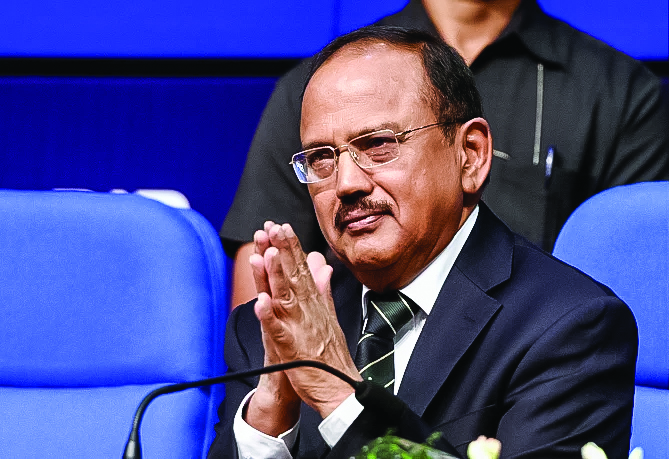
Ajit Doval.
A Mission beyond Espionage
In the early 1980s, a man in tattered clothes wandered the streets of Pakistan. He looked like a beggar, invisible to those around him. But this figure was Ajit Doval, then an intelligence officer from India, on one of the most daring covert missions of his career.
Stationed near a barber shop that attracted Pakistani nuclear scientists, he quietly collected discarded hair samples. Tests later revealed uranium traces— evidence of a clandestine weapons program. This single act provided India with undeniable proof of Pakistan’s nuclear efforts, delaying their capability by years and buying India precious time to recalibrate its own strategy. The episode resurfaced in public memory when it appeared in an e-book released in December 2023. But more than a thrilling tale of espionage, it symbolises a philosophy that has guided Ajit Doval for decades: security is not just about defending borders but about shaping the conditions that allow a nation to prosper.
This is where Doval’s story matters most for India’s business community. His career demonstrates how stability, foresight, and resilience—qualities of national security—are also the foundations of sustainable economic growth.
Security as Strategy
Traditionally, security was seen as the military’s domain: weapons, borders, and conflicts. Doval’s legacy has been to expand this definition into a multi-dimensional concept. In his view, threats emerge from hostile armies and cyberattacks, disrupted supply chains, energy chokepoints, disinformation campaigns, and economic coercion.
This expanded framework transforms security into strategy. It underlines that national resilience and economic vitality are inseparable. For businesses, security is not a background function but an enabling environment. Investors, manufacturers, and digital platforms depend on the assurance that the system is strong enough to withstand shocks.
Investor Confidence and Stability
Global capital is guided by perception as much as by policy. Investors evaluate not only growth figures and reform agendas but also the risks of instability. The confidence that a country can absorb shocks and respond decisively is central to where money flows.
Over the past decade, India’s perception as a resilient destination has strengthened. The assurance that external threats are being managed, that terrorism is contained, and that crises are handled steadily has made India a more attractive place for investment.
In this sense, security has functioned as a multiplier of economic opportunity. When businesses see predictable governance and credible responses to threats, they are more willing to commit capital and expand operations. Doval’s steady stewardship of national security has influenced the business environment in an indirect but powerful way.
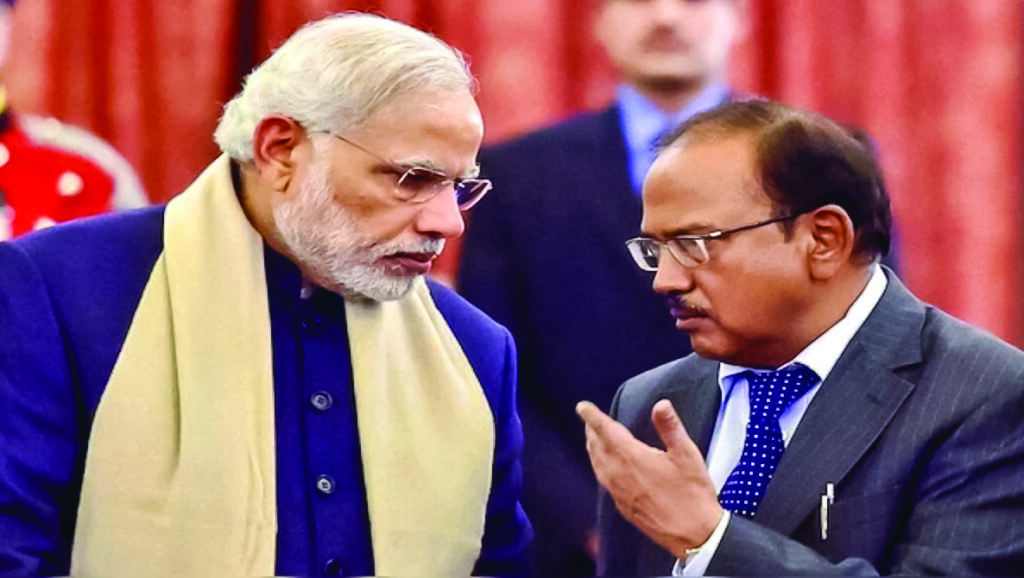
Ajit Doval has been a trusted aide to Prime Minister Narendra Modi since 2014. He serves as the Prime Minister’s National Security Advisor and shares similar views on security matters.
Cybersecurity and the Digital Economy
India’s transformation into a digital powerhouse has been one of the defining features of the last decade. From UPI and Aadhaar to the emerging ONDC and semiconductor ambitions, India has built a vast digital public infrastructure. But with digital expansion comes vulnerability.
Doval has consistently placed cyber threats at the center of the security agenda. Elevating cybersecurity from a technical issue to a matter of national security has reshaped how government and industry view the digital landscape.
For businesses, this shift has been profound. Cyber resilience is no longer seen as a discretionary IT investment but as essential for survival. Financial institutions, e-commerce platforms, and even traditional industries recognize that a single breach can paralyze operations, damage reputation, and undermine confidence. By framing cyber as a strategic frontier, Doval has effectively forced a cultural shift across India Inc.—from compliance to vigilance.
Maritime Security and Supply Chains
India’s economy is deeply dependent on maritime trade. Over 95 percent of its trade by volume and most of its energy imports pass through the seas. Disruption in these waters—whether by piracy, conflict, or blockade—would have immediate consequences for growth.
Under Doval’s watch, maritime security has been elevated as a national priority. Strengthening the Indian Navy, building regional alliances, and focusing on Indo-Pacific stability are not just defence moves but economic strategies. Secure sea lanes mean uninterrupted supply chains, predictable trade, and protected energy flows.
The lesson here for business is clear: geography is destiny, and securing the arteries of commerce is as vital as securing markets themselves. India’s growing credibility as a maritime power reinforces its attractiveness as a trading partner and investment destination.
Lessons from the Doval Playbook
Beyond policy, Ajit Doval’s personal style offers lessons for corporate leaders. His career reveals a consistent reliance on foresight, patience, and disruption— qualities that resonate in the business world.
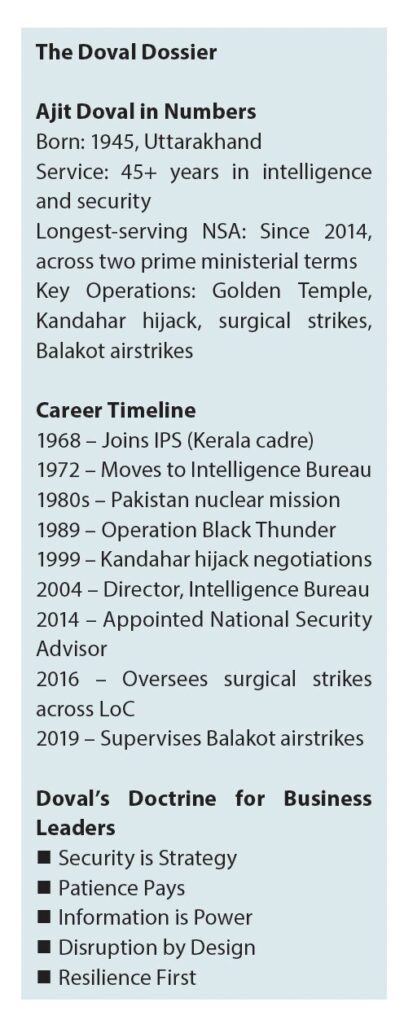
- Resilience through disruption: His disguise and unorthodox methods show the value of thinking differently to outmanoeuvre adversaries. Businesses, too, must innovate to survive in crowded markets.
- Long-term payoff: The nuclear mission delayed threats by over a decade, creating time for India to consolidate. Companies that invest in long-term resilience rather than chasing short-term gains build durable advantages.
- Strategic patience: Ajit Doval is known for waiting for the right moment before acting. In volatile markets, the ability to hold fire until perfect timing often separates success from failure.
- Information as power: Intelligence is the bedrock of his career. For businesses, market insight, risk analysis, and data are the equivalents of intelligence, essential for strategic decision-making.
These principles, abstracted from security, are equally relevant for corporate strategy.
“Security is not a cost—it’s the foundation on which economies are built.” — Ajit Doval, 2016
A Broader Legacy
While the Pakistan mission is the most dramatic example, Doval’s career spans multiple turning points: his role in Operation Black Thunder at the Golden Temple, the Kandahar hijack negotiations, and later oversight of India’s surgical strikes and Balakot response.
What ties these moments together is not merely operational daring but a worldview. Doval has consistently emphasised that economic strength is both a goal and a prerequisite of national security. A nation that loses its economic edge will eventually lose its strategic autonomy. For business, this is a powerful reminder: resilience is not just about balance sheets but about the ecosystem in which those balance sheets exist.
Business, Security, and the New India
Ajit Doval’s career illuminates why security and economic growth are inseparable. India’s ambition to become a USD five trillion economy rests not only on reforms and entrepreneurship but also on the assurance that growth can proceed without being derailed by external shocks.
Stable borders, secure seas, protected digital infrastructure, and resilient supply chains are as critical to business as tax policies and ease of doing business. Doval’s doctrine embodies this truth. His actions have reinforced the perception that India is not only an emerging economic power but also a secure and reliable partner in an uncertain world.
Even at the level of startups and SMEs, the connection holds. A fintech disrupted by a cyberattack or a logistics firm hit by trade disruption faces risks no different in nature—if not in scale— from those managed at the national level.
The Final Word
Ajit Doval’s story is not simply one of espionage. It is a study in how foresight, patience, and resilience can shift the trajectory of nations. His beggar’s disguise delayed a bomb, but more importantly, it bought India time to grow, reform, and build confidence.
For businesses, the parallel is clear. Strategy is not only about speed or scale; it is about resilience and vision. Security—whether of data, supply chains, or capital—is not a drag on growth but its precondition.
The same principle holds in both boardrooms and war rooms: growth without security is an illusion.

Ajit Doval’s career underscores the vital connection between security and economic growth, demonstrating that they are fundamentally intertwined.