
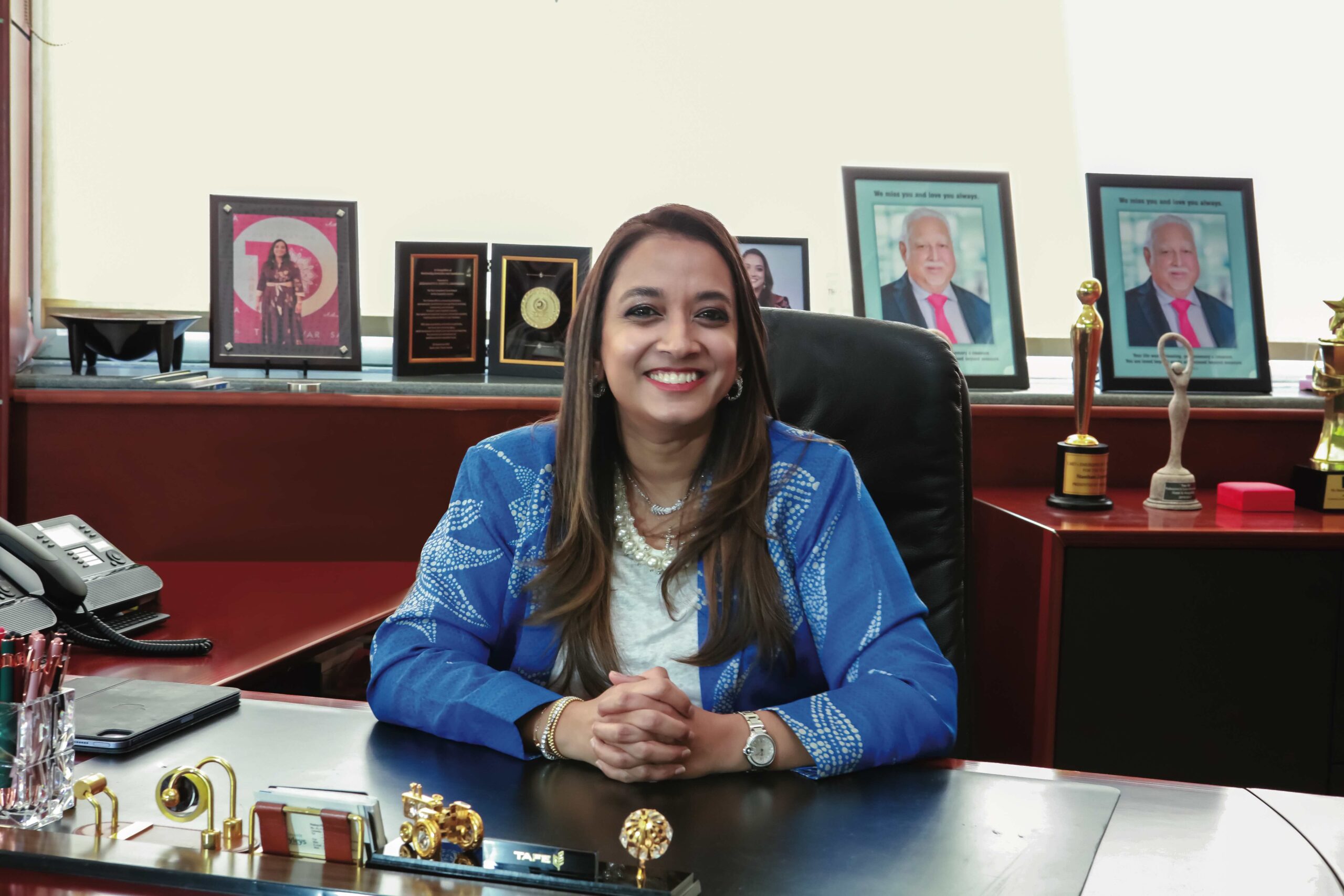
At a time when Sri Lanka’s corporate landscape is navigating recovery amid global uncertainty, Aitken Spence has delivered a standout performance—recording a robust EBITDA and a sharp rise in profitability in FY 2024/25, while sustaining momentum into the current financial year. At the helm of this performance is Chairperson Stasshani Jayawardena, who is steering the Group through a pivotal phase marked by disciplined portfolio management, strategic clarity, and a renewed focus on sustainable, long-term value creation.
Speaking with Business Today, she reflects on the strategic decisions underpinning the Group’s resilience, the evolving role of tourism and logistics as dual growth engines, and the importance of agility in responding to global trade and market shifts. She also outlines Aitken Spence’s approach to capital allocation, international partnerships, and sustainability—positioned not as a parallel agenda, but as a core driver of competitiveness and financial returns. Against the backdrop of a leadership transition and a rapidly changing business environment, she shares her perspective on governance, inclusivity, and preparing the Group for its next phase of growth.
Photography: Sujith Heenatigala and Dinesh Fernando.
Aitken Spence recorded a strong EBITDA of 25.4 billion rupees and a 61 percent increase in profit before tax in FY 2024/25. What were the strategic decisions you believe most drove this resilience across the Group?
The resilience we delivered in FY 2024/25 was not accidental; it was the outcome of improved portfolio management and an unwavering focus on operational fundamentals. We prioritized capital allocation toward segments with clearer earnings visibility, while strengthening balance sheet efficiency. We also benefited from a lower interest-rate environment that eased finance costs and bolstered economic recovery in the country.
At the same time, we sharpened our execution in the Group’s key sectors: tourism and maritime and freight logistics while balancing volatility in more challenged verticals. Importantly, we continued investing in capability: talent, systems, and governance processes that help us respond faster to market shifts.
These are some of the factors that contributed to and supported a strong EBITDA and improved profitability.
In the FY 2024/25 tourism contributed over half of total Group earnings reflecting significant improvements in hotel occupancy and destination management performance. How do you assess sustainability in this growth trajectory?
Our Group’s Tourism sector’s contribution reflects both recovery dynamics and a deliberate strengthening of our offering. Higher occupancies across our hotels and improved destination management performance point to a healthier demand environment, but sustainability depends on quality of earnings and not just the growth in volume. Our approach is to protect brand equity through consistent service delivery, further diversify our source markets and make Sri Lanka a sought after, year-round, non-seasonal destination. We also view sustainability in the broader sense; one that focuses on resource efficiency, climate readiness and community impact, because they directly influence long-term competitiveness. Our environmental intensity improvements and formalization of near-term targets aligned to our net-zero ambition underscore that tourism growth must be profitable and responsible. I am immensely proud to say that Aitken Spence Group became the first and only diversified holding company in Sri Lanka to have its climate targets validated by the Science Based Targets Initiative (SBTi).
I am immensely proud to say that Aitken Spence Group became the first and only diversified holding company in Sri Lanka to have its climate targets validated by the Science Based Targets Initiative (SBTi).
As the Maritime and Freight Logistics sector delivered robust results in 2024/25, how is Aitken Spence positioning itself to capitalize on global trade volatility and shipping market shifts moving forward?
Global trade volatility and shipping market shifts are structural realities, and our intent is to compete through agility and integration. In FY 2024/25, the sector’s robust performance was supported by a strong presence in cargo agency representation, overseas operations, and continued momentum in integrated container services, while our liner agency and port management activities remained resilient amid change.
Given the current context of challenges in macro-economic fundamentals and geopolitics, we are sharpening scenario planning, deepening customer partnerships, and investing in capabilities that improve speed, visibility, and compliance. This is one of the main reasons that we have maintained a diversified portfolio to reduce concentration risk and capture opportunities when trade lanes reconfigure.
Our advantage comes from being a trusted business partner with the scale and discipline to navigate cycles responsibly.

In the last reporting period of 2024/25, there were some underperformances in areas like strategic investments. What corrective strategies have been put in place to improve outcomes in these areas?
The Strategic investments sector comprises of printing, apparel manufacture, power and plantation segments and will, by nature, experience uneven periods, particularly where global demand and cost structures are volatile. What is important is how quickly we identify the root causes and recalibrate. In FY 2024/25, while the sector reported a loss, it was significantly lower than the previous year, indicating that corrective actions were already taking hold. If a segment remains structurally unviable and continues to place a strain on the Group, we will need to take hard but necessary decisions. That said, our priority is always to manage change responsibly, minimizing adverse impacts on our people.
Our focus now is threefold: to strengthen operating discipline in underperforming assets, to improve portfolio selectivity around capital deployment, and to accelerate value-creation initiatives that can unlock efficiencies or market access. Where structural headwinds persist, we are prepared to take decisive steps, be it repositioning, partnering, or exiting a sector, so that capital is protected and redeployed to higher-return opportunities.
In moments of geopolitical uncertainty, such as are currently being experienced, our deliberate diversification of source markets enables us to manage the impact, ensuring that we have the agility and resilience to navigate global headwinds.
In the current financial year, for the nine months ending December 2025, Aitken Spence delivered a 30 percent growth in PBT and a 42 percent increase in PAT, with tourism and logistics driving performance. What are the key operational levers that helped deliver this performance amid macroeconomic pressures?
The Group’s performance was driven by overall growth in economic activity and increased tourist arrivals, coupled with sharp execution at an operating level. In tourism, higher occupancies, better pricing and tighter cost control lifted profitability, particularly at the Maldivian resorts, alongside improved results from hotels in India and Oman.
In logistics, network optimization, cost management and a focus on higher-margin business helped cushion softer volumes and margin pressure. Importantly, portfolio diversity played to the Group’s advantage, with strong contributions from plantations, printing, renewable energy, and services such as the Port City BPO. Together, these levers helped offset macro-headwinds and translate revenue growth into stronger profits.
The tourism sector continued as the core revenue generator, but the maritime and freight logistics sector led PBT contributions in the third quarter of FY 2025/26. How do you balance investment focus between these sectors to maximize Group returns?
We balance investment by harnessing the distinct roles that each sector performs in the portfolio. Tourism remains a key growth sector for the Group and attracts the highest investments, but remains largely seasonal, while the Group’s maritime, and freight logistics sector is managed as a strong cash and earnings anchor, with a focus on operational efficiency, margin protection and disciplined capital allocation.
However, investments are made based on future potential and our strategic focus. Moreover, capital is directed towards sectors that perform well and those that have been identified for selective expansions. This approach allows us to capture the upside from tourism cycles while logistics delivers stability and consistent PBT contributions, ensuring capital is deployed where risk-adjusted returns are strongest at any point in the cycle.
With mention of potential investments and partnerships, particularly in markets like Bangladesh and within logistics, what criteria will be most decisive in approving these opportunities?
Our investment and partnership decisions are grounded in a consistent set of criteria. First is strategic alignment – we closely look at the opportunity to see if it strengthens an existing core capability.
Second is risk-adjusted returns, with clear pathways to value creation and strong governance oversight.
Third is partner quality: we look for shared values, operational credibility, and long-term intent. Fourth is resilience; how an investment performs across cycles, including regulatory and foreign currency considerations, whether in Bangladesh or elsewhere. Last, we examine sustainability and social impact, because these increasingly determine our license to operate and long-term competitiveness.
I want to point out that we do not invest to simply follow headlines. We invest where we feel we can make a strong contribution in a business sense, where it benefits people and communities. In other words, we operate where we can create measurable value for stakeholders.
As Sri Lankan tourism recovers, how is Aitken Spence mitigating reliance on traditional source markets and enhancing competitiveness in new or emerging markets?
Diversification of source markets has been a strategic priority for Aitken Spence, grounded in rigorous market research and competitive analysis. While traditional markets remain important, we are broadening demand through more segmented approaches, including niche travel, multi destination itineraries and stronger digital demand generation, via our destination management networks.
Our market leadership in DMC operations provides real time insight into traveler behavior, enabling quicker recalibration when conditions shift. In moments of geopolitical uncertainty, such as are currently being experienced, our deliberate diversification of source markets enables us to manage the impact, ensuring that we have the agility and resilience to navigate global headwinds.
Sustainability is also integral to our core strategy, rooted in responsible destination development, community engagement and low impact tourism practices that enhance a location’s long term appeal. We are also leveraging our regional hotel footprint across four countries to create cross selling opportunities and reduce single market exposure. Competitiveness today is built on consistency, experience quality, and responsible operations, which is how we translate recovery into sustainable, diversified growth.
As Aitken Spence represents some of the world’s largest and most prestigious tour operators, how does the Group leverage these global partnerships to strengthen Sri Lanka’s positioning as a competitive destination and what measures are in place to ensure service standards are aligned with the expectations of these international partners?
Our relationships with leading global tour operators such as TUI are built on trust, consistency, and delivery, especially during periods when destinations face perception challenges. We use these partnerships to co-create itineraries, align on demand forecasts, and enhance Sri Lanka’s positioning through differentiated experiences.
Maintaining standards is non-negotiable; we deploy structured quality assurance, partner feedback loops, and training systems across our destination management and hospitality operations.
Importantly, service quality is not only front-end; reliability in logistics, crisis readiness, and responsiveness matter deeply to international partners. As Sri Lanka competes with regional destinations, excellence in execution becomes our strongest form of marketing. Our intent is to be the partner that global operators can rely on consistently and at scale. Aitken Spence has many success stories of globally renowned partnerships, still going strong after 50 years.
With tourism rebounding strongly in Sri Lanka, how does Aitken Spence view the strategic direction of its hotels’ portfolio, and what are your future plans to capitalize on renewed global travel demand while ensuring long-term value creation for the Group?
We see renewed global travel demand as an opportunity to grow value, not just room nights. Our hotels strategy focuses on targeted enhancements across product refreshments, service excellence, and digital enablement. With the renewed demand for Sri Lanka as a travel destination, we have been actively exploring emerging global trends affecting source markets, pursuing new opportunities, and capitalizing on market gaps. In particular, this entails re-aligning our operations to meet future demands, considering a more experiential proposition, or delivering targeted, culinary-based offerings. Furthermore, we continue to champion sustainable experiences, integrating them into our core systems, talent and operating standards.
Over the long term, the hotels portfolio must embed regenerative practices that enhance destination resilience while reinforcing the Group’s diversified value creation model.
Aitken Spence has widely reported on the Group’s sustainability commitments in its annual disclosures. How are sustainability initiatives positioned to contribute to long-term value and measurable financial returns?
Sustainability is embedded as a core value-creation lever rather than as a parallel agenda. This is underscored by Aitken Spence becoming the first and only diversified holding company in Sri Lanka to have its climate targets validated by the Science Based Targets Initiative, providing a rigorous, externally benchmarked framework for action.
Operationally, improvements in energy management, reduced emissions and water intensity directly lower costs and strengthen our resilience, particularly in energy-intensive businesses such as hotels and logistics.
Strategically, SBTi-aligned, Board- approved targets enhance the Group’s credibility with partners, talent and capital providers who increasingly factor climate performance into their decision-making. Sustainability also functions as a risk-management tool, safeguarding continuity, reputation, and supply chains. Over time, these outcomes translate into more durable earnings and a stronger license to operate.
As Chairperson/ Chairman of a legacy institution, you have a pivotal role of shaping corporate governance and strategic direction at the highest level. How do you view the role of women in corporate leadership in Sri Lanka and what structural shifts do you believe are required to create a more inclusive and equitable leadership landscape?
Since women comprise half of Sri Lanka’s workforce, women’s leadership is essential to building better-governed, better-performing organizations.
Today, gender equality is not only a moral, but a business imperative, because it affects performance, risk, and growth. Organizations that fail to embrace inclusivity struggle to compete; they struggle to retain talent; and they struggle to make the kind of well-rounded decisions that come from diverse perspectives.
When we create workplaces where both men and women are empowered to contribute fully, we are not only doing the right thing; we are securing our ability to succeed. But structural shifts must move beyond intent into everyday action and behavior: ensuring that women are truly heard, creating space for them at decision-making tables, and building safe environments where people can take ownership, innovate and thrive.
This responsibility cannot sit with HR or management alone; it requires men and women, at every level, acting as partners in our shared progress. Inclusion is innately practical and can translate into mentorship, amplifying quieter voices, offering constructive feedback, or providing cross-generational learning, because “when we give equity, we gain excellence.”
Aitken Spence marks a new era of leadership with the passing of Harry Jayawardena. Since assuming the Chairpersonship after him, how has the leadership transition affected execution of strategy and organizational performance?
What measures have ensured continuity of delivery across the Group? Harry Jayawardena’s legacy is deeply woven into Aitken Spence. His strategic clarity and bold leadership shaped the Group’s trajectory, and we honor that with continuity of purpose and disciplined execution.
One of our priorities has been succession planning, strengthening institutional capabilities, and enhancing the knowledge base.
We have maintained momentum through strong governance processes, an experienced management structure, and clear strategic priorities that are well understood across our businesses.
We have reinforced performance rhythms, ensured oversight at the Board and supervisory levels, and continued to invest in talent and operational systems that deliver consistently across sectors and geographies.
We believe, continuity comes from rigorous governance, expanded capability and of course culture. To remain relevant, particularly during challenging periods of geopolitical upheaval, we must be able to maneuver through crisis situations, which alter the order of business, causing significant global economic disruption, soaring energy prices, and severe supply chain strains, which are being felt across every region.
At the same time, it is critical that we don’t forget the younger generations that continue to adapt to new life experiences, brought about by the current situation, as they continue to learn, evolve, and challenge us as we head on this journey together.
We have built a strong foundation of more than 157-years, and we are preparing the Group, head-on, for the next phase of growth. I have been fortunate to learn from the best, and a continued curiosity to learn will remain central to my journey.