

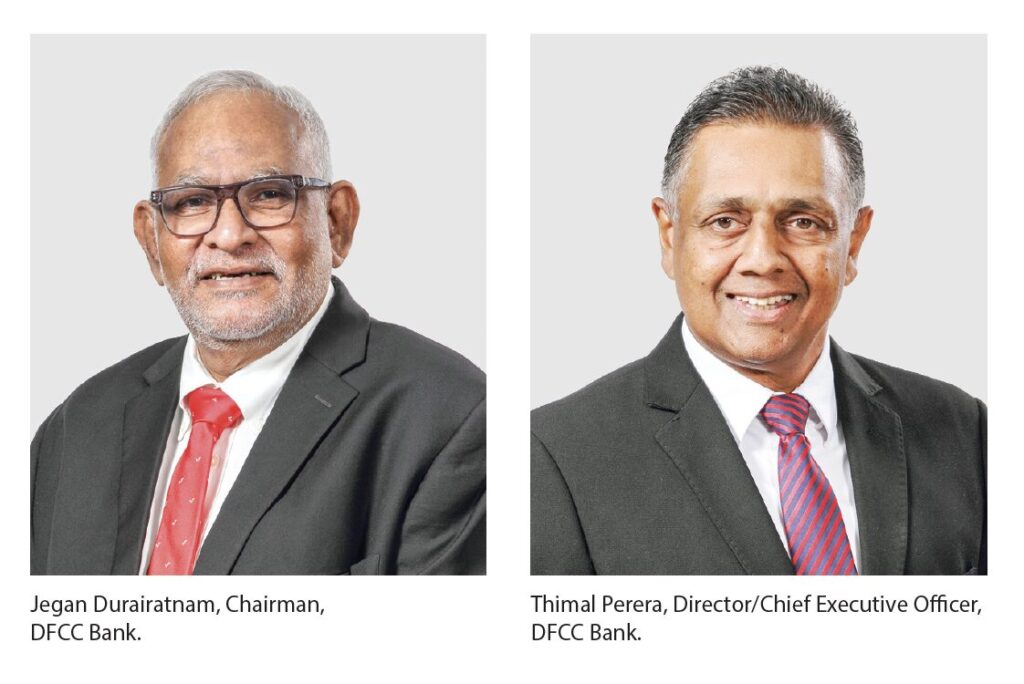
DFCC Bank delivered a strong performance for the period ended September 30, 2025, underscoring its financial resilience and the success of its strategic initiatives. The Bank recorded consistent growth across key indicators, supported by disciplined asset–liability management, credit expansion, and funding optimization. Loan and deposit volumes grew significantly, while Net Interest Income (NII) increased by 11 percent, reflecting the Bank’s focus on long-term value creation for shareholders and customers.
The Bank sustained its balance sheet expansion, with loans increasing by 26 percent and deposits by 22 percent, driven by a strategy aligned with the easing interest rate environment and the country’s economic recovery. Private sector credit also experienced strong growth as lower interest rates supported renewed business activity. A modest rise in interest income marked a turnaround from earlier pressure caused by rate compression, supported by a strengthened CASA base.
A major highlight of Q3 2025 was the launch of Sri Lanka’s first Blue Bond, a three billion rupee initiative aimed at financing ocean-positive SMEs and climate adaptation—strengthening DFCC’s leadership in sustainable finance. The Bank also celebrated its 70th anniversary with special Fixed Deposit products designed to reward customer loyalty and deepen long-term relationships.
DFCC Bank, the largest entity within the Group, reported a Profit Before Tax (PBT) of 12,151 million rupees and a Profit After Tax (PAT) of 8,328 million rupees from continuing operations, up from 9,559 million rupees and 6,013 million rupees, respectively, in the previous year. Earnings Per Share from core operations stood at 19.07 rupees, rising to 30.44 rupees with the gain from the disposal of its stake in Acuity Partners. At the Group level, PBT was 12,480 million rupees, and PAT was 8,530 million rupees.
Return on Equity was a strong 15.85 percent, while Return on Assets before tax was 2.71 percent. Interest income rose by four percent during the period, supported by loan book expansion. NII increased to 22,969 million rupees, backed by a 25 percent growth in the CASA portfolio, which improved the CASA ratio to 25.34 percent. The Net Interest Margin declined from 4.18 percent to 3.95 percent due to competitive market conditions.
Non-interest income gained momentum, with higher remittances, trade commissions, credit-related fees, and credit card activity contributing to a 48 percent rise in net fee and commission income to 5,281 million rupees. Asset quality improved, with the Stage 3 impaired loan ratio declining to 4.82 percent. Impairment charges rose by 10 percent to 3,938 million rupees, reflecting prudent provisioning and risk-calibrated growth.
The Bank continued to invest in digital transformation, IT infrastructure, marketing, and customer engagement initiatives. Operating expenses increased to 13,348 million rupees, but this investment supported long-term competitiveness and efficiency gains.
Total assets grew by 148 billion rupees (21 percent) since December 2024, while the loan book reached 495 billion rupees. Deposits increased to 568 billion rupees, resulting in a loan-to-deposit ratio of 96.09 percent. With concessionary credit lines included, the adjusted CASA ratio improved to 30.72 percent.
Equity increased by 20 billion rupees, supported by profits and fair value gains. The Tier 1 Capital Ratio stood at 11.806 percent and the Total Capital Ratio at 14.276 percent, with liquidity ratios comfortably above regulatory minimums.
Thimal Perera, CEO, noted that DFCC’s performance reflects resilience, purposeful strategy, and the Bank’s commitment to inclusive finance, sustainable growth, and delivering meaningful value to Sri Lankans as it marks its 70th year.