
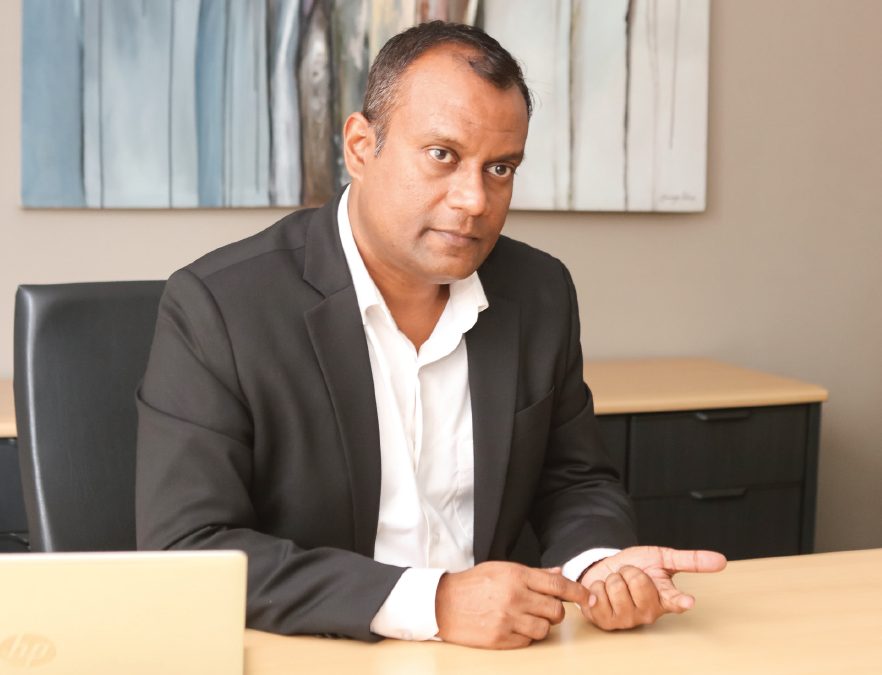
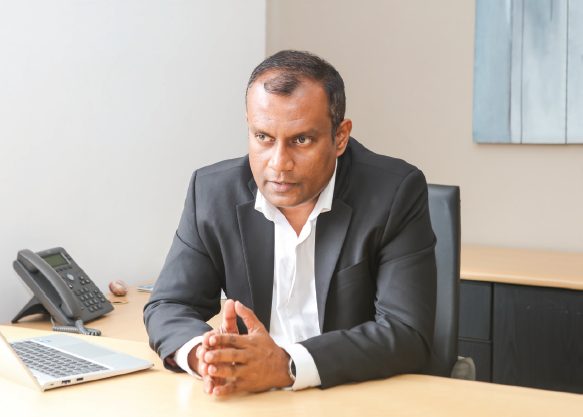
Ranga Kariyawasam, Group Chief Technology Officer, Dialog Axiata.
Sri Lanka is finally at the cusp of deploying 5G technology, taking positive steps more than five years after it was introduced globally and adopted. According to Ranga Kariyawasam, Group Chief Technology Officer of Dialog Axiata, the deployment of 5G is a technological upgrade and a strategic enabler that can foster economic growth by attracting foreign investment, encouraging entrepreneurship, and positioning Sri Lanka as a competitive force in the global digital economy. Speaking with Business Today, he elaborated on the tremendous potential that Sri Lanka could reap by embracing the transformative power of 5G, pointing out that Sri Lanka can unlock new development opportunities, create an efficient public service and a more connected and efficient business environment, and solidify its position as a dynamic player in the global marketplace.
Words Jennifer Paldano Goonewardane.
Photography Sujith Heenatigala.
What makes Sri Lanka a suitable market for the rollout of 5G?
Historically, our industry has followed ten-year technology cycles, as evidenced by the introduction of 2G in the 1990s, the transition to 3G at the turn of the millennium, and the advancement to 4G around 2010—cycles that Dialog was quick to embrace. The early global deployments of 5G began in 2018, and we are now preparing to deploy it in Sri Lanka. Dialog has a strong track record of technology adoption, from implementing the Global System for Mobile Communications (GSM) with 2G and later 3G, setting a precedent as the first to adopt these technologies in South Asia. That was followed by the deployment of 4G in 2011, coinciding with India’s rollout of the same technology.
However, Sri Lanka is over five years behind the global technology cycle with regard to 5G. While the world has rapidly advanced with 5G, it is no longer considered a new technology. Unfortunately, Sri Lanka is lagging, not only in comparison to global standards but also within the regional context, due to delays in deploying 5G technology.
When considering why Sri Lanka is a suitable market for the rollout of 5G, the most pertinent reason is that we are already behind in adopting the technology, having almost reached the point of saturation with the capacity of 4G mobile communication. Sri Lankans deserve the enhanced experience that 5G offers. The maximization of 4G’s capacity, including its frequency spectrum, has led to network congestion, and as its capacity continues to approach its limits, further limitations are inevitable.
The broader economic context also hindered early adoption, as Sri Lanka faced a series of crises, with the economic downturn being particularly impactful in slowing investment and the growth of the handset ecosystem. Despite these challenges, Dialog has continued to invest. We also see a 23 percent 5G device penetration in denser areas of the country such as Colombo, Jaffna, and Gampaha. Dialog has deployed a 5.5G ultra-advanced non-commercial trial network with limited coverage and observed a positive adoption by our customers. The success of this initial rollout further demonstrates that Sri Lanka is ready for full-scale 5G deployment. We plan to rapidly expand this network upon obtaining commercial 5G licenses from the Telecommunication Regulatory Commission of Sri Lanka soon.
5G technology presents a significant opportunity for Sri Lanka to enhance its home broadband penetration. Broadband infrastructure is primarily deployed through costly fiber optic networks and, as such, has limited coverage, especially concentrating on Colombo and key urban centers, while suburbs and rural areas remain underserved. This disparity has proven detrimental, particularly during the COVID-19 lockdowns, where the lack of adequate broadband access negatively impacted students’ education and businesses’ ability to operate. According to a recent study, Sri Lanka’s home broadband penetration currently ranks 131st out of 153 countries. By leveraging the high speeds and low latency offered by 5G, this ranking can be significantly improved, fostering greater access to education, business, and overall development.
Under the Government’s leadership, Sri Lanka’s digital economy is ready for a significant transformation. In collaboration with the private sector, the Government aims to increase the annual digital economy revenue to five billion dollars by 2030. This ambitious goal seeks to foster innovation, entrepreneurship, and investment across various industries and the public sector, thereby improving access to services for the population. In this context, 5G technology will be pivotal in enhancing broadband connectivity, benefiting multiple sectors, particularly businesses, by supporting automation through ultra-high speeds, ultra-low latency, and IoT connectivity.
Twenty-twenty-five represents a critical window for the deployment of 5G technology. The longer we delay, the more likely emerging technologies will take precedence within the next four to five years. This delay could significantly shorten the return on investment cycle for 5G infrastructure, potentially rendering the investment unviable in the long term.
What steps has Dialog taken to develop the infrastructure necessary for 5G deployment across the island?
Dialog is Sri Lanka’s largest mobile network operator, with the most extensive customer base carrying the lion’s share of Sri Lanka’s data traffic volume, which underscores our significant responsibility to those we serve. We are also recognized as a leader in technology, consistently adopting new advancements shortly after they are unveiled globally, from the implementation of GSM for 2G to the subsequent rollouts of 3G and 4G.
However, 5G differs from its predecessors in that it operates on higher frequency bands, which offer faster speeds but have a shorter range than 4G. As a result, 5G requires a denser network of towers to ensure continuous coverage and high-speed connectivity.
Dialog already possesses the most extensive tower infrastructure in the country. That puts us in a strong position to support 5G with much more larger coverage than the competition.
Given its ultra-high capacity, 5G relies on a robust fiber optic infrastructure to deliver lower latency and higher speeds. We can only fully realize these advantages by fiberizing our 5G sites, and Dialog has successfully converted 70 percent of its sites to fiber backhaul over time. The initial phases of 5G deployment will have 100 percent fiberized site infrastructure, allowing us to support capacity enhancements seamlessly.
The ability of 5G to handle higher traffic demands a higher band spectrum, necessitating the installation of energy-intensive new hardware on our towers. This, in turn, requires higher electricity consumption and a high-capacity grid connection. In preparation, Dialog has focused on modernizing and upgrading its energy infrastructure at all sites designated for 5G deployment over the past two years.
5G’s faster speeds and increased capacity enable new applications to revolutionize various sectors. Applications of 5G will benefit in automating industries, healthcare, transportation, logistics, and public services. The wide array of potential applications will drive digitization across industries and catalyze the digital economy the government envisions.
These advancements rely on the availability of vast amounts of data and processing power to build these applications, supporting the transition to a fully realized digital economy. This requires high-capacity, secured, and resilient data centres. Dialog has consolidated its Data Centre architecture into three Geo-Redundant Tier 3 DCs to support this explosion of use cases. This year, we plan to equip them with graphics processing units (GPU servers) to enhance their capacity to support applications relying on AI.
To facilitate the growth of the new Digital Economy, we must provide network capabilities to developers, enabling them to create applications that interact with telecommunication networks. Our GSMA-compliant API Gateway, equipped with security and privacy features, grants developers access to network capabilities for application development. The success of 5G will depend significantly on developing applications that leverage data from and interact with the network layer, including subscriber data, location data, network performance data, and more. We have already implemented this critical layer.
Thus, we are ready to deploy 5G in Sri Lanka from both a physical infrastructure and application development standpoint, positioning ourselves to roll out the technology immediately upon receiving the necessary license from the TRC. We already have an approved trial network equipped with a substantial number of base stations, which we can convert to provide 5G commercial services from day one once the TRC grants us the license.
Upon receiving the 5G deployment license, which we anticipate by mid-2025, we will prioritize coverage in every district, ensuring nationwide access to 5G within the next two and a half years.
Has Sri Lanka been very cautious in deploying 5G?
Sri Lanka has been relatively cautious in deploying 5G technology. Countries such as the United States, South Korea, and China were early adopters of 5G, although some operators and nations initially questioned the technology’s business case. Over time, however, everyone realized the value of 5G, especially as the 4G experiences began to deteriorate due to network congestion.
As 5G adoption began globally, we still relied heavily on 4G capacity in Sri Lanka. From the perspective of regulators and the government, there was a ‘wait and see’ approach across much of Asia, and Sri Lanka followed suit. Unfortunately, the onset of the economic crisis exacerbated the situation, limiting operators’ ability to invest in 5G infrastructure. The regulator was also cautious, contributing to the prolonged delay in deploying 5G within the country.
That said, I do not believe this caution was intentional. The economic crisis significantly impacted operators’ financial capacity, making it challenging to meet the substantial investment requirements for 5G. However, further delays are no longer viable, as they could be detrimental to the country’s digital infrastructure, the public, and overall technological progress. As I mentioned, the time to move forward with 5G deployment is now; we should not delay any longer.
What role do you see 5G playing in Sri Lanka’s economic growth? Are there specific sectors that stand to benefit most?
Sri Lanka’s National Digital Economy Strategy 2030 aims to increase its Digital Economy sector to five billion dollars by 2030. This goal is core to the nation’s economic growth, as achieving the government’s digital aspirations will be pivotal in driving progress. The deployment of 5G technology is crucial to this strategy, as it forms the basis of Digital Infrastructure, which is essential for digitalizing services and enterprises and transforming the entire ecosystem.
The public sector is a key component of this strategy, with industries such as healthcare, education, tax and revenue collection, transportation, and essential government services being integral to the overall roadmap laid out by the Ministry of Digital Economy. 5G will enhance efficiency and effectiveness by facilitating easier access to government services.
Additionally, 5G will support the government in generating revenue and maintaining law and order by enabling law enforcement agencies to leverage advanced technologies. A good example of this is Dialog’s provision of a virtual private network (VPN) for Sri Lanka Police, connecting over 1,200 police stations in 2024, alongside state-of-the-art switching infrastructure and security solutions using 4G and other technologies. This demonstrates how 5G, if available, can enhance the digitalization drive in the public sector even more in the future as we evolve into more advanced services, ultimately contributing to economic growth through improved operational efficiency and speed.
On the industrial front, the Fourth Industrial Revolution (IR 4.0) is ready to have a transformative impact on sectors such as manufacturing, healthcare, logistics, tourism, transportation, financial services, and retail. 5G’s role in driving automation and digital application development will be critical. Automation solutions, for instance, require high-speed, low-latency connectivity to operate effectively. While certain government services may not need the full capabilities of 5G, sectors such as transportation, and logistics will benefit from its unique features, such as low latency and high capacity, which are unavailable with 4G.
In the private sector, 5G will enable advancing technologies like Artificial Intelligence (AI), the Internet of Things (IoT), Big Data, robotics, and automation—technologies that aim to enhance productivity, efficiency, and flexibility. Developers will build applications that rely on real-time data and high-speed connectivity to perform tasks such as remote surgery, where precision and low latency are crucial. The applications of 5G technology across industries—from manufacturing to retail, using Augmented Reality (AR) and Virtual Reality (VR) to create immersive customer experiences—are vast and promising.
For these innovations to succeed, the country must have a secure, high-speed, and low-latency network that is highly resilient. Dialog has long been committed to ensuring the readiness of this infrastructure, having invested in both physical hardware and software upgrades and modernizations. We are ready to collaborate with the government to promote digital technology adoption across businesses and sectors.
How will the advent of 5G foster innovation and entrepreneurship in Sri Lanka? Can we expect new start-ups and opportunities to emerge in the tech sector?
As mentioned, the advent of 5G will undoubtedly foster innovation and entrepreneurship in Sri Lanka, particularly by enabling the development of a wide range of applications and services across both public and private sectors. 5G will create opportunities for businesses to innovate, adapt, and stay competitive in a rapidly changing technological landscape.
Innovation and entrepreneurship will primarily take place at the application and services layer. Industries such as manufacturing and retail will see the creation of new applications that open new revenue streams and enhance operational efficiency. As a result, we expect significant innovation in various sectors, with entrepreneurs capitalizing on the emerging opportunities to develop new solutions and services. A key enabler of this innovation is the exposure of valuable data from the network and the ability to interact with the network, facilitated by the Application Programming Interface (API) layer associated with 5G. The API layer will provide access to critical network data that developers can use to create applications tailored to specific industries and business needs.
Dialog’s 5G network will operate in both non-standalone and standalone modes, aligning with global practices and ensuring that entrepreneurs and innovators have access that caters to their needs. The non-standalone mode integrates 5G with existing 4G infrastructure, enabling 5G to add capacity to the current network. Essentially, 5G in this mode will rely on 4G for connectivity but offer the enhanced capacity and speed associated with 5G.
In the standalone mode, 5G operates independently as a fully standalone network, providing the full capabilities of 5G without relying on 4G infrastructure. This mode is crucial for enabling real-time applications, particularly in automation and healthcare, logistics, and other industries requiring low latency and high-speed connectivity.
As an enabler infrastructure, 5G, with its capabilities, will always drive innovation in high-tech spaces such as Cloud Computing and cellular network infrastructure. This is a game that involves cutting-edge R&D and is highly capital intensive; therefore, it is left to tech giants of the world like NVIDIA, Qualcomm, Intel, IBM, Ericsson, Huawei, and Nokia. Innovation in Sri Lanka in this space happens when we bring these new technologies to the country, adopt them into our ecosystems, and develop use cases that will create economic value. This is a role Dialog intends to play together with the high-tech global partners mentioned above.
5G networks and their associated development ecosystems generally remain fragmented in the industry. This fragmentation exists between the key stakeholders—application developers, network providers, equipment and software vendors, and cloud service providers. To effectively harness the potential of 5G, AI, and cloud technologies, it is essential to have high-caliber system integrations, an area still under-developed in Sri Lanka. System integrators are specialized technical experts who bridge the gaps between disparate technologies, ensuring that all components—such as the 5G network, cloud infrastructure, and AI applications—work together as a cohesive whole. They are responsible for designing and implementing solutions that combine these elements into a unified, functional system.
Sri Lanka is blessed with skilled engineers, some of whom have worked internationally and gained experience in regional markets. These professionals possess the technical expertise necessary to drive integration efforts, helping the country emerge as a hub for advanced system integration in the region. Their ability to innovate and create tailored solutions will be crucial for maximizing the benefits of 5G technology and ensuring its successful deployment across various sectors. So, System Integration is another major space for entrepreneurial success, and we will see it with the advent of 5G in Sri Lanka.
Dialog is committed to providing the necessary infrastructure layer to support these innovations. By incorporating AI, cloud technologies, and 5G connectivity, we can create a robust ecosystem for developing next-generation applications to empower entrepreneurs and drive economic growth in Sri Lanka. This approach will foster innovation and enable local businesses to adopt global best practices, ultimately positioning Sri Lanka as a hub for digital entrepreneurship.
Can 5G attract foreign investment to Sri Lanka? How can the country position itself as a competitive player in the global digital economy?
The deployment of 5G in Sri Lanka represents a significant investment in infrastructure that enhances local capabilities and presents Sri Lanka as an attractive destination for international businesses looking to leverage advanced connectivity for innovation and growth. Telecommunications companies, many of which are partially owned by foreign investors, have already pledged considerable investments in developing 5G technology. This infrastructure lays the groundwork for creating new applications across various industries, showcasing Sri Lanka as an ideal location for businesses seeking to harness cutting-edge technology.
With 5G and cloud infrastructure, foreign companies can establish operations in Sri Lanka, using the country’s advanced digital infrastructure and a highly skilled local workforce to service the entire SA and APAC region. That can create a mutually beneficial scenario where local developers contribute to the global digital ecosystem. At the same time, foreign companies enjoy the competitive advantages of operating in a market with fast, reliable, and high-capacity connectivity. As Sri Lankan businesses adopt these advanced technologies, they will become more competitive and profitable, attracting foreign investment and strategic partnerships. The availability of 5G can catalyze industry-wide transformation, enhancing productivity and opening new avenues for collaboration and investment.
A strong 5G network positions Sri Lanka as a strategic player in the regional digital economy, offering enhanced business communication capabilities and facilitating smoother global interactions. Moreover, such infrastructure will also serve as a foundation for growing other sectors, such as tourism, transportation, and logistics. With enhanced connectivity, Sri Lanka can host international conferences, events, and global collaborations, making the country an appealing destination for business and leisure. That, in turn, would boost the tourism sector and contribute to Sri Lanka’s reputation as a hub for innovation and commerce.
We’ve been talking about Sri Lanka having a geographical advantage in becoming a transportation and logistical hub, but we never realized this potential. It will be an increasingly distant dream without the correct type of digital infrastructure, especially considering how Singapore and Malaysia to the East and Gulf states to the West have evolved in this journey. 5G will undoubtedly be able to bridge this gap going forward to a good extent with smart ports, smart airports, and smart cities. It is important to ensure we are not left behind and render our geographical advantage insignificant. This is an area that, if we play right, will attract lots of foreign investments.
Another area of foreign investments will be the System Integrator space. As I mentioned previously, system integrators will be at the heart of the innovation ecosystem in Sri Lanka, acting as the critical link between different technologies and enabling the successful integration of 5G with AI, cloud, and application development. Their role will be vital in ensuring that Sri Lanka maximizes the potential of its 5G infrastructure and positions itself as a competitive player in the global digital landscape. Global system integrators, valued in the billions of dollars, may show interest in Sri Lanka’s system integrator ecosystem, given its strategic positioning within a small geographic area. These international firms could acquire or invest in local system integrators. Such developments may soon become a significant prospect for growth and collaboration.
How does Dialog plan to ensure widespread availability in urban and rural areas?
The deployment of 5G requires substantial investments and operational costs. Therefore, to create a sustainable growth environment for 5G, every operator needs to make space in the annual budgets for 5G Capex and Opex, be it in Sri Lanka or anywhere in the world. As a result, operators need to optimize their cost structures and reduce the BAU (Business-As-Usual) spend. Dialog has been strategically managing these costs to ensure we have room to invest in 5G in urban and rural areas when licensed. In 2023, we decommissioned our 3G network, transitioning to a dual 2G and 4G network.
Additionally, we have modernized our transmission networks to fully IP-based systems and implemented significant upgrades and modernizations to our power infrastructure, including the solarization of close to 25 percent of our base station sites. We have also been painstakingly optimizing our 2G and 4G networks to yield more capacity from the investments we had already made. These advancements over the past two years have enabled us to substantially lower our cost structure, providing us with a solid financial buffer to effectively manage the impending deployment of 5G. This means that Dialog will be in a sound financial position to deploy 5G nationwide and make it a widespread service available to our customers.
We have achieved 97 percent population coverage on 4G high-speed Mobile Broadband. Our goal is to replicate this level of coverage for 5G within the next two and a half years following the commercial license, ensuring that the same proportion of the population will have access to 5G services. Upon receiving the 5G deployment license, which we anticipate by mid-2025, we will prioritize coverage in every district, ensuring nationwide access to 5G within the next two and a half years.
We already have dense coverage in urban areas such as Colombo, Gampaha, Kandy, Jaffna, and their surrounding suburbs. There the 5G network will further enable mobile and home broadband services. The deployment will be phased, with initial coverage expanding rapidly, followed by broader nationwide reach.
How important is collaboration between the private sector, government, and other stakeholders in ensuring the successful deployment of 5G?
It is imperative. The TRCSL is ready to issue licenses for 5G deployment. The next step is for the government to expedite the auction process, enabling us to contribute to the nation’s digital infrastructure growth. From that point onwards there has to be a lot of collaboration in the industry and support from the government to make 5G successful in Sri Lanka.
As the telecommunication industry, we have proactively engaged with the government to address key concerns, such as the availability of spectrum, high electricity tariffs, high government rentals for optical fibre networks, inefficient and lengthy approval processes for establishing base station sites, and improving logistics and customs processes.
Whilst operators will do their utmost to expand 5G coverage countrywide, the government and the regulator can also give an impetus by making 700MHz frequency band available for 5G. This frequency band is currently tied up inefficiently in analog television broadcasting. As mentioned, deploying 5G technology requires significant energy consumption, escalating operational costs. In light of this, introducing a tariff structure specifically designed for Telecommunications providers would be more beneficial in lowering energy costs and enabling them to plough that money back into network expansions. Although industrial tariff categories are available to other sectors, we, as telecommunications services providers and enablers of the larger industry, do not benefit purely due to the archaic criteria used for the classification of the industry. As an industry, Telecommunication operators collectively have a strong view that we should be placed under the industrial category. After all, we are the fourth utility after electricity, water, and gas. And the only sector that has not increased tariffs post-economic crisis.
With 5G and Fibre being the backbone of the digital infrastructure, we also need government support to lower the cost of deploying optical fibre networks, especially in the area of rentals charged by the Road Development Authority and various local and other authorities. Current regimes of right-of-way leave charges, as we call them in the industry, are counterproductive for expanding broadband access to the masses and are only an impediment.
An area where collaboration is essential is in facilitating site development. Dialog has made significant progress in expanding its network, with 5,500 sites strategically positioned across the island. However, critical locations under government jurisdiction remain where approvals are required to establish additional towers. Facilitating land plots to build towers and the timely approval of these sites will benefit all the operators and contribute to the broader telecommunications ecosystem by improving broadband coverage for the public. Furthermore, operators can collaborate to develop a 5G network, sharing infrastructure to reduce the financial burden and maximize coverage. Such RAN sharing models would entail one operator developing a certain geography of the country and sharing that 5G infrastructure with another operator, in return for the second operator building another part of the country and sharing with the first operator. Such models have existed since the days of 3G and are technically feasible, subject to commercial agreements between the parties. The other collaboration area is in Digital Services, where application developers, government/public sector, 5G network providers, and Cloud providers must come together to develop an open architecture and drive growth in the digital economy.
You mentioned that 5G infrastructure requires significant energy consumption. How does Dialog plan to mitigate the environmental impact and prioritize sustainable practices in the transition to 5G deployment?
While it is true that 5G infrastructure requires significant energy consumption, the technology offers considerable potential to support a wide range of simultaneous activities. Compared to 4G, 5G is more energy-efficient per unit of data transmitted, kWhr per Giga Byte (GB), using less power to communicate the same volume of data. In essence, 5G delivers higher data speeds, reducing the time devices spend in active power-intensive states, ultimately leading to more efficient energy usage. Initially, the energy consumption associated with 5G deployment may be higher, mainly as both 4G and 5G networks operate concurrently. As the transition progresses, Dialog plans to gradually offload traffic from the 4G network onto the 5G network. This shift will reduce energy consumption and operational costs, creating a more sustainable network environment.
From an environmental perspective, 5G includes several energy-saving features, such as the ability to enter deep sleep mode during periods of low data traffic, high-energy-efficient hardware, and dynamic transmission modes that further optimize energy consumption. While the initial phase of 5G deployment may come with higher costs, both financial and environmental, we are confident that the steady-state benefits, including reduced energy consumption and improved cost efficiency, will far outweigh these initial challenges.
Embracing 5G as a nation is the only way forward to becoming a digitized economy! Hence, the sooner we embrace 5G, the sooner we will experience its benefits—both as individuals and as a nation.
What does the introduction of 5G mean for the average Sri Lankan consumer? Will they experience immediate benefits?
The transition from 2G to 3G marked a shift from voice-only services to the introduction of basic data usage, allowing consumers to access more than just voice communication.
However, the transition to 4G was transformative, as it positioned data at the core of the consumer experience, enabling the widespread adoption of smartphones, smoother streaming, faster download speeds, high-definition video content, and enhanced applications for content creation.
Introducing 5G will offer significantly higher data volumes at much faster speeds for the average Sri Lankan consumer. One key consumer benefit will be the availability of 5G home broadband, which, while not fiber-optic, will provide a comparable experience. That will allow users to enjoy uninterrupted television and content streaming at superior speeds.
As mentioned, Sri Lanka is at the bottom of the pyramid regarding home broadband capabilities and experience. This does not lend well to our digital economy aspirations. 5G will immediately elevate the home broadband experience of the Sri Lankan customer.
For mobile customers, as I mentioned, it will be much faster broadband speeds and much larger data buckets at a lower price per GB than with 4G. However, as we have alluded to throughout this discussion, the most significant value derived from 5G will be for the Enterprise Segment.
The deployment of 5G technology presents vast opportunities for developing industrial applications, driving greater operational efficiency, and unlocking significant value across various sectors.
The true potential of 5G lies in its ability to enable businesses to enhance their processes, innovate, and deliver improved services to their customers. This is a space where the entire industry needs to collaborate openly to develop and drive growth.
What is your message to consumers and businesses in Sri Lanka about embracing 5G, and how can they best prepare for the future of connectivity?
My message to consumers in Sri Lanka is simple: embrace 5G. As mentioned, 5G offers significantly improved speed and lower latency, providing an enhanced experience for high-resolution video streaming on mobile devices. It will enable seamless home broadband connectivity and support more significant use cases such as 4K/8K TV, Work from Home for various high throughput and time-sensitive environments, and Smart Homes. Therefore, I encourage consumers to adopt 5G for its numerous benefits.
5G represents a tremendous opportunity for businesses to improve operational efficiency, mainly through automation.
Dialog Enterprise, the business arm of Dialog Axiata Group, is well-positioned to assist companies in adopting 5G technology to streamline processes and enhance productivity.
Our team can work with businesses to identify unique solutions that drive business process simplification and increase efficiency. I encourage businesses to prepare for the upcoming 5G rollout, as early adoption will enable them to leverage these improvements to generate more value and returns.
For the general public, 5G offers the essential digital infrastructure for making various government and public services much more efficient and effective. Embracing 5G as a nation is the only way forward to becoming a digitized economy!
Realizing that the rollout of 5G is a gradual process is essential. Over the next two years, Dialog will work to expand coverage to match the reach of our 4G network. This rollout will require time, as new hardware needs to be installed, commissioned, optimized, and integrated. Nevertheless, within two years, we anticipate having coverage comparable to 4G. I encourage consumers to join us on this journey as we expand 5G coverage, ultimately improving the overall experience for all. Hence, the sooner we embrace 5G, the sooner we will experience its benefits—both as individuals and as a nation. I urge everyone to prepare for this transformative journey and look forward to its positive impact on our economy, businesses, and daily lives.